

.png)
7 Mistakes You're Making with Merchant Interchange Fees (And How Larecoin Fixes Them)
- [[[Free!!]<<<<]] Watch: 스포르팅 - 토트넘 Live Stream 13 September 2022
- Jan 20
- 4 min read
![Writer: [[[Free!!]<<<<]] Watch: 스포르팅 - 토트넘 Live Stream 13 September 2022](https://lh3.googleusercontent.com/a/AItbvmktwQc0wCdd3ZEETSYItRQubwwBzOyjD_dcigRf=s96-c)
Interchange fees. The silent profit killer.
Every swipe. Every tap. Every transaction. Money disappears before it even hits your account.
The average merchant loses 2-3% on every single sale. That's thousands, sometimes millions, vanishing into thin air annually.
Here's the kicker: most of those losses are completely avoidable.
You're probably making at least three of these seven mistakes right now. Legacy payment processors love that. They're counting on your confusion.
Time to stop bleeding cash.
Let's break down exactly where you're going wrong, and how Larecoin's Web3 payment ecosystem slashes those fees by up to 50%.
Mistake #1: You Don't Actually Know What You're Paying
Sound familiar?
You signed up with a processor. They quoted you a rate. You assumed that was the whole story.
Spoiler alert: it wasn't.
Interchange fees are layered. Complex. Deliberately opaque. Your processor passes through the base interchange rate, then stacks their markup on top. Hidden fees lurk everywhere, monthly minimums, PCI compliance charges, statement fees, batch processing costs.
Most merchants can't identify their true cost per transaction. That's by design.
How Larecoin Fixes This:
Transparency is baked into the blockchain. Every transaction on LarePAY is visible. Verifiable. No hidden markups. No surprise fees buried in 40-page terms of service.
The Larecoin ecosystem operates on gas-only transfers. You see exactly what you're paying. Every single time.
Compare that to NOWPayments or CoinPayments, they still layer processing fees that can creep up on high-volume merchants.
Mistake #2: You Never Audit Your Interchange Costs
When's the last time you actually reviewed your merchant statement?
Be honest.
Interchange rates change twice per year. Card networks adjust categories constantly. Your business profile shifts. Yet most merchants set it and forget it, for years.
That complacency costs real money.
How Larecoin Fixes This:
NFT receipts. Yes, really.
Every transaction through the Larecoin ecosystem generates an NFT receipt. Immutable. Timestamped. Instantly searchable. Your accountant will thank you.
No more digging through spreadsheets. No more reconciliation nightmares. Real-time visibility into every payment that flows through your business.
Tax season? Handled. Audit requests? Sorted in seconds.
Mistake #3: You're Letting Transactions Get Downgraded
This one hurts.
Transaction downgrades happen when your payment doesn't meet certain criteria. Missing customer data. Late settlement. High chargeback rates. Address verification failures.
Each downgrade bumps your transaction into a higher fee category. Same sale. Higher cost.
Legacy processors rarely flag this. They benefit from your ignorance.
How Larecoin Fixes This:
Smart contracts don't downgrade.
When you process payments through LarePAY, transactions settle instantly on-chain. No batching delays. No missing data fields. No arbitrary reclassifications.
The QR-generated POS system captures all necessary information at the point of sale. Clean data in. Clean settlement out.

Mistake #4: You're Misclassifying Transactions
Here's a dirty secret about traditional payment processing:
A chip transaction and a keyed-in transaction can cost vastly different amounts: even for identical purchases.
Card-present vs. card-not-present. Rewards cards vs. standard cards. Debit vs. credit. Corporate vs. consumer.
Each classification carries different interchange tiers. Processors often default to the highest-cost category. More profit for them.
How Larecoin Fixes This:
Crypto payments don't play the classification game.
LUSD (Larecoin's stablecoin) transactions are peer-to-peer. No card networks in the middle deciding what tier your sale falls into. No rewards card surcharges. No premium business card fees.
One transaction type. One cost structure. Predictable every time.
Competitors like Triple-A still rely on fiat conversion layers that introduce classification complexity. Larecoin keeps it native.
Mistake #5: You're Not Settling Same-Day
Batching kills margins.
Traditional POS systems accumulate transactions throughout the day. Settlement happens later: sometimes 24-48 hours later.
That delay triggers higher interchange rates. Card networks penalize slow settlement. Your processor pockets the difference.
How Larecoin Fixes This:
Instant finality.
Blockchain transactions settle in seconds. Not hours. Not days. The moment a customer pays, those funds move.
The Larecoin Smart Wallet gives you self-custody. Your money lands in your wallet immediately. No intermediary holding your cash hostage. No waiting for batch processing windows.
Plus: push to card functionality means you can move crypto to fiat whenever you want. On your schedule.
Mistake #6: You're Skipping Level II and Level III Data
Big savings hiding in plain sight.
B2B merchants can qualify for significantly lower interchange rates by submitting enhanced transaction data. Sales tax amounts. Accounting codes. Ship dates. Customer reference numbers.
This is called Level II and Level III data. Most merchants either don't know it exists or can't be bothered.
That laziness costs 0.5-1% per transaction. On B2B volume, that's massive.
How Larecoin Fixes This:
LareBlocks captures everything.
The Larecoin ecosystem is built for B2B2C commerce. Enhanced data fields are standard: not optional add-ons requiring expensive integrations.
NFT receipts automatically store all transaction metadata on-chain. Supplier codes. Invoice references. Tax breakdowns. Everything your enterprise clients need for their own accounting.
Traditional crypto processors like CoinPayments treat business transactions like consumer payments. One-size-fits-all. Larecoin understands the difference.
Mistake #7: You Think Interchange Is Non-Negotiable
The biggest lie in payments.
Interchange rates are set by card networks. That part's true. But processor markup? Completely negotiable.
Most merchants accept whatever rate they're quoted. They assume it's fixed. Immutable.
It's not.
But here's the real question: why negotiate within a broken system when you can sidestep it entirely?
How Larecoin Fixes This:
Skip the negotiation. Skip the middlemen.
Larecoin slashes interchange fees by up to 50% compared to legacy systems. Not through better negotiation: through elimination.
The receivables token model removes layers of intermediaries. No acquiring banks. No card network assessments. No processor spreads.
Direct merchant-to-consumer settlement. Gas fees only.

The Bottom Line
Seven mistakes. Seven ways legacy payment processors drain your profits.
Hidden fee structures
No visibility into costs
Transaction downgrades
Misclassifications
Settlement delays
Missing enhanced data
Accepting "standard" rates
Larecoin fixes all of them.
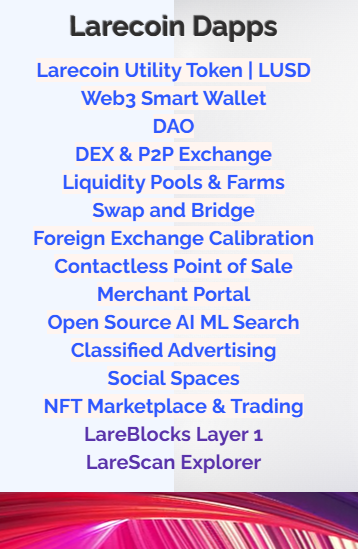
The ecosystem: LUSD stablecoin, LarePAY processing, LareBlocks data layer, Smart Wallet self-custody: is purpose-built for merchants tired of feeding the interchange beast.
NFT receipts for bulletproof accounting. QR-generated POS for seamless checkout. Push-to-card for instant liquidity. Cross-chain capability for maximum flexibility.
While NOWPayments, CoinPayments, and Triple-A still operate within traditional crypto payment frameworks, Larecoin reimagines the entire merchant experience from the ground up.
50% lower fees. Full transparency. True self-custody.
Ready to Stop Overpaying?
Your competitors are already making the switch.
The merchants winning in 2026 aren't negotiating better rates with legacy processors. They're abandoning the old system entirely.
Web3 payments aren't the future. They're the present.
Explore Larecoin and see exactly how much you're leaving on the table.
Your margins will thank you.
Comments