

.png)
How to Convert Crypto to Fiat Instantly with Self-Custody Merchant Accounts (Without Losing 3% to Fees)
- [[[Free!!]<<<<]] Watch: 스포르팅 - 토트넘 Live Stream 13 September 2022
- Feb 20
- 4 min read
The 3% Problem Killing Your Margins
Traditional crypto payment processors steal 3-5% of every transaction.
CoinPayments charges 0.5% plus network fees. NOWPayments takes 0.5-1% per transaction. Add conversion fees, withdrawal fees, and monthly minimums: suddenly you're hemorrhaging profit.
Merchants lose $30-50 on every $1,000 sale.
That's unacceptable in 2026.
Self-Custody Changes Everything
Self-custody merchant accounts eliminate the middleman entirely.
You control your wallet. You receive crypto directly. You convert on your terms.
The difference:
Custodial Platforms (NOWPayments, CoinPayments):
Hold your funds in their wallets
Charge conversion fees
Control withdrawal timing
Add processing delays
Require KYC verification for withdrawals
Self-Custody Solutions:
You own the private keys
Direct blockchain settlement
Instant conversions via DEX integration
Zero custody fees
Complete merchant independence

Traditional platforms act as banks. Self-custody platforms act as infrastructure.
Instant Crypto-to-Fiat Without Exchange Delays
Real-time conversion solves the volatility problem.
Customer pays in BTC, ETH, or USDT. System converts instantly to fiat or stablecoins. Settlement happens in seconds, not days.
How it works:
Customer initiates payment
Smart contract receives crypto
DEX protocol converts to LUSD or fiat equivalent
Funds settle in your self-custody wallet
Push-to-card transfers complete withdrawal
Total time: 30-90 seconds.
Compare that to NOWPayments' 24-48 hour settlement window or CoinPayments' manual withdrawal process.
LUSD: The Zero-Fee Stablecoin Advantage
LUSD (Liquity USD) operates without stability fees.
Unlike USDC or USDT, LUSD charges zero interest on minting. No centralized issuer controlling supply. Pure algorithmic stability backed by ETH collateral.
Why LUSD matters for merchants:
Zero holding fees
Decentralized stability mechanism
No blacklist risk
Direct conversion from volatile crypto
Accepted across DeFi protocols
Convert customer payments to LUSD instantly. Hold value without bleeding fees. Convert to fiat only when needed.
Traditional stablecoins charge hidden costs. LUSD doesn't.

Fee Breakdown: Self-Custody vs Custodial Platforms
$10,000 Monthly Transaction Volume:
NOWPayments:
Platform fee: 0.5% = $50
Conversion fee: 0.5% = $50
Withdrawal fee: $10-25
Network fees: $15-30
Total: $125-155 (1.25-1.55%)
CoinPayments:
Platform fee: 0.5% = $50
Conversion fee: 1% = $100
Withdrawal fee: Variable
Network fees: $20-40
Total: $170-190 (1.7-1.9%)
Larecoin Self-Custody:
Platform fee: $0
Conversion fee: DEX fees only (0.1-0.3%) = $10-30
Withdrawal fee: $0
Network fees: Gas only = $5-15
Total: $15-45 (0.15-0.45%)
You save 80-90% on processing costs.
That's $1,200-1,680 saved annually per $10K monthly volume.
NFT Receipts: Proof of Payment on the Blockchain
Every transaction generates an immutable NFT receipt.
This isn't marketing fluff. It's verifiable proof of payment stored permanently on-chain.
NFT receipt benefits:
Instant dispute resolution
Automated accounting records
Customer loyalty tracking
Resale/transfer capability
Tax documentation built-in
Zero storage costs
Traditional payment processors give you CSV exports. Self-custody systems give you blockchain-verified receipts that can't be altered or deleted.
CoinPayments offers transaction history. NOWPayments provides API logs. Neither offer blockchain-native proof.
NFT receipts do.

Direct Bank Integration Without Custodians
Push-to-card technology completes the loop.
Convert crypto to LUSD. Hold stablecoins in self-custody. Push fiat to debit cards instantly when needed.
The process:
Merchant receives payment in BTC/ETH
Smart contract converts to LUSD
LUSD sits in merchant's wallet (zero fees)
Merchant triggers push-to-card when ready
Fiat appears on linked debit card in 30 seconds
No waiting for exchange withdrawals. No minimum withdrawal amounts. No processing windows.
Traditional platforms require manual withdrawal requests, KYC verification, and 1-3 day processing. Self-custody solutions push fiat instantly via card networks.
You control the timing. You control the funds.
Merchant Independence Matters
Custodial platforms can freeze accounts.
It happens regularly. Compliance reviews. Suspicious activity flags. Arbitrary policy changes.
NOWPayments froze multiple merchant accounts in 2025 for "irregular activity patterns." CoinPayments requires enhanced verification for withdrawals exceeding $10K.
Self-custody eliminates this risk entirely.
Your wallet. Your keys. Your funds. No platform can freeze assets they never controlled.
True merchant freedom means:
No account holds
No withdrawal limits
No platform approval required
No surprise policy changes
No third-party risk
You answer to blockchain consensus, not corporate compliance departments.
Implementation in 3 Steps
Step 1: Set Up Self-Custody Wallet
Create merchant wallet with multi-sig security. Generate unique payment addresses per transaction. Configure automatic conversion rules.
Step 2: Integrate Payment Gateway
Add checkout widget to your site. Connect to DEX protocols for instant conversion. Set up LUSD as your settlement currency.
Step 3: Link Bank Card
Connect debit card for push-to-card withdrawals. Configure automatic or manual fiat conversion. Start accepting payments immediately.
Total setup time: 30-45 minutes.
No lengthy KYC processes. No account approval waiting periods. No platform review delays.
Deploy infrastructure and start processing payments.
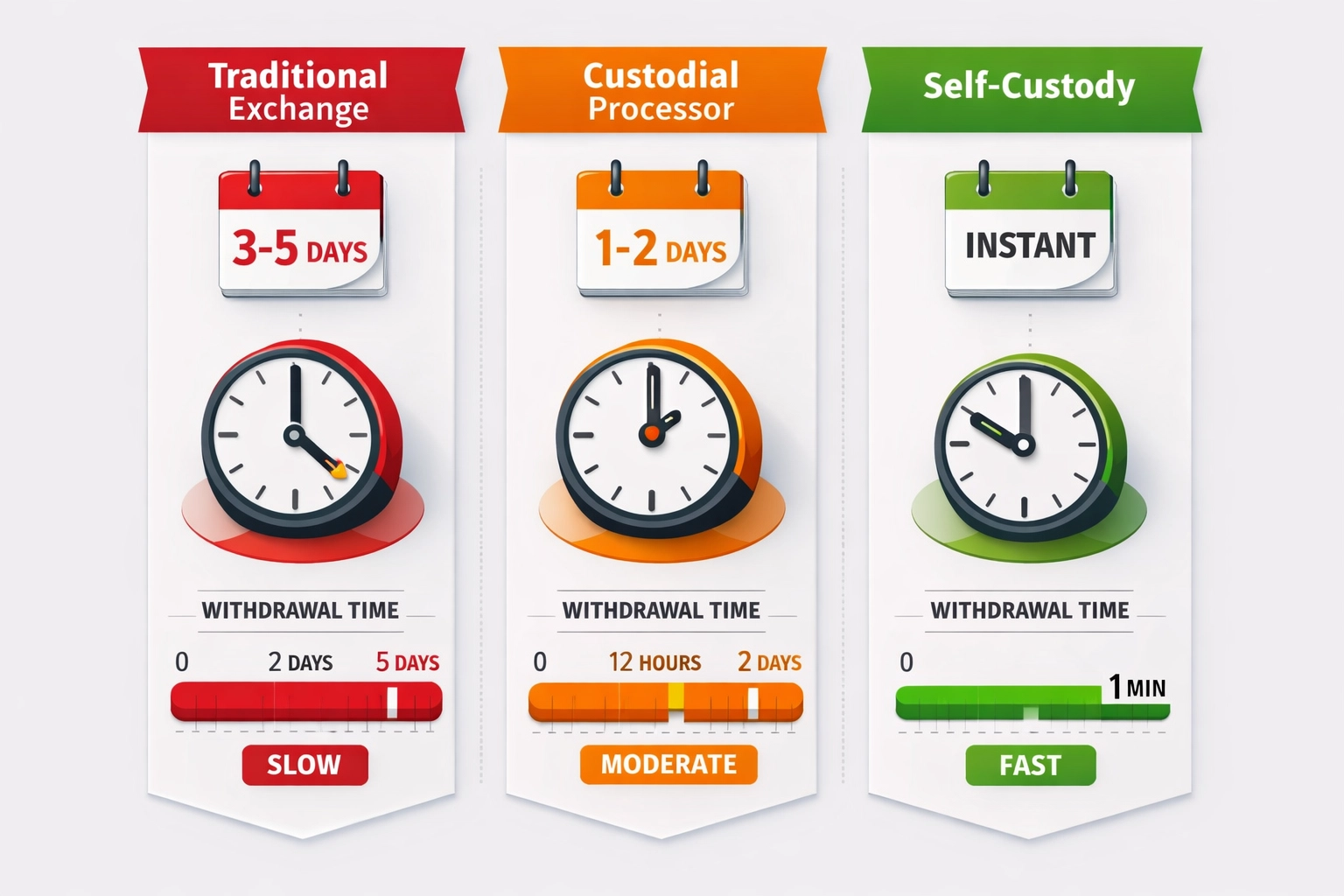
Real Conversion Speed Comparison
Traditional Exchange Withdrawal:
Transfer to exchange: 10-60 minutes
Exchange processing: 30 minutes
Conversion to fiat: Instant
Withdrawal initiation: 24-48 hours
Bank settlement: 1-3 business days
Total: 2-5 days
Custodial Payment Processor:
Payment reception: Instant
Platform processing: 1-24 hours
Conversion approval: 1-2 days
Withdrawal to bank: 2-3 days
Total: 3-7 days
Self-Custody with Instant Conversion:
Payment reception: Instant
Smart contract conversion: 30 seconds
LUSD settlement: 30 seconds
Push-to-card (optional): 30 seconds
Total: 90 seconds
Speed matters when you're managing cash flow.
Why NOWPayments and CoinPayments Can't Compete
Custodial models can't match self-custody efficiency.
They're built on legacy payment rails. They operate as intermediaries. They require infrastructure that costs money to maintain.
Those costs get passed to merchants.
Fundamental limitations:
Must hold customer funds
Regulatory compliance overhead
Insurance and security costs
Withdrawal processing systems
Customer support requirements
Self-custody platforms eliminate these costs by eliminating the custody function entirely.
Larecoin doesn't hold your crypto. We provide the infrastructure to receive, convert, and settle payments directly.
No custody = no custody fees.
The Decentralized Payments Future
Web3 payments remove financial intermediaries permanently.
Banks charge fees because they provide custody and settlement. Payment processors charge fees because they manage conversions and compliance.
Blockchain-native systems handle all of this automatically through smart contracts.
What changes:
Instant settlement replaces 3-day clearing
Smart contracts replace payment processors
DEX liquidity replaces bank forex desks
Self-custody replaces corporate wallets
Blockchain verification replaces manual reconciliation
The infrastructure costs 90% less to operate. Those savings transfer directly to merchants.
Traditional payment systems can't compete with this cost structure.
They're optimized for the wrong era.
Start Converting Crypto Instantly Today
Stop losing 3% to outdated payment processors.
Self-custody merchant accounts deliver instant conversion, zero custody fees, and complete financial independence.
The technology exists now. Implementation takes less than an hour. The fee savings compound daily.
Visit Larecoin to set up your self-custody merchant account and start processing crypto payments without losing profit to intermediaries.
Your money. Your wallet. Your control.
That's how crypto payments should work in 2026.