

.png)
How to Reduce Merchant Interchange Fees by 50% (Without Giving Up Control of Your Crypto)
- [[[Free!!]<<<<]] Watch: 스포르팅 - 토트넘 Live Stream 13 September 2022
- 2 hours ago
- 4 min read
![Writer: [[[Free!!]<<<<]] Watch: 스포르팅 - 토트넘 Live Stream 13 September 2022](https://lh3.googleusercontent.com/a/AItbvmktwQc0wCdd3ZEETSYItRQubwwBzOyjD_dcigRf=s96-c)
Merchants pay $138 billion annually in interchange fees.
That's money vanishing into the traditional payment infrastructure.
Every swipe. Every transaction. Another 2.5-3.5% gone.
But here's the twist: crypto was supposed to fix this.
The Crypto Payment Paradox
Most crypto payment processors just recreated the old system with new labels.
NOWPayments? 0.5% transaction fee.
CoinPayments? 0.5% transaction fee.
They're better than Visa and Mastercard, sure. But they're still taking a percentage of every sale.
And they hold your funds in custody while they process payments.
You're trading one middleman for another.
The Gas-Only Revolution
Gas-only payment models flip the script entirely.
Instead of percentage-based fees that scale with transaction size, you pay a fixed network cost regardless of amount.
Process $100? Pay $0.20 in gas.
Process $100,000? Still pay $0.20 in gas.
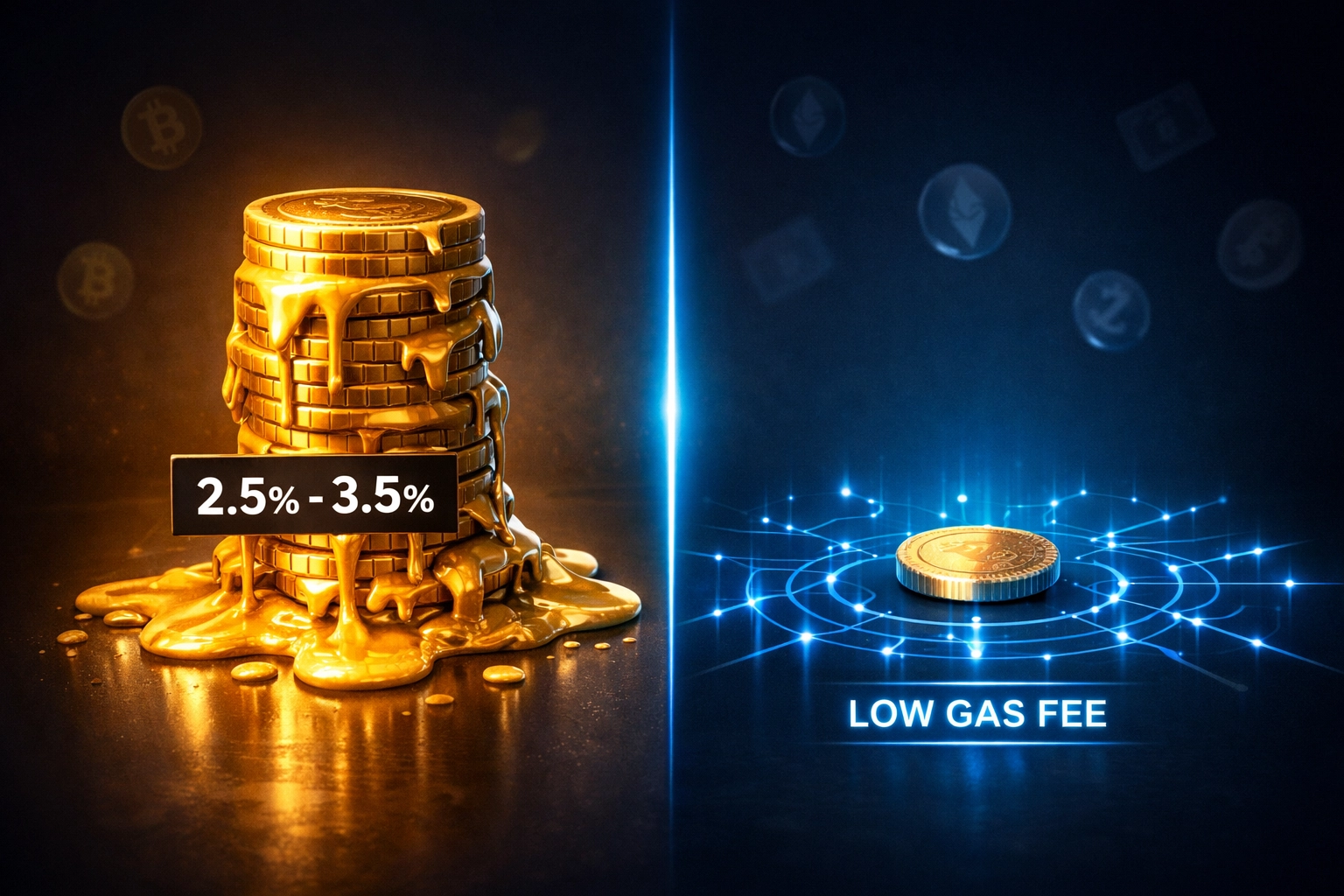
The math is simple:
Traditional Processor ($50K monthly volume):
2.5% average rate
$1,250/month in fees
$15,000/year disappeared
Standard Crypto Processor ($50K monthly volume):
0.5% transaction fee
$250/month in fees
$3,000/year
Gas-Only Model ($50K monthly volume):
Fixed network costs
~$20/month in fees
~$240/year
That's a 98% reduction compared to traditional processors.
And a 92% reduction compared to standard crypto alternatives.
Self-Custody Isn't Optional Anymore
When NOWPayments or CoinPayments process your transactions, they control the funds.
You're waiting for settlements. Dealing with withdrawal limits. Trusting intermediaries.
Self-custody means you control every dollar from the moment it arrives.
No waiting periods. No custody risk. No permission needed to access your own money.
Larecoin's approach gives merchants complete control while maintaining compliance.
You hold the keys. You decide when and where funds move.

LUSD: The Stability Layer
Here's the volatility problem nobody talks about:
A customer pays you 0.05 ETH on Monday. By Friday, that's worth 8% less.
Traditional processors solve this by immediately converting to fiat (and charging you for the privilege).
LUSD changes the equation.
It's a decentralized stablecoin that maintains dollar parity without centralized issuers.
No Circle. No Tether. No single point of failure.
Merchants receive payments in LUSD, keep them in LUSD, and spend them in LUSD.
Zero conversion fees. Zero volatility exposure. Zero dependence on traditional banking infrastructure.
All while maintaining the gas-only fee structure that makes crypto payments viable.
NFT Receipts: Beyond Transaction Records
Every Larecoin transaction generates an NFT receipt.
Not a PDF. Not an email. A blockchain-native proof of purchase that doubles as a programmable asset.
Merchants can embed:
Warranty information
Loyalty rewards
Future discounts
Exclusive access rights
Customers own provable records of every purchase forever.
No lost receipts. No fraudulent chargebacks. No disputes about what was purchased when.
The receipt itself becomes part of your customer relationship strategy.

US Compliance Done Right
Cryptocurrency payment processing in the US isn't the Wild West.
Larecoin operates with a clear regulatory strategy:
MSB Registration: Money Services Business registration with FinCEN.
State MTL Strategy: Money Transmitter License approach across state jurisdictions.
This isn't about avoiding regulation. It's about working within the framework while delivering innovation.
When merchants choose Larecoin, they're not taking regulatory shortcuts.
They're choosing a platform that balances cutting-edge technology with compliance infrastructure.
That matters when you're processing real revenue.
The Five-Minute Setup
Traditional merchant accounts take weeks to approve.
Credit checks. Application reviews. Bank relationships.
Self-custody crypto payments take five minutes to two hours.
Generate a wallet. Connect to the network. Start accepting payments.
No approval process. No credit requirements. No waiting for some committee to decide if you're worthy of processing payments.
You control your business infrastructure from day one.
Real Numbers From Real Merchants
Compare three scenarios for a growing e-commerce business:
Monthly Revenue: $100,000
Traditional Processing:
Fees: $2,500-$3,500
Setup time: 2-4 weeks
Custody: Processor controls funds
Compliance: Outsourced to processor
Standard Crypto (NOWPayments/CoinPayments):
Fees: $500
Setup time: 1-2 days
Custody: Processor controls funds
Compliance: Processor-managed
Larecoin Gas-Only:
Fees: $40-$100
Setup time: 5 minutes
Custody: Merchant controls funds
Compliance: Built-in MSB/MTL framework
Annual savings vs traditional: $28,800-$41,400
Annual savings vs standard crypto: $4,800-$5,520

The Control Premium
Legacy processors charge percentage fees because they provide custody and compliance infrastructure.
But what if you don't need them to hold your funds?
What if compliance can be built into the protocol layer instead of the service layer?
That's the Larecoin model.
Merchants pay only for network usage (gas fees). Not for custody services they don't want. Not for compliance theater. Not for permission to access their own revenue.
The "control premium" everyone worried about? It doesn't exist with proper infrastructure.
Self-custody actually reduces costs while increasing security and autonomy.
Beyond Payment Processing
Traditional processors sell you transaction processing.
Larecoin gives you a global payment infrastructure.
Accept payments anywhere. No geographic restrictions. No currency conversion headaches.
Push to card when you need fiat. Keep crypto when you don't.
Bridge between chains seamlessly. Your customers pay with whatever they hold.
The system handles routing, conversion, and settlement automatically while maintaining gas-only fee economics.
The Path Forward
Merchant interchange fees aren't going away in traditional systems.
Visa and Mastercard have zero incentive to reduce their cut.
Standard crypto processors (NOWPayments, CoinPayments) offer marginal improvements but maintain percentage-based models because that's their business model.
Gas-only protocols destroy that entire cost structure.
For merchants processing significant volume, the savings compound fast:
$100K monthly = ~$30K annual savings
$500K monthly = ~$150K annual savings
$1M monthly = ~$300K annual savings
All while maintaining complete control over funds and compliance positioning.
That's not incremental improvement.
That's a complete reimagining of how payment infrastructure should work.
Ready to cut your processing fees by 50%+?
Explore Larecoin's gas-only payment infrastructure at larecoin.com.
Self-custody. LUSD stability. NFT receipts. Full US compliance.
No percentage fees. No custody requirements. No permission needed.
Just direct, peer-to-peer global payments the way crypto was meant to work.
Comments