

.png)
LareBlocks Layer 1 Explained in Under 3 Minutes: Why Merchants Are Ditching Legacy Payment Rails
- [[[Free!!]<<<<]] Watch: 스포르팅 - 토트넘 Live Stream 13 September 2022
- Feb 23
- 4 min read
![Writer: [[[Free!!]<<<<]] Watch: 스포르팅 - 토트넘 Live Stream 13 September 2022](https://lh3.googleusercontent.com/a/AItbvmktwQc0wCdd3ZEETSYItRQubwwBzOyjD_dcigRf=s96-c)
Legacy payment rails are bleeding merchants dry.
Interchange fees. Chargeback fraud. Settlement delays. Account freezes.
LareBlocks Layer 1 fixes this. Here's how.
What Layer 1 Actually Means
Layer 1 = Base protocol. Foundation layer. The whole enchilada.
It's not built on top of Ethereum, Bitcoin, or anyone else's infrastructure. LareBlocks operates independently with its own consensus rules, validator network, and settlement finality.
No parent chain dependency. No inherited problems. No gas fee spikes from external networks.
When you transact on LareBlocks, settlement happens directly on-chain. Not on some Layer 2 rollup that eventually syncs back to a parent chain. Not through third-party bridges that add risk and latency.
Your payment. Your chain. Your rules.

The Architecture Merchants Actually Need
Independent Consensus LareBlocks validators secure the network globally. Distributed nodes reach consensus without centralized gatekeepers. No single entity controls transaction approval or account access.
Native Smart Contracts Payment logic executes directly on the base layer. Master wallets. Sub-wallet management. Enterprise treasury controls. All native to the protocol.
Built-In AI Integration Dynamic pricing algorithms run on-chain. AI customer service integrates at the protocol level. Metaverse shopping functionality operates natively: not through external APIs that charge recurring fees.
Sub-Second Finality Transactions confirm in under one second. Not "pending." Not "waiting for confirmations." Settled. Done. Customer walks out with their product.
Legacy payment processors take 3-5 business days for settlement. LareBlocks takes less time than swiping a credit card.
Why Enterprise Merchants Are Switching
Problem #1: Censorship Risk
Traditional processors freeze accounts arbitrarily. One compliance flag. One angry customer complaint. One algorithm misfire.
Your business shuts down overnight.
LareBlocks distributes control across validator nodes. No single party can deplatform your business. Transactions require network consensus: not one corporation's approval department.
Problem #2: Fee Hemorrhaging
Interchange fees drain 2-3% per transaction. Currency conversion adds another layer. International transfers stack additional charges.
LareBlocks charges minimal gas fees for base transactions. The 1.5% transaction tax supports global charities: not banking executives.
Problem #3: Settlement Delays
Cash flow dies in legacy systems. You ship product Monday. Funds arrive Friday. Maybe.
LareBlocks settles instantly. Customer pays. You receive. Treasury management happens in real-time: not on banking schedules.
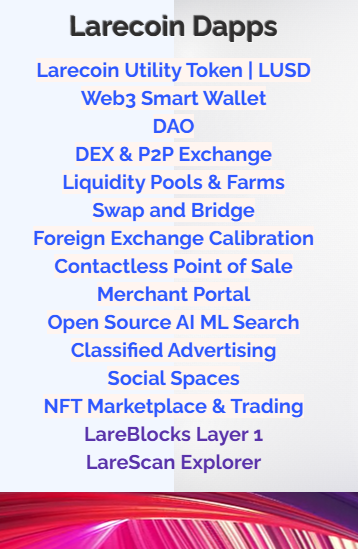
LareScan: The Explorer Merchants Didn't Know They Needed
Block explorers traditionally serve developers. LareScan serves merchants.
Real-Time Transaction Visibility Every payment appears instantly. Customer ID. Transaction hash. Timestamp. Amount. Status.
No calling customer service. No waiting for batch processing. No mystery delays.
NFT Receipt Generation Every transaction creates an immutable receipt on-chain. Tax advantages. Accounting automation. Dispute resolution with cryptographic proof.
Traditional receipts get lost. Ink fades. Systems crash.
Blockchain receipts exist forever.
Wallet Analytics Dashboard Master wallets track sub-wallet performance. Revenue by location. Transaction volume trends. Peak hours analysis.
Legacy systems charge for analytics dashboards. LareScan includes this natively.
Compliance Verification Auditors love blockchain transparency. Every transaction traces back to origin. No hidden fees. No mystery deductions. No accounting discrepancies.
Pull reports in seconds instead of weeks.
The Master/Sub-Wallet System
Enterprise merchants don't operate from single wallets.
You need treasury controls. Location-based tracking. Employee access levels. Multi-signature approvals.
Master Wallet = Corporate Treasury Central control point. Multi-sig security. Configurable approval workflows. Fund allocation to sub-wallets.
Sub-Wallets = Store Locations Individual outlets operate independently. Transaction tracking by location. Performance metrics per store. Automated reconciliation with master wallet.
Legacy systems require separate merchant accounts. Different logins. Manual consolidation. Reconciliation nightmares.
LareBlocks handles this at the protocol level. One master wallet manages thousands of sub-wallets. Native infrastructure: not bolt-on solutions.

Real-World Performance Advantages
Scalability Without Degradation Thousands of simultaneous transactions. Zero performance impact. No network congestion during peak periods.
Ethereum gas fees spike during high usage. Bitcoin transactions slow to a crawl. LareBlocks maintains consistent performance.
Global Operations, Single Chain No currency conversion complexity. No forex rate gambling. No international wire delays.
Customer in Tokyo pays. Merchant in Toronto receives. Same chain. Same settlement speed. Same predictable fees.
Metaverse-Ready Commerce Virtual storefronts operate on the same chain as physical POS systems. AI shopping assistants integrate natively. Social spaces connect directly to payment infrastructure.
Traditional processors can't handle metaverse commerce. They're built for card-present and card-not-present transactions: not virtual worlds.
LareBlocks launches with metaverse infrastructure already built in.
Legacy Rails vs. LareBlocks: The Numbers
Settlement Time
Legacy: 3-5 business days
LareBlocks: Sub-second finality
Transaction Fees
Legacy: 2-3% + processing fees
LareBlocks: Minimal gas + 1.5% (charity-directed)
Chargeback Risk
Legacy: 6-month dispute window
LareBlocks: Cryptographic finality
Account Control
Legacy: Platform controls your access
LareBlocks: You control your keys
International Processing
Legacy: Currency conversion + wire fees
LareBlocks: Native global settlement
Analytics Access
Legacy: Paid add-on services
LareBlocks: Built into LareScan

The Onboarding Reality
Merchants fear crypto complexity. LareBlocks eliminates it.
Gift Card Entry Points Customers buy Larecoin gift cards with fiat. Load wallets without exchanges. No KYC friction.
ACH Integration Direct bank connections. Fiat on-ramps built in. Customers fund wallets from checking accounts.
Push-to-Card Services Merchants convert crypto revenue to fiat instantly. Push directly to business debit cards. Treasury management without exchange accounts.
Traditional crypto payments require merchant exchange relationships. Custody services. Tax reporting headaches.
LareBlocks handles this infrastructure-level.
The 3-Minute Summary
Layer 1 means independence. No parent chain. No inherited problems. No external dependencies.
LareBlocks delivers sub-second settlement, enterprise scalability, and native AI commerce features. All on a single base layer.
LareScan provides merchant-focused analytics, NFT receipts, and compliance verification: not developer tools disguised as business solutions.
Master/sub-wallet architecture handles enterprise complexity natively. No third-party treasury management services. No reconciliation software subscriptions.
The result: merchants control their infrastructure without technical complexity.
Legacy payment rails extract fees, introduce delays, and maintain censorship control.
LareBlocks eliminates all three.
That's why merchants are switching.
Ready to ditch legacy payment rails? The infrastructure is live. The onboarding is simple. The future is Layer 1.
Comments