

.png)
LUSD Stablecoin Benefits: Why Gas-Only Transfers Beat Visa by 50% (And What the CLARITY Act Means for You)
- [[[Free!!]<<<<]] Watch: 스포르팅 - 토트넘 Live Stream 13 September 2022
- 2 hours ago
- 5 min read
![Writer: [[[Free!!]<<<<]] Watch: 스포르팅 - 토트넘 Live Stream 13 September 2022](https://lh3.googleusercontent.com/a/AItbvmktwQc0wCdd3ZEETSYItRQubwwBzOyjD_dcigRf=s96-c)
Let's talk about something that's been bugging merchants for decades: payment processing fees.
You know the drill. Every time a customer swipes a Visa or Mastercard, you're hemorrhaging 2.9% plus transaction fees. Plus chargebacks. Plus PCI compliance costs. Plus gateway fees.
It adds up. Fast.
But here's where things get interesting. LUSD stablecoin flips the entire model on its head with gas-only transfers. No percentage cuts. Just flat network fees.
And the CLARITY Act? That's the regulatory green light that makes all of this not just possible: but actually practical for everyday merchants.
The Gas-Only Revolution: Why LUSD Doesn't Take a Cut
Traditional payment processors operate on a percentage model. They take their slice regardless of transaction size.
Processing a $10 sale? 2.9% plus fees. Processing a $10,000 sale? Still 2.9% plus fees.
LUSD operates differently. The blockchain charges gas fees: network computation costs that remain relatively flat regardless of transaction amount.

Think of it like this: mailing a postage stamp costs the same whether you're sending a $5 check or a $5,000 check. Gas fees work similarly.
For a typical $100 transaction, LUSD gas fees run around $0.15. That's it. No hidden percentages. No surprise fees at month-end.
The math is simple. And brutal for traditional processors.
Breaking Down the 50% Advantage
Let's run real numbers.
Merchant A processes $500,000 annually through traditional cards:
Base fees: $14,500 (2.9%)
Chargeback fees: $1,500-$2,000
Gateway costs: $500-$800
PCI compliance: $500-$1,000
Total: ~$18,000/year
Same merchant using LUSD:
Gas fees only: $2,500-$5,000/year
No chargebacks (blockchain transactions are final)
No gateway fees (direct peer-to-peer)
No compliance costs (self-custody)
Total: $2,500-$5,000/year
That's $13,000-$15,500 in savings. Annually.
For a merchant processing $100,000 monthly? You're looking at $29,820-$90,000 in annual savings compared to traditional rails.
The percentage advantage isn't marketing fluff. It's fundamental economics.
The CLARITY Act: Regulatory Rocket Fuel
Here's where H.R. 3633: the CLARITY Act: changes everything.
This legislation provides clear regulatory frameworks for digital assets. No more gray zones. No more "is this a security or not?" debates.
What it means for merchants:
Tax clarity: Gas-only transfers are treated as utility costs, not capital gains events. You're not triggering tax complications with every transaction.
Legal certainty: Clear rules mean you can accept LUSD without worrying about future regulatory flip-flops.
Banking access: Financial institutions can work with crypto merchants without fear of regulatory backlash.
Consumer protection: Established frameworks mean customers trust the system more.
The CLARITY Act essentially gives LUSD and other digital payment systems the same regulatory footing as traditional payment methods: without the legacy baggage.
It's the difference between operating in regulatory quicksand versus solid ground.
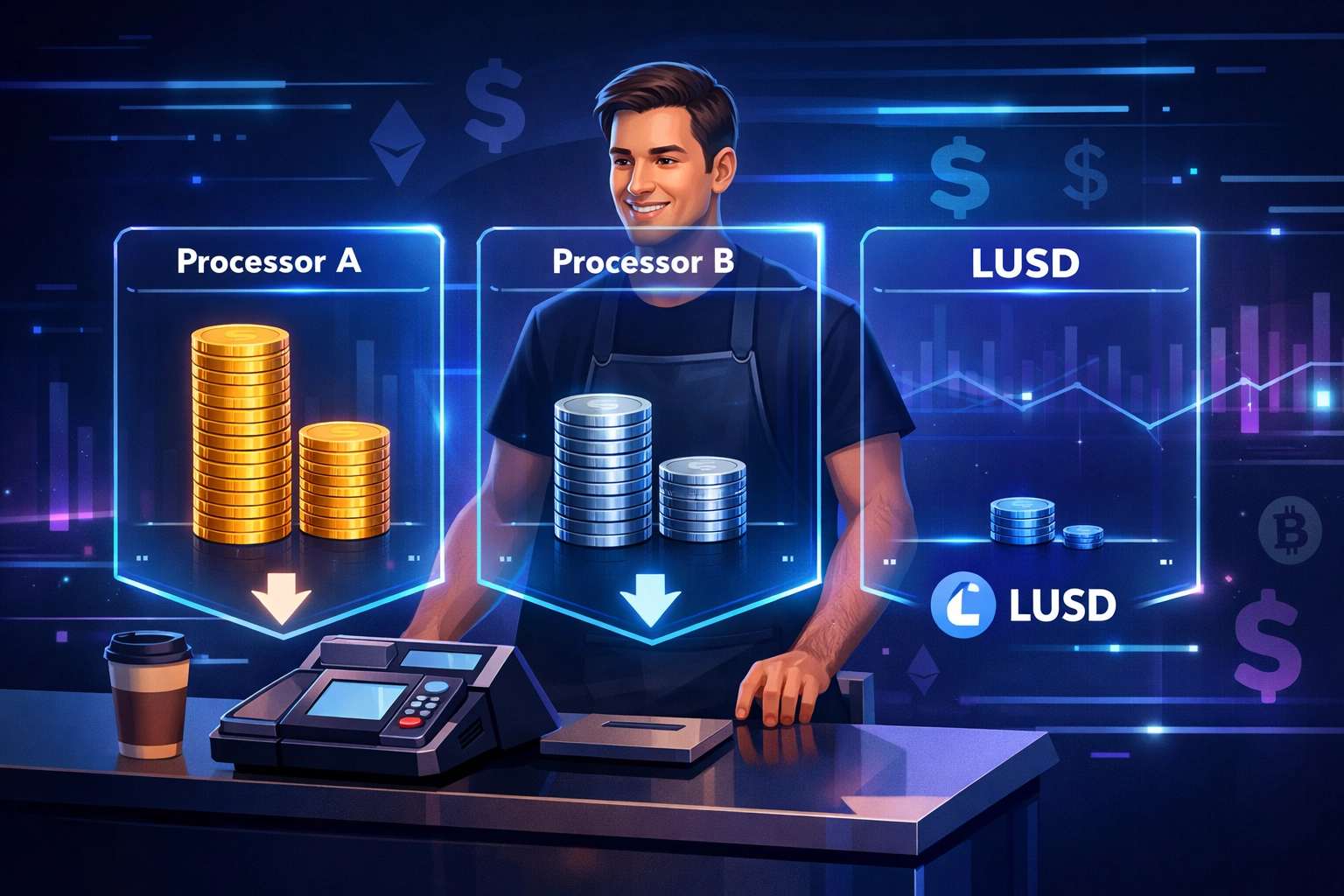
Real-World Cost Breakdowns: NOWPayments vs. CoinPayments vs. LUSD
Let's compare apples to apples with actual crypto payment processors.
NOWPayments:
0.5% transaction fee
$50,000 annual volume = $250/year
$500,000 annual volume = $2,500/year
CoinPayments:
0.5% transaction fee
Additional withdrawal fees
$50,000 annual volume = $250+ fees
$500,000 annual volume = $2,500+ fees
LUSD on LareBlocks:
Gas-only model
~$0.15 per transaction
1,000 transactions = $150/year (regardless of volume)
10,000 transactions = $1,500/year
The more volume you process, the more LUSD's gas-only model dominates.
At scale, there's no competition.
Settlement Speed: Minutes vs. Days
Traditional card payments take 2-3 days to settle. Your money sits in limbo while banks shuffle papers.
LUSD settles in minutes. Sometimes seconds.
Why this matters:
Cash flow: Money hits your wallet immediately Working capital: No need to finance the settlement gap Certainty: Transaction finality means no chargebacks weeks later Reinvestment: Faster access to capital for inventory, payroll, growth
For businesses operating on thin margins, settlement speed isn't a luxury. It's survival.

Self-Custody: Your Money, Your Rules
Card processors can freeze your account. It happens.
High-risk industry? Frozen. Unusual transaction pattern? Frozen. Algorithm doesn't like something? Frozen.
LUSD operates on self-custody principles. Your wallet. Your keys. Your control.
No intermediary can lock you out. No payment processor playing judge and jury.
The blockchain doesn't care about your business model. It just processes transactions.
This is particularly crucial for merchants in emerging industries, international sellers, or anyone tired of arbitrary account holds.
NFT Receipts: Immutable Transaction Records
Every LUSD transaction on Larecoin's LareBlocks infrastructure generates an NFT receipt.
These aren't just cool digital collectibles. They're immutable, timestamped, verifiable records of every transaction.
Practical applications:
Accounting: Automated, tamper-proof books Tax compliance: Perfect audit trails Customer disputes: Irrefutable transaction history Analytics: Real-time transaction data without third-party dashboards
Traditional receipts can be lost, altered, or disputed. NFT receipts exist permanently on-chain.
Your accountant will thank you. So will your auditor.
The Merchant Toolkit: Master/Sub-Wallets
Larecoin's merchant tools go beyond simple payment acceptance.
Master/Sub-wallet architecture lets you:
Create separate wallets for different store locations
Allocate specific payment streams to specific accounts
Manage employee wallets with spending limits
Track revenue sources with granular precision
It's enterprise-level treasury management without enterprise-level costs.
Push-to-Card: Bridge to Traditional Banking
Here's the kicker: you don't have to live entirely in crypto.
Push-to-Card services let you instantly convert LUSD to traditional currency on your debit card.
Accept crypto. Spend fiat. Zero friction.
This bridges the gap between Web3 innovation and legacy infrastructure. Customers pay with LUSD. You receive dollars (or euros, or whatever) on your card within minutes.
Best of both worlds.
The 1.5% Social Impact Fee: Cost That Actually Matters
Larecoin's ecosystem includes a 1.5% social impact tax directed to charity.
Unlike payment processor fees that disappear into corporate profits, this fee creates measurable social good.
You're already paying fees somewhere. Might as well make them count for something beyond shareholder returns.
It's cost with purpose.
Integration Reality: Easier Than You Think
"This sounds complicated."
It's not.
Setting up LUSD payments takes less time than traditional merchant account applications. No credit checks. No underwriting delays. No mountains of paperwork.
Create wallet. Generate payment address. Start accepting transactions.
Most merchants are processing payments within 30 minutes of setup.
The technical complexity? Hidden. The user experience? Simple.
Why This Matters Now
The payment infrastructure built in the 1970s is crumbling under modern demands.
Cross-border fees. Settlement delays. Chargeback fraud. Percentage-based pricing that makes no sense in a digital age.
LUSD's gas-only model isn't just cheaper. It's structurally superior.
And with the CLARITY Act providing regulatory certainty, there's no reason to wait.
The merchant payment landscape is shifting. Fast.
Early adopters aren't just saving money. They're positioning themselves at the forefront of Web3 commerce.
Take Action
Want to see how much you could save with LUSD gas-only transfers?
Check out Larecoin's merchant tools and run the numbers for your specific business.
The 50% advantage isn't theoretical. It's mathematical.
And with regulatory clarity finally here, there's never been a better time to make the switch.
Your payment processor has been taking 2.9% long enough.
Maybe it's time they competed with $0.15 instead.
Comments