

.png)
The Ultimate Guide to US-Compliant Crypto Payments: MSB Registration, State MTL, and Fee Savings Revealed
![Writer: [[[Free!!]<<<<]] Watch: 스포르팅 - 토트넘 Live Stream 13 September 2022](https://lh3.googleusercontent.com/a/AItbvmktwQc0wCdd3ZEETSYItRQubwwBzOyjD_dcigRf=s96-c)
Crypto payments in the US aren't the Wild West anymore.
The regulatory landscape is real. And it's here to stay.
If you're running a crypto payment operation or thinking about it, compliance isn't optional. It's mandatory. MSB registration. State money transmitter licenses. AML programs. The whole nine yards.
But here's the thing most platforms won't tell you: compliance doesn't have to kill your margins.
Let's break down what actually matters.
Federal MSB Registration: Your First Checkpoint
Every crypto payment service transmitting value needs to register with FinCEN as a Money Service Business.
Timeline: 180 days from starting operations. Not negotiable.
You'll file FinCEN Form 107 through the BSA e-filing system. Simple process. Critical requirement.
Before you even think about taking your first payment, you need:
Official incorporation papers
EIN from the IRS
Written AML program addressing BSA/AML compliance pillars
Designated compliance officer
Skip any of these? FinCEN doesn't care if you "didn't know." The FBI actively warns consumers against unregistered services. Enforcement is real.
What You're Actually Registering:
Requirement | Details |
Company Info | Legal entity, address, ownership |
Compliance Contact | Designated AML officer |
Services Offered | Specific crypto operations |
Geographic Scope | Where you operate |
This isn't just paperwork. It's your license to operate in regulated finance.
State MTL: The Real Challenge
Federal MSB registration is step one.
State money transmitter licensing? That's where it gets expensive.
You need a license in every state where you operate. Each state has different requirements:
Minimum capital requirements
Surety bonds (often $100K-$500K per state)
Management background checks
Audited financials
Business plan documentation
New York has BitLicense. Other states have their own regimes.
Most crypto payment platforms operate in 20-40 states. Do the math on those surety bonds alone.
This is why most "compliant" platforms cut corners.
They register federally but skip state licenses in certain jurisdictions. They offshore operations. They use regulatory arbitrage.
Not Larecoin.
The Larecoin Compliance Advantage
Here's where we're different.
Larecoin is building a rigorous multi-state MTL strategy from day one. No shortcuts. No regulatory gray zones.
Why does this matter to you?
Because when platforms get shut down for compliance failures, your business goes down with them.
Remember when platforms suddenly stopped serving certain states? When banking partners pulled out? When accounts froze without warning?
That's what happens when you build on shaky regulatory ground.
Larecoin's approach:
Full MSB registration with FinCEN
Progressive state MTL acquisition strategy
Comprehensive AML/KYC infrastructure
Transparent compliance documentation
Self-custody architecture that reduces regulatory burden
Translation: Your payments don't disappear overnight.
Fee Savings: The Real ROI
Compliance costs money. Everyone knows that.
But here's what NOWPayments and CoinPayments won't highlight in their pricing pages: their fee structures subsidize their compliance gaps.
NOWPayments: 0.5% + network fees. Sounds cheap. But:
No custody transparency
Limited self-custody options
Hidden conversion spreads
Third-party processing delays
CoinPayments: 0.5% base fee. Better than traditional processors. Still:
Centralized custody model
Conversion fees buried in spreads
Limited token selection
No LUSD stablecoin benefits
Larecoin: Different model entirely.
Gas-only transfers for LARE token holders. No platform fees. Just network costs.
LUSD stablecoin integration means price stability without conversion fees eating your margins.
Real-world example:
$100K monthly crypto payment volume:
NOWPayments: $500 + network fees + conversion spreads (realistically $800-1,200)
CoinPayments: $500 + network fees + hidden spreads (similar $800-1,200)
Larecoin: Network gas only (typically $50-150 on Solana)
Annual savings: $9,000-13,800.
That's not pocket change.
NFT Receipts: The Innovation Nobody Asked For (But Everyone Needs)
Traditional payment platforms give you CSV exports.
Larecoin gives you NFT receipts.
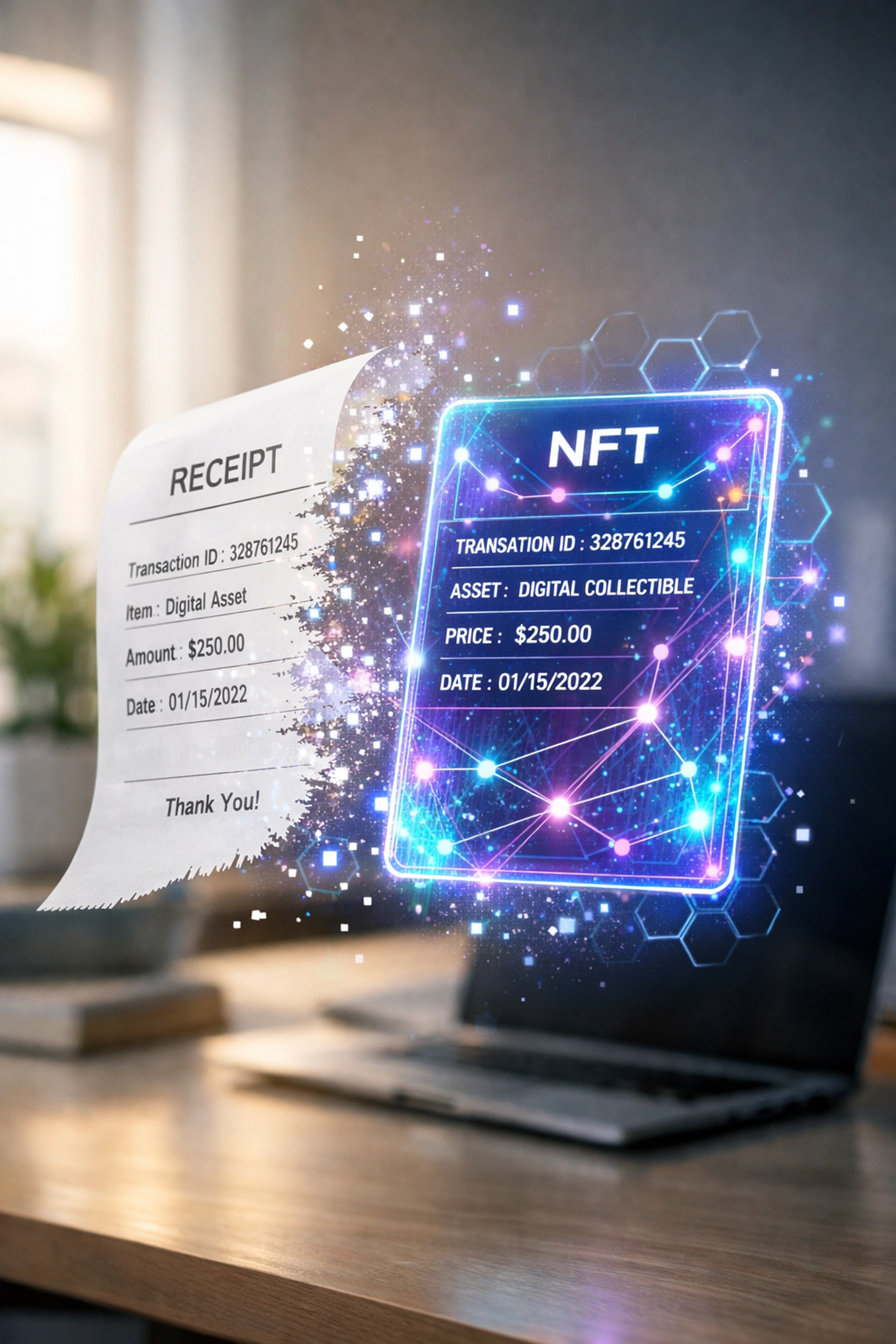
Every transaction generates an immutable, blockchain-verified receipt as an NFT. This means:
Permanent transaction records
Automatic compliance documentation
Built-in audit trails
Transferable proof of payment
Integration with Web3 accounting tools

For regulated businesses needing compliance documentation, this is game-changing.
Your accountant won't lose invoices. Your auditor can verify transactions on-chain. Your compliance officer has immutable records.
All automatic. All verifiable. All permanent.
LUSD: Stablecoin Stability Without the Centralization Risk
Most stablecoins have counterparty risk.
USDC? Circle controls it. USDT? Tether's transparency is... questionable.
LUSD is different. Decentralized. Over-collateralized. No centralized issuer that can freeze your funds.
For merchant payments, this matters:
Price stability for invoicing
No conversion fees between crypto and stable value
Decentralized custody
Regulatory clarity
When you accept payments in LUSD through Larecoin, you're not betting on Circle's banking relationships or Tether's reserves.
You're using math and smart contracts.
Self-Custody: Your Keys, Your Crypto, Your Compliance
Here's the dirty secret about most "compliant" crypto payment platforms:
They hold your funds in omnibus wallets.
Your crypto sits with everyone else's crypto. Commingled. Custodied. Controlled.
This creates regulatory complications. It creates counterparty risk. It creates exit problems.
Larecoin's architecture is built on self-custody principles.
You hold your keys. You control your funds. The platform facilitates transactions without taking custody.
This changes the regulatory equation. It reduces the compliance burden. It eliminates the exit risk.
And it aligns with Web3 principles: trustless, permissionless, self-sovereign.
The Larecoin Stack vs. Traditional Processors
Let's compare full-stack capabilities:
Feature | Larecoin | NOWPayments | CoinPayments |
MSB Registered | ✓ | ✓ | ✓ |
Multi-State MTL Strategy | ✓ | Partial | Partial |
Self-Custody | ✓ | ✗ | ✗ |
NFT Receipts | ✓ | ✗ | ✗ |
LUSD Integration | ✓ | ✗ | ✗ |
Gas-Only Option | ✓ | ✗ | ✗ |
Fee Transparency | Full | Limited | Limited |
The difference isn't subtle.
It's architectural.
Why This Matters in 2026
Regulatory enforcement is accelerating.
The SEC is cracking down. FinCEN is watching. State regulators are activating.
Platforms built on compliance shortcuts will face pressure. Banking partners will pull out. States will revoke licenses.
Businesses that built on shaky platforms will scramble.
Larecoin is building for the long game. Full compliance. Progressive licensing. Transparent operations.
This isn't about being conservative. It's about being sustainable.
The crypto payment revolution doesn't happen if platforms keep getting shut down for regulatory violations.
It happens when compliant, innovative platforms create lasting infrastructure.
Getting Started
Ready to explore US-compliant crypto payments that actually save you money?
Check out Larecoin's ecosystem and see how Web3 payments should work.
Self-custody. Fee transparency. NFT receipts. LUSD stability. Full compliance.
The future of crypto payments isn't about choosing between compliance and innovation.
It's about platforms smart enough to deliver both.
Welcome to Larecoin.
Comments