

.png)
Why Everyone Is Talking About Metaverse Shopping (And Your Business Should Too)
- [[[Free!!]<<<<]] Watch: 스포르팅 - 토트넘 Live Stream 13 September 2022
- 2 hours ago
- 4 min read
![Writer: [[[Free!!]<<<<]] Watch: 스포르팅 - 토트넘 Live Stream 13 September 2022](https://lh3.googleusercontent.com/a/AItbvmktwQc0wCdd3ZEETSYItRQubwwBzOyjD_dcigRf=s96-c)
The metaverse isn't coming. It's here.
And it's reshaping how consumers shop, interact, and spend.
By 2026, 25% of consumers will spend at least one hour daily in metaverse environments. Shopping. Socializing. Building.
The market? Currently valued at $155.35 billion. Projected to hit $7.17 trillion by 2035.
That's a 46.7% compound annual growth rate.
If your business isn't thinking about metaverse shopping, you're already behind.
What Is Metaverse Shopping, Exactly?
Virtual reality meets commerce.
Picture this: Your customer puts on a headset. Walks into your virtual storefront. Picks up products. Tries them on. Makes a purchase.
No shipping delays. No crowded aisles. No geographical limitations.
Metaverse shopping combines VR, AR, and blockchain technology to create immersive retail experiences. Customers navigate 3D stores. Interact with products. Complete transactions: all from their couch.
The benefits are stacking up:
Reduced returns: Virtual try-ons mean customers know what they're getting
Global reach: Sell to anyone, anywhere, instantly
New revenue streams: Virtual goods, NFTs, digital accessories
Community building: Customers shop together in shared spaces
Forever 21 already proved the model. Their metaverse storefront generated serious revenue. They even converted virtual products into physical bestsellers.
This isn't experimental anymore. It's ROI-driven.
The Payment Problem in Virtual Worlds
Here's the catch.
Traditional payment rails weren't built for this.
Credit card fees eat into margins. Cross-border transactions get complicated. Settlement times lag. Chargebacks happen.
And in the metaverse? These problems multiply.
Virtual goods need instant settlement. Global customers need frictionless payments. Merchants need proof of purchase that lives on-chain.
Enter crypto payments.
Specifically, crypto payments built for the metaverse.
How Larecoin Powers Metaverse Commerce
Larecoin wasn't built as an afterthought to Web3. It was designed from the ground up for this moment.
NFT Receipts
Every transaction generates a verifiable, on-chain receipt. No disputes. No "he said, she said." Just cryptographic proof of purchase that lives forever on the blockchain.
In the metaverse, where virtual goods need authentication, NFT receipts become essential. They prove ownership. They enable resale. They create trust.
LUSD Stablecoin
Volatility kills commerce. Nobody wants to pay 1 ETH for a virtual jacket and watch that ETH double in value the next day.
LUSD solves this. A stable, dollar-pegged token designed for everyday transactions. Price consistency. Predictable revenue. Happy merchants. Happy customers.
Gas-Only Transfers
Most crypto payment processors charge transaction fees on top of network fees. Double dipping.
Larecoin operates differently. Gas-only transfers mean you pay network costs: nothing more. No hidden percentages. No surprise deductions.
Self-Custody
Your funds. Your keys. Your control.
Unlike centralized processors that hold your crypto (and your risk), Larecoin's self-custody model means merchants maintain direct ownership. No third-party exposure. No frozen accounts. No waiting for withdrawals.
Comparing the Competition
Let's be direct about what's out there.
NOWPayments offers decent crypto acceptance. But their fee structure adds up. They charge transaction fees plus conversion fees. For high-volume merchants, that's significant margin erosion.
CoinPayments has been around since 2013. Longevity is great. But their technology shows its age. Limited metaverse integration. No NFT receipt functionality. Traditional custodial model.
Triple-A focuses on enterprise. Solid compliance. But their pricing structure and feature set target large corporations, leaving SMBs underserved.
Here's how Larecoin stacks up:
Feature | Larecoin | NOWPayments | CoinPayments | Triple-A |
NFT Receipts | ✅ | ❌ | ❌ | ❌ |
Native Stablecoin (LUSD) | ✅ | ❌ | ❌ | ❌ |
Gas-Only Transfers | ✅ | ❌ | ❌ | ❌ |
Self-Custody | ✅ | ❌ | ❌ | Partial |
Metaverse Integration | ✅ | Limited | ❌ | ❌ |
Federal MSB Registration | ✅ | Varies | Varies | ✅ |
The difference is architecture. Larecoin was built for where commerce is going: not where it's been.
Merchant Benefits That Actually Matter
Let's talk numbers.
Fee Savings Over 50%
Traditional interchange fees run 2-3% per transaction. Some premium cards hit 4%.
Crypto payments through Larecoin? Gas-only. On most networks, that's fractions of a cent.
For a merchant processing $100,000 monthly, traditional fees eat $2,000-$3,000. With Larecoin? Negligible.
That's not marginal improvement. That's business transformation.
Master/Sub-Wallets
Running multiple locations? Multiple brands? Multiple revenue streams?
Larecoin's master/sub-wallet structure lets you manage everything from one dashboard. Track individual store performance. Consolidate funds automatically. Maintain separate accounting.
Enterprise-grade infrastructure without enterprise-grade complexity.
QR-Generated Crypto POS
No expensive hardware. No complicated integrations.
Generate a QR code. Customer scans. Payment complete.
Works in physical stores. Works in virtual stores. Works everywhere.
The Future: Social Shopping in the Larecoin Metaverse
Here's where it gets interesting.
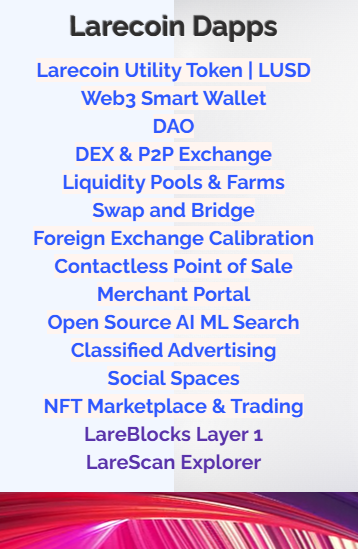
Larecoin is building a B2B2C metaverse designed specifically for commerce.
Imagine social shopping experiences where customers browse together. Try on virtual products. Get recommendations from AI assistants. Purchase seamlessly with LUSD.
VR/AR shopping isn't a gimmick. It's a conversion optimization tool.
Virtual try-ons reduce return rates by up to 40%
3D product visualization increases purchase confidence
Social shopping creates FOMO and drives impulse purchases
Gamification elements boost engagement and time-on-site
The brands establishing metaverse presence now will own the customer relationships of tomorrow.

Compliance and Trust: The Foundation
Innovation means nothing without legitimacy.
Larecoin maintains Federal MSB (Money Services Business) registration. This isn't optional paperwork: it's the foundation of legal crypto commerce in the United States.
Beyond federal compliance, Larecoin holds state-level MTL (Money Transmitter License) coverage across the U.S. This means merchants can accept payments with confidence, knowing their payment processor operates within regulatory frameworks.
Why MTL compliance matters:
Legal protection for merchants
Consumer confidence in transactions
Banking relationship stability
Reduced regulatory risk
Too many crypto payment processors operate in gray areas. Larecoin doesn't.
Getting Started
The metaverse shopping wave is building. The question isn't whether your business will adapt: it's when.
Early movers gain advantages:
Lower customer acquisition costs
Brand positioning as innovative
First access to metaverse-native customers
Time to build digital asset pipelines
The infrastructure exists. The compliance frameworks are established. The customer demand is growing.
Larecoin provides the payment rails.
Ready to explore crypto payments for your business?
Visit larecoin.com to learn more about merchant solutions, the upcoming metaverse platform, and how fee savings can transform your bottom line.
The future of commerce isn't waiting. Neither should you.
Comments