

.png)
Are Traditional Merchant Processors Dead? How Web3 Global Payments Are Rewriting the Rules
- [[[Free!!]<<<<]] Watch: 스포르팅 - 토트넘 Live Stream 13 September 2022
- 2 hours ago
- 5 min read
![Writer: [[[Free!!]<<<<]] Watch: 스포르팅 - 토트넘 Live Stream 13 September 2022](https://lh3.googleusercontent.com/a/AItbvmktwQc0wCdd3ZEETSYItRQubwwBzOyjD_dcigRf=s96-c)
Short answer: No.
Long answer: They're getting a serious wake-up call.
Traditional merchant processors aren't dying. They're evolving: or getting left behind. The question isn't whether Visa, Mastercard, and legacy payment gateways will disappear. It's whether they can adapt fast enough to stay relevant in a world where Web3 global payments are rewriting the entire playbook.
Let's break down what's really happening in 2026 and why merchants are questioning everything they thought they knew about payment processing.
The Old Rules Are Breaking Down
For decades, merchant processing meant one thing: card rails. Swipe, chip, tap. Visa. Mastercard. Interchange fees eating 2-3% of every transaction. Settlement delays of 2-5 days. Chargebacks. Fraud liability.
It worked because there was no alternative.
Now there is.
Stablecoins moved $6+ billion monthly in B2B payments by mid-2025. That's not experimental anymore. That's operational. Cross-border transfers that used to take days and cost 3-5% now happen in seconds for pennies in gas fees. Treasury teams at major enterprises are using stablecoins to move funds on-chain, then convert to local currencies through existing rails.
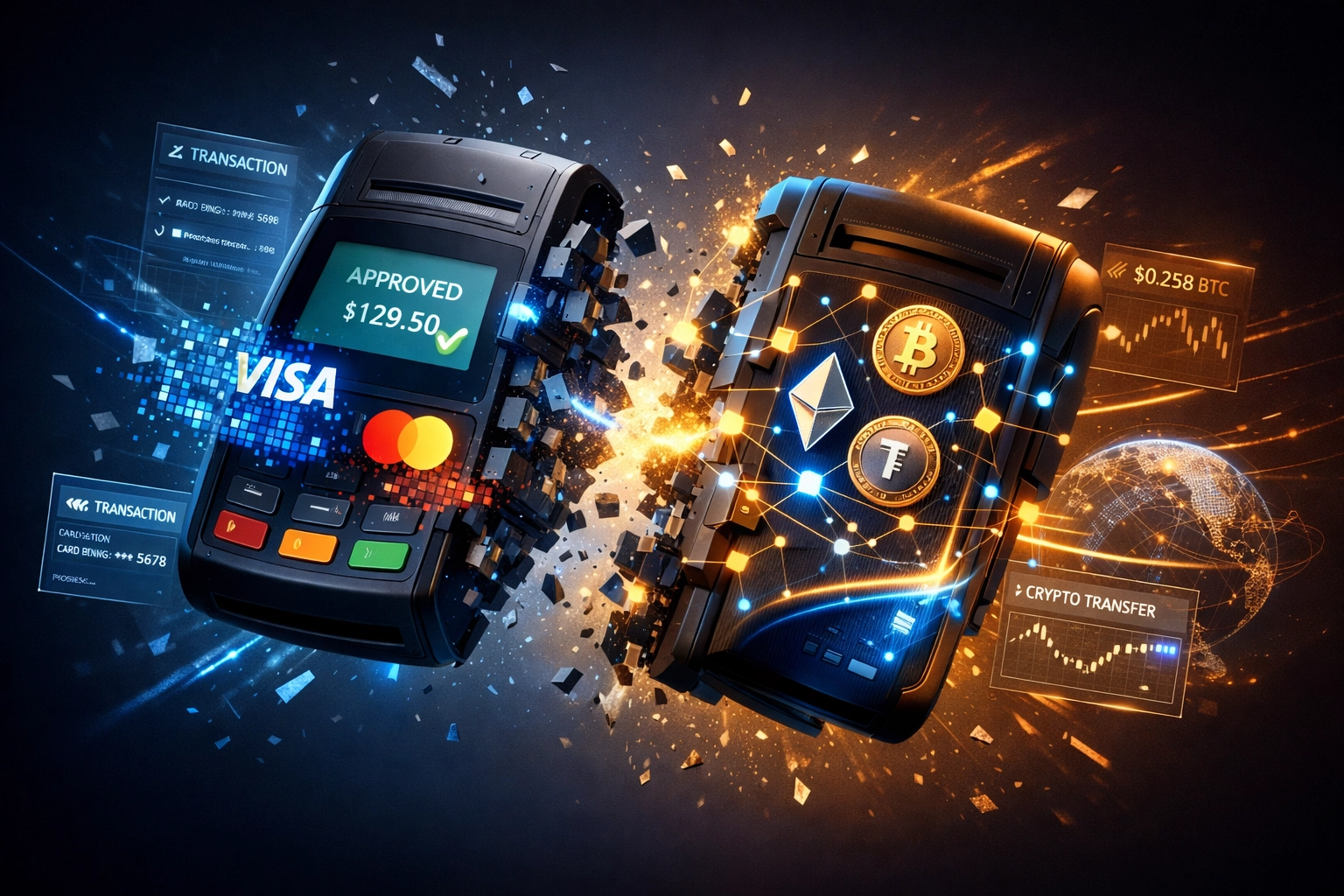
Cards aren't going away. But they're no longer the only game in town. And merchants know it.
The Rise of Payment Orchestration
Here's what changed: merchants got tired of being locked in.
Legacy processors want you on their single platform. Their gateway. Their settlement cycle. Their terms.
But smart merchants in 2026 are demanding orchestration: the ability to manage multiple payment methods, gateways, and processors through one unified dashboard. Need to route transactions through different channels based on approval rates? Done. Want to add stablecoins next to credit cards without rebuilding infrastructure? Easy.
The payment orchestration market is growing at over 20% annually. It's a $2 billion industry because merchants realized they don't need to be held hostage by any single processor.
They can build a multi-rail strategy. Cards. Bank transfers. Stablecoins. Web3 wallets. All in one place.
Web3 Isn't Replacing: It's Competing
Traditional processors made one critical mistake: they assumed Web3 was a novelty.
It's not.
Web3 global payments offer something legacy systems can't match:
Instant settlement (no 3-day holds)
50%+ lower fees (no interchange bloat)
Self-custody (no frozen accounts)
Global reach (no cross-border surcharges)
Transparency (every transaction on-chain)
Platforms like Larecoin aren't trying to kill Visa. They're giving merchants a choice. And that choice is getting more attractive every quarter.
Take LUSD stablecoin benefits. A merchant using LUSD through Larecoin can accept payments globally, settle in seconds, and avoid the currency conversion fees that traditionally eat 2-4% on international transactions. No intermediaries. No delays. Just peer-to-peer value transfer.

Add in NFT receipts for accounting, and suddenly merchants have immutable, timestamped proof of every transaction: perfect for compliance, chargebacks, and audits. Try getting that from a traditional processor.
The Real Transformation: Control
Here's the shift no one talks about: merchants are taking control back.
Legacy processors built empires on gatekeeping. You want to accept payments? You follow their rules. Their KYC. Their compliance frameworks. Their settlement schedules. Their fee structures.
Web3 flips that model.
With self-custody merchant accounts, businesses control their own funds. No payment processor can freeze your account because they don't like your industry. No intermediary can hold your revenue hostage for "risk assessment."
This isn't theoretical. Merchants in high-risk industries: CBD, nutraceuticals, digital goods: have been getting deplatformed for years. Web3 gives them an alternative.
Larecoin's approach? Bank-free business operations. Accept payments directly. Hold funds in your own wallet. Convert to fiat when you need it. Or don't. Your business, your rules.
The Fee Revolution
Let's talk numbers.
Traditional merchant processing:
2.9% + $0.30 per card transaction
3-5% for international payments
1-2% for currency conversion
Chargeback fees: $15-$100 per dispute
Web3 global payments through Larecoin:
0.5-1% transaction fee
Seconds for global settlement
No currency conversion fees (accept LUSD or LARE directly)
NFT receipts eliminate most chargeback fraud
Do the math. A merchant processing $100k/month saves $2,000-$3,000 monthly by switching to Web3 rails. That's $24k-$36k annually. For doing nothing except accepting payments smarter.
Small businesses operating on thin margins? That's the difference between survival and growth.

The Alternatives Are Here
Merchants don't need to guess about Web3 anymore. Platforms like NOWPayments and CoinPayments proved crypto payments work at scale. But they focused on crypto-native audiences.
Larecoin built something different: a Web3 global payments system for everyone.
Not just crypto enthusiasts. Not just blockchain developers. Every merchant who's tired of overpaying legacy processors.
The platform includes:
Receivables token for instant liquidity
Crypto POS system for small business (tap, pay, done)
Multi-chain support (Solana, Binance, Ethereum)
Fiat off-ramps for merchants who need local currency
Self-custody without sacrificing usability
It's not a NOWPayments alternative. It's not a CoinPayments alternative. It's a fundamental rethinking of how global payments should work in 2026.
What Traditional Processors Are Doing (And Why It's Not Enough)
Credit where it's due: legacy processors see the threat.
They're launching "crypto services." Partnering with stablecoin issuers. Talking about blockchain integration.
But here's the problem: they're trying to bolt Web3 onto legacy infrastructure.
You can't slap blockchain onto Visa's rails and call it innovation. The whole point of Web3 is disintermediation. Removing the middleman. Giving merchants direct control.
Traditional processors will never offer that because it destroys their business model. They make money from intermediation. From settlement delays. From fees and gatekeeping.
Web3 makes all that obsolete.
The Hybrid Future
Here's the reality: most merchants in 2026 aren't going full Web3. Yet.
They're running hybrid payment stacks. Cards for mainstream customers. Web3 for tech-savvy buyers. Bank transfers for bulk orders. Orchestration platforms managing it all.
That's fine. That's smart.
But the trend line is clear: Web3 adoption is accelerating. Stablecoin volumes are growing. Merchants are experimenting. And once they see the fee savings and settlement speed, they're not going back.
Traditional processors aren't dead. But they're being forced to compete on value instead of monopoly. And that changes everything.
Why This Matters Right Now
The window is open.
The Crypto Clarity Act is moving through Congress. Regulatory frameworks are solidifying. Stablecoins are being legitimized. Enterprises are building treasury strategies around digital assets.
Merchants who adapt now get first-mover advantage. Lower fees. Better margins. Competitive differentiation.
Merchants who wait? They keep paying 3% to Visa while their competitors operate at 0.5%.
Your call.
The Larecoin Advantage
Larecoin isn't asking merchants to abandon cards. We're giving them options.
Accept LARE. Accept LUSD. Accept stablecoins from any chain. Convert to fiat instantly through our off-ramps. Or hold crypto and use it for B2B payments, treasury management, or DeFi yield.
Your funds. Your control. Your timeline.
We built Web3 global payments that work for businesses: not just crypto traders. Self-custody without complexity. Fee savings without sacrifice. Global reach without gatekeepers.
Traditional merchant processors aren't dead. But they're no longer the only option. And in 2026, having options is everything.
Ready to reduce merchant interchange fees by 50%+? The future of payments is already here. The question is whether you're coming along for the ride.
Comments