

.png)
Are Traditional Payment Processors Dead? Here's Why Web3 Global Payments Are Taking Over in 2026
![Writer: [[[Free!!]<<<<]] Watch: 스포르팅 - 토트넘 Live Stream 13 September 2022](https://lh3.googleusercontent.com/a/AItbvmktwQc0wCdd3ZEETSYItRQubwwBzOyjD_dcigRf=s96-c)
Let's cut through the noise.
Traditional payment processors aren't technically dead. But they're on life support, and they know it.
Stripe just dropped $1.1 billion on Bridge in February 2025. Visa's scrambling to settle payments with PYUSD. Mastercard's Multi-Token Network hit $2 billion in annualized volume from crypto cards alone.
These aren't expansion moves. They're survival plays.
The legacy payment infrastructure built in the 1970s is getting absolutely demolished by Web3 global payments. And if you're still paying 3% per transaction in 2026, you're basically burning cash.
The Real Cost of "Traditional"
Here's the math that keeps payment processors up at night.
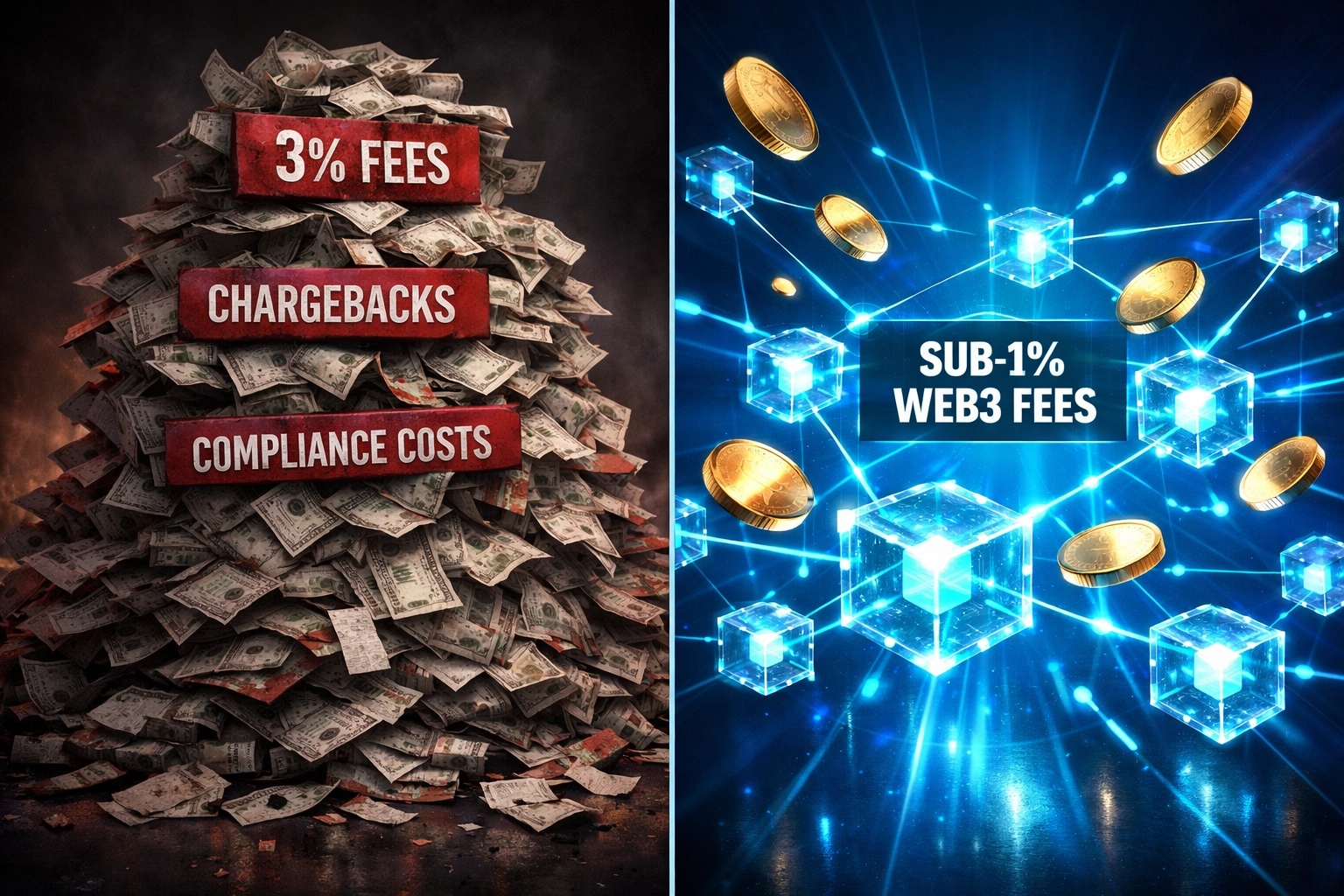
Process $500,000 monthly through traditional credit card rails? You're paying roughly $14,500 in fees. Every single month.
That's 2.5-3.5% per transaction plus flat fees. Plus chargeback fees. Plus PCI compliance costs. Plus foreign exchange markups. Plus cross-border transaction fees.
It's death by a thousand cuts.
Web3 global payments? Sub-1% costs with instant settlement. Same volume costs around $100 in gas fees.
The difference isn't marginal. It's existential.
Speed Isn't a Feature, It's the Entire Point
Traditional processors take 3-5 business days to settle payments. Business days. In 2026.
Your money sits in limbo while banks process batches. Your working capital gets frozen. Your cash flow suffers.
Web3 payments settle in seconds. Not minutes. Seconds.
24/7/365 operation. No banking hours. No maintenance windows. No "the ACH network is closed for the weekend."
Cross-border payments? Forget SWIFT. Forget correspondent banks. Forget paying three intermediaries to move money from Point A to Point B.
Instant transfers in stablecoins like LUSD. Zero friction. Zero delays.
Self-Custody Changes Everything
Here's what traditional processors don't want you to know.
You don't actually control your money in their system. They do.
They hold your funds. They process your transactions. They decide when you can access your capital. They freeze accounts based on opaque risk models.
You're renting access to your own money.
Web3 flips this entirely.
Self-custody merchant accounts mean you control your funds. Smart contracts execute automatically. Payments settle on-chain. Complete financial sovereignty.
No intermediaries. No gatekeepers. No "sorry, your account is under review."
Your business. Your money. Your control.

The Competitor Landscape Is Shifting Fast
Let's talk about the alternatives that actually matter.
NOWPayments offers crypto payment processing but still operates on traditional custody models. You're trading one intermediary for another. Fees hover around 0.5-1.5%. Better than credit cards, but you're still giving up control.
CoinPayments has been around since 2013. Legacy crypto processor. Clunky interface. High fees for withdrawals. Security incidents in their history. They're basically trying to be PayPal for crypto, which defeats the entire purpose.
Triple-A focuses on B2B payments. Enterprise-only. Minimum contracts. They want to be your crypto payment provider, not empower you to control your own infrastructure.
None of them offer true financial sovereignty.
Larecoin does.
Technical Benefits That Actually Matter
NFT receipts for accounting aren't a gimmick. They're revolutionary.
Every transaction mints an immutable, time-stamped record. Complete transaction metadata. Automated bookkeeping. Zero manual reconciliation.
Your accountant will actually thank you.
LUSD stablecoin benefits eliminate volatility concerns. Accept crypto. Receive stable value. No exposure to Bitcoin's price swings. All the efficiency of blockchain with none of the speculation.
The receivable token model transforms how businesses manage cash flow. Tokenize invoices. Create liquid receivables. Access working capital instantly without traditional factoring costs.
It's not just payments. It's an entire financial operating system.
Merchant Growth Isn't About Adoption, It's About Survival
Slash interchange fees by 50%+ minimum. That's not a selling point. That's table stakes.
Small businesses getting crushed by payment processing fees now have options. A crypto POS system for small business that actually works. No enterprise minimums. No complex onboarding.
Global reach without global banking infrastructure. Serve customers in 180+ countries. Accept payments in any currency. Settle in stablecoins.
Traditional processors charge 3-5% for international transactions. Web3 global payments charge gas fees, pennies per transaction regardless of geography.
The math is so obvious it hurts.
Financial Sovereignty Is the End Game
Bank-free business operations sound radical until you actually think about it.
Why do you need a bank account to operate? Because payment processors require it. They need somewhere to deposit your money (that they're holding).
Web3 eliminates this dependency entirely.
Smart contracts replace escrow. Blockchain replaces settlement infrastructure. Self-custody replaces correspondent banking.
You're not anti-bank. You're just not dependent on them anymore.
That's freedom.

What 2026 Actually Looks Like
Traditional processors aren't disappearing overnight. They're becoming crypto payment facilitators: bolting blockchain capabilities onto 1970s infrastructure.
Stripe's acquisition of Bridge. Visa's PYUSD integration. PayPal's stablecoin push.
These are defensive moves. They're trying to protect terminal business models.
But here's the reality: you can't compete with fundamentally superior infrastructure by adding a blockchain API.
The dominant approach emerging is accepting crypto while avoiding direct exposure. Businesses want Web3 efficiency benefits without holding volatile assets.
That's exactly what LUSD stablecoin integration provides.
The cost, speed, and control advantages of native Web3 infrastructure fundamentally undermine traditional payment processors' value proposition.
They built empires on information asymmetry and technological moats. Both are collapsing.
The Transition Is Already Happening
Merchants are waking up to the math.
Process payments at sub-1% costs. Settle instantly. Maintain complete financial control. Accept customers globally without forex nightmares.
Or pay 3% to intermediaries using infrastructure from the Nixon administration.
The choice isn't difficult. It's just different.

Traditional payment processors built incredible businesses. They solved real problems. They enabled global commerce.
But their time is ending.
Not because they're bad. Because something fundamentally better exists.
Web3 global payments aren't the future. They're the present.
The question isn't whether to adopt them. It's whether you can afford not to.
Want to reduce merchant interchange fees by 50%+ while gaining complete financial sovereignty? Want NFT receipts for accounting that actually make your life easier?
Check out Larecoin and see what Web3 payments actually look like in 2026.
The revolution is here. Traditional processors are just the last to realize it.
Comments