

.png)
How to Reduce Merchant Interchange Fees by 50%+ Using Web3 Global Payments
- [[[Free!!]<<<<]] Watch: 스포르팅 - 토트넘 Live Stream 13 September 2022
- 2 days ago
- 4 min read
![Writer: [[[Free!!]<<<<]] Watch: 스포르팅 - 토트넘 Live Stream 13 September 2022](https://lh3.googleusercontent.com/a/AItbvmktwQc0wCdd3ZEETSYItRQubwwBzOyjD_dcigRf=s96-c)
Interchange fees are killing your margins.
Every swipe. Every tap. Every online checkout. The traditional payment networks take their cut: 2.5%, 3%, sometimes 4%+ on international transactions.
For a business doing $500K annually, that's $15,000 to $20,000 vanishing into the pockets of card networks, issuing banks, and payment processors.
Here's the thing: Web3 global payments can slash those fees by 50% or more.
Not someday. Not theoretically. Right now.
Let's break down exactly how it works.
The Hidden Tax on Every Transaction
Traditional payment processing is a relay race of intermediaries.
Your customer pays. The acquiring bank takes a cut. The card network (Visa, Mastercard) takes a cut. The issuing bank takes a cut. Foreign exchange fees stack on top for international sales.
The result? Cross-border card payments often hit 4-6% in combined fees. Settlement takes 3-5 business days. Chargebacks create chaos.
And you're locked into their system with zero alternatives.
Until now.
How Web3 Payments Eliminate the Middlemen
Blockchain-based payments flip the script entirely.
No correspondent banks. No card networks. No 72-hour settlement windows.
Direct peer-to-peer transactions. Funds move from customer wallet to merchant wallet. Smart contracts handle the heavy lifting: compliance checks, currency conversions, instant settlement.
The fee savings are dramatic:
Traditional cross-border payment: 4-6%
Crypto/stablecoin payment: Under 1%
That's not a minor optimization. That's a fundamental restructuring of payment economics.
Some Web3 payment solutions report fee reductions up to 80% compared to traditional card processing. Even conservative implementations deliver 50%+ savings.
Why Stablecoins Are the Secret Weapon
Volatility concerns keep many merchants away from crypto payments.
Fair point. Nobody wants to accept payment in a token that drops 15% overnight.
Enter stablecoins.
Stablecoins like LUSD (Larecoin's native stablecoin) are pegged to fiat currencies. Price stability of the dollar. Speed and cost efficiency of blockchain rails.
Benefits for merchants:
Zero FX exposure on international sales
Instant settlement (not 3-5 business days)
Sub-1% transaction fees
No chargebacks (blockchain transactions are final)
Major platforms are already building stablecoin rails into existing merchant infrastructure. You don't need a "crypto strategy." You need better payment rails.

Larecoin's Merchant-First Approach
Most crypto payment processors bolt Web3 onto legacy systems.
Larecoin built from scratch for merchant economics.
Here's what sets it apart:
LUSD Stablecoin Settlement
Accept payments in any supported crypto. Settle instantly in LUSD. No volatility. No conversion delays. Your accounting stays clean.
Self-Custody Merchant Accounts
Your funds. Your keys. Your control.
Traditional processors hold your money for days or weeks. Larecoin's self-custody architecture means funds hit your wallet immediately. No waiting. No third-party risk.
NFT Receipts for Accounting
Every transaction generates an immutable NFT receipt. Audit-ready documentation baked into the blockchain. No more reconciliation nightmares.
Receivables Token
Tokenize outstanding invoices. Improve cash flow. Access liquidity without traditional factoring fees.
Gas-Only Transfers
Move funds between wallets paying only network gas fees. No percentage-based charges eating into every transaction.
The Competitor Landscape: How Larecoin Stacks Up
Web3 payment processors aren't new. But most come with significant trade-offs.
NOWPayments
Solid option for basic crypto acceptance. Supports 100+ cryptocurrencies.
The catch: Custody model means your funds sit in their system. Limited stablecoin options. No NFT receipt infrastructure. Fee structure gets complex at scale.
CoinPayments
One of the oldest players. Massive coin support.
The catch: Aging infrastructure. Settlement delays on certain chains. No native stablecoin solution. Self-custody requires manual configuration.
Triple-A
Enterprise-focused. Strong compliance framework.
The catch: Premium pricing. Complex integration requirements. Less flexibility for small-to-mid-size merchants.
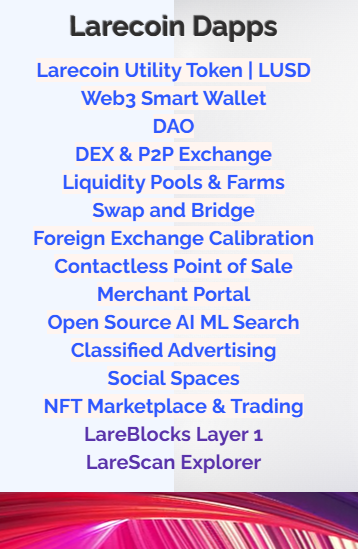
Larecoin Advantage
Native stablecoin (LUSD) built for merchant settlement
True self-custody from day one
NFT receipts for bulletproof accounting
Receivables tokenization for cash flow optimization
Crypto POS system for in-store, online, and metaverse commerce
Not a retrofit. Purpose-built Web3 payment infrastructure.
Real Math: What 50%+ Fee Reduction Looks Like
Let's run the numbers.
Scenario: E-commerce business processing $1M annually
Cost Category | Traditional Processing | Larecoin Web3 Payments |
Domestic transaction fees | $25,000 (2.5%) | $8,000 (0.8%) |
International transaction fees | $12,000 (4% on $300K) | $2,400 (0.8%) |
Chargeback losses | $5,000 | $0 |
FX conversion fees | $3,000 | $0 |
Total Annual Cost | $45,000 | $10,400 |
Annual savings: $34,600
That's not theoretical. That's the power of eliminating intermediaries.

Implementation: Easier Than You Think
Switching to Web3 payments used to require blockchain expertise.
Not anymore.
Here's the fast track:
Set up your Larecoin merchant wallet : Self-custody from the start
Configure LUSD settlement : Automatic conversion from supported cryptos
Integrate the crypto POS system : Works in-store, online, and metaverse environments
Enable NFT receipts : Automatic transaction documentation
Go live : Start accepting payments immediately
No lengthy bank applications. No underwriting delays. No merchant account reserves.
Global reach from day one. Accept payments from customers in 150+ countries without the traditional cross-border fee stack.
The Bank-Free Business Model
Here's the bigger picture.
Interchange fee reduction is just the entry point.
Web3 payments enable complete financial sovereignty for merchants:
No bank account required to accept global payments
No payment processor approval gatekeeping your business
No fund holds during "risk reviews"
No geographic restrictions on customer base
No currency conversion delays on international revenue
You control the stack. You keep the margin. You scale without permission.
Traditional finance treats merchants as risks to be managed.
Larecoin treats merchants as businesses to be empowered.
The Bottom Line
Interchange fees are a legacy tax from a pre-blockchain era.
Web3 global payments offer a clear path to 50%+ fee reduction: without sacrificing settlement speed, security, or accounting clarity.
The infrastructure exists. The stablecoin rails are built. The integration is straightforward.
The only question: How long will you keep paying the old toll?
Ready to slash your payment processing costs?
Explore Larecoin's merchant solutions at larecoin.com and see what bank-free business operations look like.
Comments