

.png)
How to Reduce Merchant Interchange Fees by 50%+ with a Crypto POS System (Easy Guide for Small Business)
- [[[Free!!]<<<<]] Watch: 스포르팅 - 토트넘 Live Stream 13 September 2022
- Jan 30
- 4 min read
![Writer: [[[Free!!]<<<<]] Watch: 스포르팅 - 토트넘 Live Stream 13 September 2022](https://lh3.googleusercontent.com/a/AItbvmktwQc0wCdd3ZEETSYItRQubwwBzOyjD_dcigRf=s96-c)
Interchange fees are quietly destroying your margins.
Every swipe. Every tap. Every online checkout. You're hemorrhaging 2-4% to card networks, acquiring banks, and payment processors who do nothing but move numbers around.
For a small business processing $500,000 annually? That's $12,500 gone. Vanished. Into the pockets of Visa, Mastercard, and a maze of middlemen.
Here's the thing: there's a better way. Crypto POS systems can slash those fees by 50% or more. And no, you don't need a computer science degree to make it happen.
Let's break it down.
The Interchange Fee Problem (It's Worse Than You Think)
Traditional payment processing is a fee sandwich. And you're the one getting eaten.
Here's what you're actually paying:
Interchange fees: 1.5-3.5%
Assessment fees: 0.13-0.15%
Processor markups: 0.2-0.5%
Stack those up. Every single transaction.
That "convenient" card payment? It's costing you real money. Money that should be going toward inventory, marketing, or: crazy idea: profit.
Cross-border payments? Even worse. Traditional rails charge 4-6% for international transactions. The SWIFT network wasn't built for the 21st century. And you're paying for that inefficiency.
How Crypto POS Systems Eliminate the Fee Trap
Blockchain technology cuts out the middlemen. Completely.
No card networks. No correspondent banks. No acquiring bank markups. Just direct, peer-to-peer transactions settling in minutes: not days.
The result? Transaction costs below 1%.
That same $500,000 in annual volume? Instead of $12,500 in fees, you're looking at roughly $3,750-$4,500. That's $8,000+ back in your pocket every single year.
For cross-border payments, the savings get even more dramatic. We're talking 75%+ reductions compared to traditional international payment rails.
Step-by-Step: Setting Up a Crypto POS System
Ready to stop the fee bleed? Here's your roadmap.
Step 1: Choose a Stablecoin Settlement Currency
Volatility kills businesses. Nobody wants to accept a payment worth $100 today and $80 tomorrow.
This is where stablecoins like LUSD come in. They maintain predictable value while delivering all the cost benefits of blockchain rails. Your accounting stays clean. Your margins stay protected.
Forget Bitcoin for everyday transactions. Stablecoins are the answer for real-world commerce.
Step 2: Select Your Crypto Payment Processor
Not all processors are created equal.
NOWPayments offers basic crypto acceptance with automatic conversion options. Decent for beginners. Limited compliance infrastructure.
CoinPayments has been around since 2013. Wide token support. But their fee structure can get complicated, and self-custody options are limited.
Larecoin? Built differently.
Full MSB registration. Active state Money Transmitter License strategy. Rigorous US compliance that actually matters when you're scaling a real business. Plus: true self-custody options so you control your funds. Always.
Step 3: Integrate With Your Existing Infrastructure
Good news: you don't need to rip out your current setup.
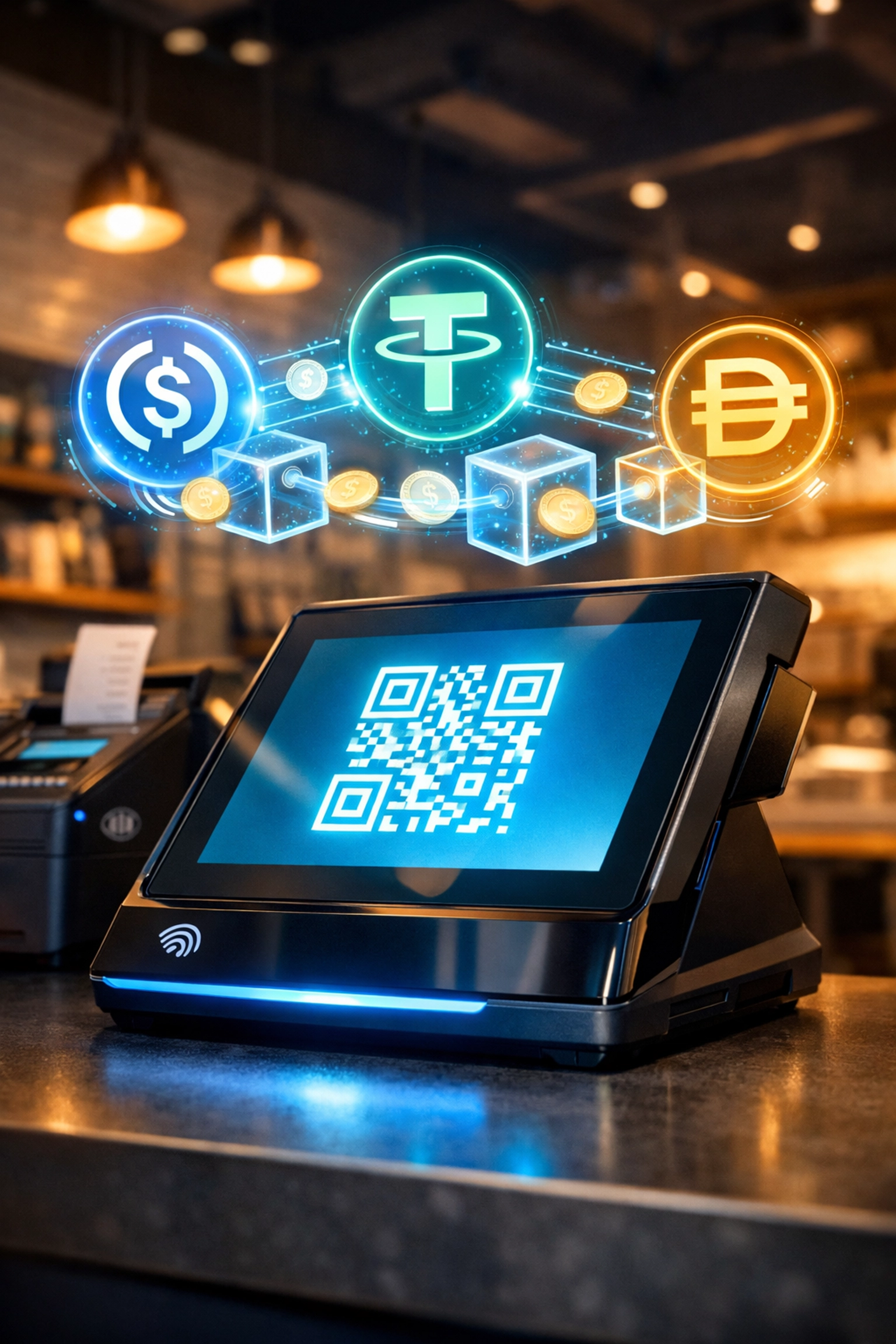
Modern crypto POS systems work alongside what you already have. QR code payments. Contactless tap. Online checkout widgets. Everything integrates seamlessly.
Larecoin's merchant solutions are designed for exactly this. Plug in. Start accepting. Keep your existing workflows intact.
Step 4: Activate Smart Contract Automation
Here's where it gets interesting.
Smart contracts handle compliance checks and currency conversions in real-time. No manual reconciliation. No waiting 3-5 business days for settlement. Transactions finalize in minutes.
Those delayed settlement fees traditional processors charge? Gone.
Step 5: Enable NFT Receipt Generation
Tax season just got easier.
Automatic NFT receipts create immutable transaction records on-chain. Every sale. Every refund. Permanently timestamped and verifiable.
Your accountant will thank you. The IRS can't argue with blockchain-verified records.
Larecoin vs. The Competition: Why We're Different
Let's get specific.
NOWPayments
Good for basic crypto acceptance. But:
Limited compliance documentation
No self-custody options
Focused primarily on conversion to fiat
CoinPayments
Wide token support. However:
Complex fee tiers
Custody concerns
Dated infrastructure
Larecoin
Built for the Web3 era:
Full MSB Registration: Legally compliant from day one
State MTL Strategy: Proactive licensing across US jurisdictions
LUSD Stablecoin: Predictable value, minimal volatility exposure
True Self-Custody: Your keys. Your funds. Period.
NFT Receipts: Immutable proof of every transaction
Smart Wallet Integration: Seamless connection to the broader DeFi ecosystem
This isn't just another payment processor. It's infrastructure for the future of commerce.
Real Numbers: What You'll Actually Save
Let's do the math.
Business A: $250,000 Annual Volume
Traditional processing (2.5%): $6,250
Larecoin crypto POS (<1%): ~$2,250
Annual savings: $4,000
Business B: $500,000 Annual Volume
Traditional processing (2.5%): $12,500
Larecoin crypto POS (<1%): ~$4,500
Annual savings: $8,000
Business C: $1,000,000 Annual Volume
Traditional processing (2.5%): $25,000
Larecoin crypto POS (<1%): ~$9,000
Annual savings: $16,000
Scale matters. The bigger you grow, the more you save.
Cross-border merchants? Multiply those savings. Traditional international fees of 4-6% drop to under 1%. That's transformational for import/export businesses, e-commerce brands shipping globally, or service providers with international clients.

The Compliance Advantage
Here's what most crypto payment articles won't tell you: compliance matters. A lot.
Operating in the US without proper licensing? That's a regulatory time bomb. Many crypto processors operate in gray areas. When regulators come knocking, you're exposed.
Larecoin takes a different approach.
We're registered as a Money Services Business (MSB) at the federal level. Our state Money Transmitter License strategy ensures we're building proper rails: not shortcuts.
What does that mean for you? Peace of mind. You're working with a compliant partner that takes regulatory requirements seriously. No surprises down the road.
Self-Custody: Why It Matters
"Not your keys, not your coins."
It's not just a meme. It's a business principle.
Traditional payment processors hold your money. They control when you access it. They set the rules.
Larecoin's self-custody approach puts you in control. Your funds settle directly to wallets you own. No intermediary holding periods. No arbitrary account freezes.
This is what Web3 commerce actually looks like.
Getting Started Today
Ready to cut your interchange fees in half (or more)?
Step 1: Visit the Larecoin merchant portal
Step 2: Set up your merchant wallet
Step 3: Integrate the payment widget with your existing checkout
Step 4: Start accepting crypto payments immediately
The setup takes minutes. The savings last forever.
The Bottom Line
Interchange fees are a tax on doing business. You've been paying it because there wasn't a better option.
Now there is.
Crypto POS systems deliver 50%+ fee reductions. Faster settlement. Better record-keeping through NFT receipts. And with Larecoin, you get all of that with proper US compliance and true self-custody.
Stop feeding the fee machine. Start keeping more of what you earn.
Your margins will thank you.
Questions? Join the Larecoin community discussion or explore our blog for more guides on Web3 payments.
Comments