

.png)
How to Slash Merchant Interchange Fees by 50%+ in 2026 (Web3 Global Payments Guide)
- [[[Free!!]<<<<]] Watch: 스포르팅 - 토트넘 Live Stream 13 September 2022
- 2 hours ago
- 4 min read
![Writer: [[[Free!!]<<<<]] Watch: 스포르팅 - 토트넘 Live Stream 13 September 2022](https://lh3.googleusercontent.com/a/AItbvmktwQc0wCdd3ZEETSYItRQubwwBzOyjD_dcigRf=s96-c)
Merchant interchange fees are bleeding businesses dry in 2026.
Traditional card networks charge 2-3.5% per transaction. Every swipe. Every sale. Every customer.
Web3 self-custody payments flip this model completely. Blockchain settlement replaces percentage-based fees with flat network costs measured in cents: not percentages.
Here's how to cut your payment processing costs by 50-95% this year.
The Traditional Interchange Fee Problem
Credit and debit card processing operates through multiple intermediaries:
Card networks (Visa, Mastercard)
Issuing banks
Acquiring banks
Payment processors
Gateway providers
Each layer extracts a percentage. The total hit ranges from 1.5% to 3.5% depending on card type, transaction size, and merchant category.
Real merchant costs:
A small business processing $10,000 monthly pays $250-350 in fees. That's $3,000-4,200 annually: pure overhead.
Medium merchants processing $100,000 monthly lose $2,500-3,500 per month. Over $30,000-42,000 yearly to payment processors.
Large enterprises moving $1M+ annually face five-figure processing bills just to accept customer payments.

The Web3 Self-Custody Alternative
Blockchain-based payment settlement eliminates the intermediary stack entirely.
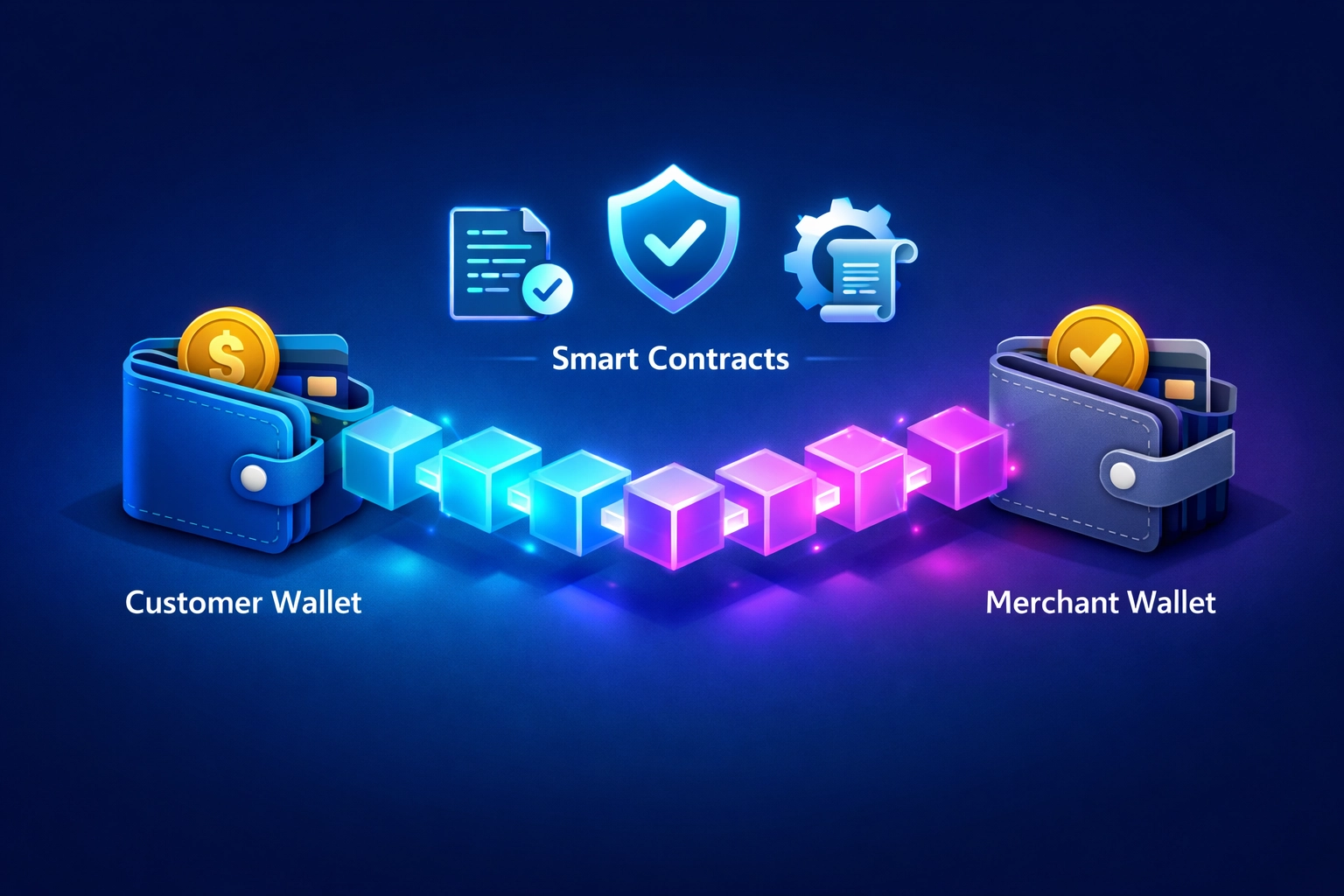
Smart contracts automate transaction verification. Network validators replace acquiring banks. Settlement happens on-chain in seconds: not days.
The cost structure shifts dramatically:
Instead of percentage-based fees, merchants pay only network gas fees. These fees are fixed or minimal regardless of transaction size.
Larecoin operates on Solana: one of the fastest, cheapest blockchain networks available. Transaction costs average fractions of a cent per payment.
Zero platform fees. Zero percentage cuts. Just network costs.
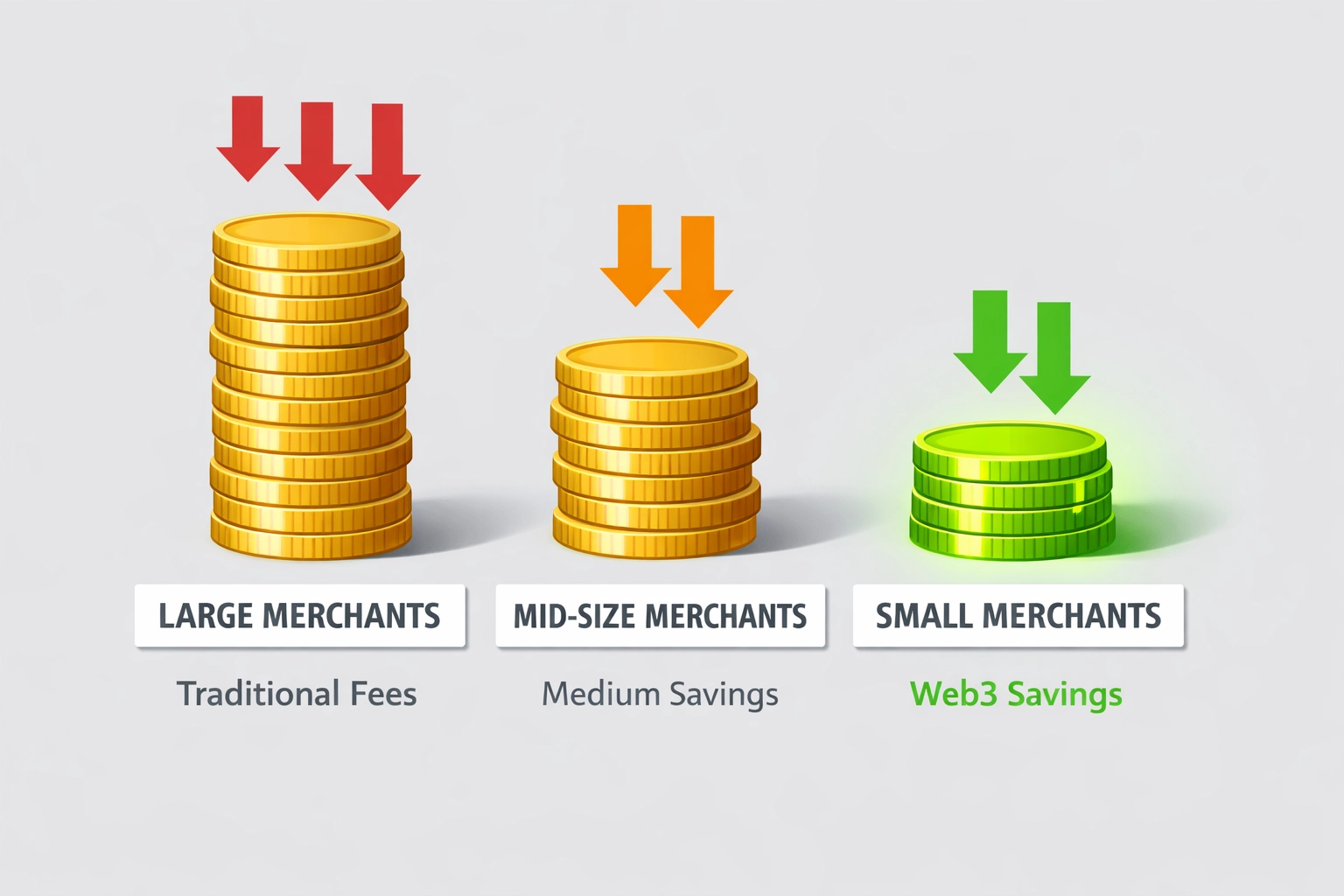
Real Savings: The Numbers
Let's calculate actual fee reductions for merchants switching to Web3 payments in 2026.
Small Merchant ($10,000 monthly volume):
Traditional processing: $250-350/month
Larecoin Web3 payments: $25-75/month
Annual savings: $2,100-3,900 (70-90% reduction)
Medium Merchant ($100,000 monthly volume):
Traditional processing: $2,500-3,500/month
Larecoin Web3 payments: $150-400/month
Annual savings: $25,200-40,200 (85-95% reduction)
Large Merchant ($1M+ annual volume):
Traditional processing: $20,000-35,000/year
Larecoin Web3 payments: $5,000-10,000/year
Annual savings: $15,000-30,000 (67-83% reduction)
These aren't theoretical projections. These are the actual economics of blockchain-based settlement versus traditional card processing.
How Larecoin Beats the Competition
NOWPayments and CoinPayments both offer crypto payment acceptance: but they're still charging merchant fees.
NOWPayments: 0.5% per transaction plus network fees. Better than Visa, sure. But still percentage-based extraction.
CoinPayments: 0.5% processing fee. Same model. Same problem.
Larecoin: Zero platform fees. Only network costs (fractions of a cent on Solana).
The difference compounds quickly. On $100,000 monthly volume:
NOWPayments: $500/month in platform fees + network costs
CoinPayments: $500/month in platform fees + network costs
Larecoin: $0/month in platform fees, only Solana gas (~$150-400)
Larecoin saves merchants an additional $3,600-6,000 annually compared to crypto-native competitors.
Why the difference?
Larecoin operates as a true Web3 receivables ecosystem: not a payment processor. No middleman fees. No percentage cuts. Direct wallet-to-wallet settlement through smart contracts.
Self-custody means merchants control their funds immediately. No chargebacks. No holds. No processor risk.
Traditional Optimization (If You're Not Ready for Web3)
Some merchants aren't ready to jump fully into crypto payments yet. Fair.
You can still reduce traditional interchange costs through tactical optimizations:
Authorization data optimization:
Include AVS (Address Verification System) for all ecommerce transactions
Require CVV verification
Settle transactions same-day to avoid downgrades
Don't retry failed cards repeatedly: it triggers higher interchange categories
Card mix management:
Prioritize regulated debit cards (lower interchange than credit)
Avoid card-not-present downgrades through proper transaction coding
Use Level 2/Level 3 processing for B2B transactions
Network programs:
Implement tokenization for recurring payments
Use 3-D Secure authentication for better rates
Enroll in regional small-business programs (like Canada's ~0.95% average credit interchange)
These tactics can shave 0.2-0.5% off your effective rate. Better than nothing.
But they'll never match Web3 self-custody economics.

2026 Regulatory Landscape
Two major regulatory shifts could impact payment costs this year:
United States Debit Cap Reduction:
The Federal Reserve proposed lowering the regulated debit interchange cap from $0.21 + 5 bps to $0.144 + 4 bps.
If finalized, this reduces debit costs for qualifying merchants. Budget conservatively: implementation dates remain uncertain.
UK-EU Cross-Border Alignment:
Payment Services Regulation (PSR) caps on cross-border ecommerce may create routing benefits between UK and EU transactions.
Marginal savings, but helpful for international merchants.
Neither regulatory change approaches the cost reduction available through Web3 self-custody payments.
The Larecoin Implementation Path
Switching to Larecoin payments is straightforward:
Step 1: Set up a Solana wallet (Phantom, Solflare, or similar)
Step 2: Create your merchant receivables account at larecoin.com
Step 3: Generate payment links or integrate checkout via API
Step 4: Accept LARE tokens, LUSD stablecoin, or other Solana assets
Step 5: Settle instantly to your wallet: no holds, no delays
Settlement happens in seconds. Funds are immediately available. Merchants maintain full custody throughout.
Optional enhancements:
NFT receipt generation for customer loyalty tracking
Stablecoin conversion (LUSD) for merchants who want dollar-pegged settlement
Push-to-card services for instant fiat off-ramps
The entire system runs on smart contracts. Zero human intermediaries. Zero percentage fees.

Why Self-Custody Matters
Traditional processors hold your funds. They control settlement timing. They impose reserve requirements. They can freeze accounts.
Web3 self-custody reverses this dynamic completely.
You control the keys. You control the funds. You control settlement.
Larecoin never touches merchant funds. Payments flow directly from customer wallets to merchant wallets through blockchain verification.
This isn't just cost reduction: it's financial sovereignty.
No processor can freeze your receivables. No bank can block your settlements. No intermediary can dictate terms.
The 50%+ Savings Blueprint
Here's your action plan to slash interchange fees in 2026:
Immediate Actions:
Calculate your current processing costs (include all fees, not just stated rates)
Set up a Solana wallet for Web3 payments
Create a Larecoin merchant account
Test small-volume transactions to verify cost savings
Gradually shift transaction volume to Web3 settlement
Medium-Term Strategy:
Offer crypto payment discounts to accelerate adoption
Use NFT receipts for customer loyalty programs
Implement LUSD stablecoin for customers uncomfortable with price volatility
Track actual cost savings monthly
Long-Term Vision:
Transition majority of volume to Web3 self-custody payments
Eliminate traditional processor dependency entirely
Reinvest cost savings into business growth
The math is undeniable. Web3 payments deliver 50-95% fee reductions versus traditional card processing.
2026 Is the Inflection Point
Merchant adoption of Web3 payments accelerates every quarter.
Regulatory clarity improves. Infrastructure matures. Customer familiarity grows.
The businesses that transition early capture maximum cost savings. The businesses that wait will play catch-up while still paying 2-3% to card networks.
Larecoin provides the rails for this transition: zero platform fees, Solana-speed settlement, self-custody architecture.
Start slashing your interchange fees today:larecoin.com
The 50%+ savings aren't coming. They're already here.
Comments