

.png)
LareBlocks Layer 1 Explained in Under 3 Minutes: Why Merchants Need a Dedicated Blockchain for Web3 Global Payments
- [[[Free!!]<<<<]] Watch: 스포르팅 - 토트넘 Live Stream 13 September 2022
- Feb 20
- 4 min read
![Writer: [[[Free!!]<<<<]] Watch: 스포르팅 - 토트넘 Live Stream 13 September 2022](https://lh3.googleusercontent.com/a/AItbvmktwQc0wCdd3ZEETSYItRQubwwBzOyjD_dcigRf=s96-c)
The Hidden Cost of Shared Blockchain Infrastructure
Most crypto payment platforms run on borrowed infrastructure.
They build on Ethereum, Polygon, or Binance Smart Chain. They compete for block space with NFT minters, DeFi degenerates, and meme coin traders.
Your merchant payment? It's stuck behind 10,000 automated trading bots.
LareBlocks solves this with purpose-built Layer 1 infrastructure.
Dedicated blockchain. Zero competition. Predictable fees.
What Makes LareBlocks Layer 1 Different?
Layer 1 means independent operation.
No reliance on external networks. No dependency on someone else's governance. No waiting for Ethereum to fix its gas fee problem.
LareBlocks handles everything natively:
Transaction validation
Consensus mechanisms
Block production
Settlement finality
Think of it like owning your building versus renting office space. You control the infrastructure. You set the rules. You optimize for your needs.
Most payment solutions? They're renters.
LareBlocks? We own the building.

Three Problems LareBlocks Eliminates
Problem #1: Network Congestion
Shared blockchains suffer from traffic jams. One viral NFT drop can clog an entire network.
Your customer tries to pay. The transaction sits pending for 30 minutes. They abandon their cart.
LareBlocks reserves block space exclusively for merchant transactions. No NFT mints. No DeFi protocols. Pure payment infrastructure.
Problem #2: Unpredictable Gas Fees
Ethereum gas fees swing from $5 to $150 based on network demand. You can't build a business model around "maybe it'll cost $10, maybe $80."
LareBlocks maintains consistent, predictable fees. Merchants know their costs upfront. Budget accordingly. Price products accurately.
Problem #3: Limited Customization
Ethereum optimizes for smart contracts. Solana optimizes for speed. Binance Smart Chain optimizes for DeFi.
Nobody optimizes for merchant payments.
LareBlocks builds every feature around commerce: wallet management, transaction tracking, settlement speed, dispute resolution.
Core Infrastructure Features for Merchants
Native Stablecoin Integration (LUSD)
Accept payments in stable value without external dependencies.
No USDC counterparty risk. No Tether controversy. No Circle freezing your funds.
LUSD operates natively on LareBlocks. Merchants receive stable payments. Revenue stays predictable. Accounting stays simple.
Enterprise Wallet Architecture
Master and sub-wallet management built into the protocol.
One business. Multiple departments. Each with spending authority. All under unified control.
Marketing gets a sub-wallet. Sales gets a sub-wallet. Operations gets a sub-wallet.
You track everything from one dashboard. Complete audit trails. Department-level accountability.
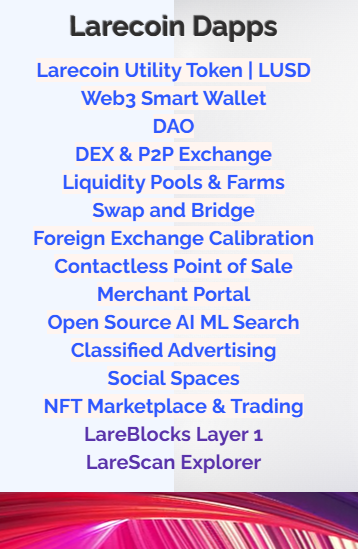
LareScan Block Explorer: Your Transaction Proof
Every payment verified on-chain in real-time.
No chargebacks. No disputes. No "I never received it" claims.
Customer pays. LareScan confirms. Transaction becomes immutable record.
LareScan provides:
Instant payment confirmation
Complete transaction history
Wallet address verification
Block-level transparency
Export-ready reports for accounting
Search any wallet. View any transaction. Verify any payment.
All public. All verifiable. All permanent.
AI-Powered Shopping Infrastructure
Dynamic pricing algorithms run natively on LareBlocks.
No third-party integrations. No API dependencies. No external service fees.
The blockchain handles intelligent pricing adjustments, inventory management, and customer behavior analysis.
Metaverse shopping experiences operate directly on the protocol. Your virtual storefront lives on-chain. Products, prices, and transactions all blockchain-native.
Layer 1 vs Layer 2: Why It Matters
Layer 2 solutions inherit problems from their parent chains.
Polygon depends on Ethereum for security. Ethereum congestion affects Polygon finality. Ethereum governance decisions impact Polygon merchants.
LareBlocks operates independently:
No parent chain dependency. No inherited limitations. No secondary consensus mechanisms.
Transactions finalize on LareBlocks. Validators secure LareBlocks. Governance happens on LareBlocks.
Faster settlement. Lower fees. Complete autonomy.
Layer 2 offers speed improvements. Layer 1 offers foundational independence.
Merchants need independence.

True Decentralization Protects Your Business
Centralized payment processors can freeze accounts.
Traditional banks can block transactions. Payment companies can deplatform businesses.
LareBlocks runs on distributed validator nodes. No single entity controls the network. Community governance prevents censorship.
Your merchant account can't be:
Frozen without consensus
Deplatformed arbitrarily
Restricted based on political pressure
Terminated without recourse
Validators span multiple countries. Governance requires community voting. Protocol changes need majority approval.
Your business operates on unstoppable infrastructure.
Real-World Advantages in Three Minutes
Minute 1: Setup
Deploy merchant wallet. Connect to LareBlocks. Configure payment parameters.
No complex integration. No middleware. No third-party dependencies.
Minute 2: First Transaction
Customer initiates payment. LareBlocks processes in seconds. LareScan confirms on-chain.
You see the payment. Customer sees confirmation. Both verify on the explorer.
Minute 3: Settlement
Funds available immediately. No 3-5 business day holds. No bank intermediaries.
Convert to LUSD for stability. Transfer to sub-wallets for department budgets. Export records for accounting.
Three minutes. Full payment cycle complete.
The Master Wallet Advantage
Enterprise operations require sophisticated controls.
LareBlocks master wallet architecture provides hierarchical management:
Master Wallet Functions:
Create unlimited sub-wallets
Set spending limits per wallet
Monitor all transactions centrally
Generate consolidated reports
Enforce security policies
Sub-Wallet Capabilities:
Department-specific budgets
Employee-level access controls
Project-based fund allocation
Automatic expense categorization
Real-time balance tracking
Marketing spends from their allocation. Sales operates within their budget. Finance tracks everything from one interface.
No separate accounting systems. No manual reconciliation. Complete visibility built into the blockchain.
Why Merchants Choose Dedicated Infrastructure
Shared blockchains optimize for developers.
LareBlocks optimizes for merchants.
Every feature serves commerce. Every update improves payments. Every upgrade enhances merchant operations.
The difference shows in:
Transaction speed optimized for checkout
Fee structures designed for retail margins
Wallet features built for business operations
Explorer functionality focused on payment verification
Smart contracts tailored to commerce logic
You don't adapt your business to the blockchain. The blockchain adapts to your business.
Get Started with LareBlocks
Visit Larecoin to explore the ecosystem.
Review the full infrastructure guide at our merchant resources.
Join the conversation. Deploy your wallet. Start accepting payments.
LareBlocks: Layer 1 infrastructure purpose-built for global commerce.
No shared resources. No unpredictable fees. No compromises.
Just dedicated blockchain infrastructure designed for merchants who demand reliability.
Comments