

.png)
Larecoin Vs CoinPayments: Which Is Better For Your Small Business Crypto POS System?
- [[[Free!!]<<<<]] Watch: 스포르팅 - 토트넘 Live Stream 13 September 2022
- 1 hour ago
- 4 min read
![Writer: [[[Free!!]<<<<]] Watch: 스포르팅 - 토트넘 Live Stream 13 September 2022](https://lh3.googleusercontent.com/a/AItbvmktwQc0wCdd3ZEETSYItRQubwwBzOyjD_dcigRf=s96-c)
Running a small business is hard enough. Your crypto payment processor shouldn't make it harder.
You've done your research. Narrowed it down. Larecoin vs CoinPayments. Two platforms. Two very different philosophies.
One gives you control. The other holds your funds.
Let's break it down.
The Bottom Line Up Front
Small business margins are tight. Every percentage point matters. Every fee adds up.
CoinPayments has been around since 2013. Solid track record. Supports over 2,000 cryptocurrencies. But here's the catch, they charge 0.5-1% processing fees. And they hold your crypto in their custody.
Larecoin? Gas-only model. No percentage cuts. Full self-custody. Your funds hit your wallet immediately.
That's not just a feature difference. That's a philosophy difference.
Fee Structure: Where The Real Savings Live
Let's talk numbers. Because numbers don't lie.
CoinPayments Fee Breakdown:
Processing fees: 0.5-1% per transaction
Annual cost at $500,000 volume: ~$3,750-$5,000
Processing time: Minutes to hours (variable)
Larecoin Fee Breakdown:
Processing fees: Gas only (no percentage)
Annual cost at $500,000 volume: ~$2,000
Processing time: Near-instant
Do the math.
That's roughly 50% savings compared to CoinPayments. At half a million in annual crypto revenue, you're pocketing an extra $1,750-$3,000 every single year.
For a small business? That's equipment. Marketing budget. An extra employee's weekly wages.
Those percentage-based fees compound. They grow as you grow. Gas-only fees? They stay predictable.
Custody: Who Actually Owns Your Money?
This is where things get philosophical. And practical.
CoinPayments operates a custodial model. Your customer pays. CoinPayments holds those funds. You request withdrawals. They process them.
Sound familiar? It should. That's exactly how traditional banking works.
Larecoin flips the script entirely.
Self-custody means payments go directly to your merchant wallet. No middleman holding your funds. No withdrawal requests. No waiting.
Your crypto. Your wallet. Your control.
Why does this matter for small businesses?
No platform risk, if CoinPayments has issues, your funds could be affected
Instant access to revenue
True ownership of your assets
No withdrawal limits or delays
The whole point of crypto was decentralization. Removing intermediaries. CoinPayments keeps one in place. Larecoin removes it.

Feature-By-Feature Showdown
Let's get specific. Here's how both platforms stack up across key features:
Feature | CoinPayments | Larecoin |
Processing Fees | 0.5-1% | Gas only |
Custody Model | Custodial | Self-custody |
Processing Speed | Minutes to hours | Near-instant |
Cryptocurrency Support | 2,000+ coins | Comprehensive + native LUSD |
NFT Receipts | No | Yes |
Smart Wallet | No | Yes |
DeFi Ecosystem Access | No | Yes |
Customizable Network Fees | No | Yes |
Several of these deserve deeper dives.
NFT Receipts: Proof That Lasts Forever
Paper receipts fade. Digital receipts get lost in email. Traditional records can be altered or disputed.
NFT receipts? Immutable. On-chain. Permanent.
Every Larecoin transaction can generate an NFT receipt. Blockchain-verified proof of purchase. No disputes. No "I never received that." No lost documentation.
For small businesses dealing with chargebacks and payment disputes, this is massive. Your records live on the blockchain forever.
CoinPayments doesn't offer this. Because they're built on Web2 infrastructure dressed up in crypto clothing.
LUSD: Stability When You Need It
Crypto volatility keeps many merchants away. Understandable. You sell a product for $100 in Bitcoin. Next week, that Bitcoin is worth $80. Or $120.
LUSD solves this.
Larecoin's native stablecoin gives merchants the option to receive payments in a stable asset. Pegged value. Predictable revenue. Still on-chain. Still decentralized.
Accept crypto. Receive stability.
CoinPayments offers various stablecoins. But LUSD is native to the Larecoin ecosystem. Deeper integration. Better support. Designed specifically for merchant use cases.
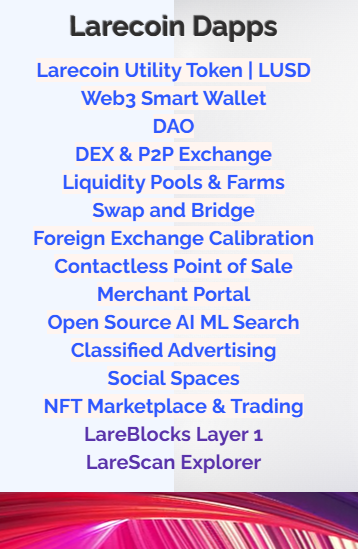
Smart Wallet + DeFi Access
Here's where Larecoin gets interesting.
Your merchant wallet isn't just storage. It's a gateway.
The Larecoin Smart Wallet connects directly to DeFi protocols. Liquidity pools. Yield opportunities. Swaps and bridges. Your business revenue can work for you while it sits in your wallet.
CoinPayments? It's a payment processor. Full stop. Your crypto sits there until you move it somewhere else.
With Larecoin, your payment infrastructure doubles as your financial infrastructure.
The Merchant Freedom Factor
Small businesses get squeezed from every direction. Payment processors take their cut. Banks charge fees. Everyone wants a piece.
Larecoin was built on a different principle: merchant freedom.
What does merchant freedom look like?
Keep more of what you earn (gas-only fees)
Own your funds immediately (self-custody)
Prove every transaction (NFT receipts)
Access financial tools directly (Smart Wallet)
Customize your fee settings (adjustable network fees)
This isn't about being anti-establishment. It's about efficiency. About cutting unnecessary costs. About true ownership of your business revenue.
CoinPayments works fine. But "works fine" isn't the same as "built for merchant independence."

Making The Switch: What To Consider
Changing payment processors feels daunting. It doesn't have to be.
If you're currently on CoinPayments, ask yourself:
How much are you paying in percentage fees annually?
Do you need immediate access to funds?
Are payment disputes or documentation issues a problem?
Would DeFi access benefit your cash flow management?
Does true self-custody matter to your business philosophy?
If you answered yes to multiple questions, Larecoin deserves serious consideration.
The transition checklist:
Set up your Larecoin merchant wallet
Configure your preferred cryptocurrency acceptance
Integrate with your existing POS system
Test a few transactions
Go live
Most merchants complete setup in under an hour.
Who Should Choose What?
CoinPayments makes sense if:
You need support for 2,000+ obscure cryptocurrencies
You prefer custodial solutions (less personal responsibility)
Platform maturity matters more than cost savings
You don't need DeFi integration or NFT receipts
Larecoin makes sense if:
Cost minimization is a priority
Self-custody aligns with your values
You want cutting-edge Web3 features
Near-instant settlement matters
You see your payment processor as financial infrastructure
For most small businesses entering crypto payments in 2026? Larecoin offers the more compelling package. Lower costs. More features. True decentralization.

The Verdict
CoinPayments has history. Stability. Broad cryptocurrency support.
Larecoin has innovation. Savings. Merchant freedom.
Both platforms process crypto payments. But they approach the problem from fundamentally different angles.
CoinPayments built a crypto version of traditional payment processing. Custodial. Fee-based. Centralized control.
Larecoin built something new. Decentralized. Gas-only. Merchant-owned.
For small businesses watching every dollar, the math favors Larecoin. At scale, those percentage savings compound dramatically.
For merchants who believe in what crypto actually stands for: decentralization, ownership, independence: Larecoin walks the walk.
Ready to explore the difference?
Check out the full Larecoin ecosystem at larecoin.com. Set up your merchant portal. Run the numbers yourself.
Your small business deserves a payment processor built for the future. Not one retrofitted from the past.
Comments