

.png)
NOWPayments vs CoinPayments vs Larecoin: Which Crypto POS System Actually Saves Small Businesses Money?
- [[[Free!!]<<<<]] Watch: 스포르팅 - 토트넘 Live Stream 13 September 2022
- 2 hours ago
- 4 min read
![Writer: [[[Free!!]<<<<]] Watch: 스포르팅 - 토트넘 Live Stream 13 September 2022](https://lh3.googleusercontent.com/a/AItbvmktwQc0wCdd3ZEETSYItRQubwwBzOyjD_dcigRf=s96-c)
Let's cut through the noise.
Small businesses lose thousands every year to payment processor fees. Traditional credit card processors take 2.9% + $0.30 per transaction. Crypto was supposed to fix this.
But here's the problem: Most crypto payment gateways just recreated the same broken model.
The Hidden Fee Trap in Crypto POS Systems
NOWPayments and CoinPayments both charge 0.5-1% per transaction. Sounds better than Visa, right?
Wrong.
That's just the platform fee. Add network fees. Currency conversion costs. Withdrawal charges. Custodial holding fees.
Suddenly you're back to 2-3% total costs.
The real kicker? They hold your funds. Not your keys, not your crypto. You're trusting a centralized middleman: exactly what Web3 was designed to eliminate.
Breaking Down the Real Costs
Let's run actual numbers for a coffee shop processing $500,000 annually:
NOWPayments/CoinPayments Model:
Platform fees: $2,500-$5,000
Network fees: $800-$1,200
Withdrawal costs: $500-$800
Conversion spreads: $600-$1,000
Total: $4,400-$8,000
Larecoin Model:
Platform fees: $0
Solana gas fees: $200-$400
Withdrawal costs: $0
Conversion spreads: $0
Total: $200-$400
That's 80-95% in savings.
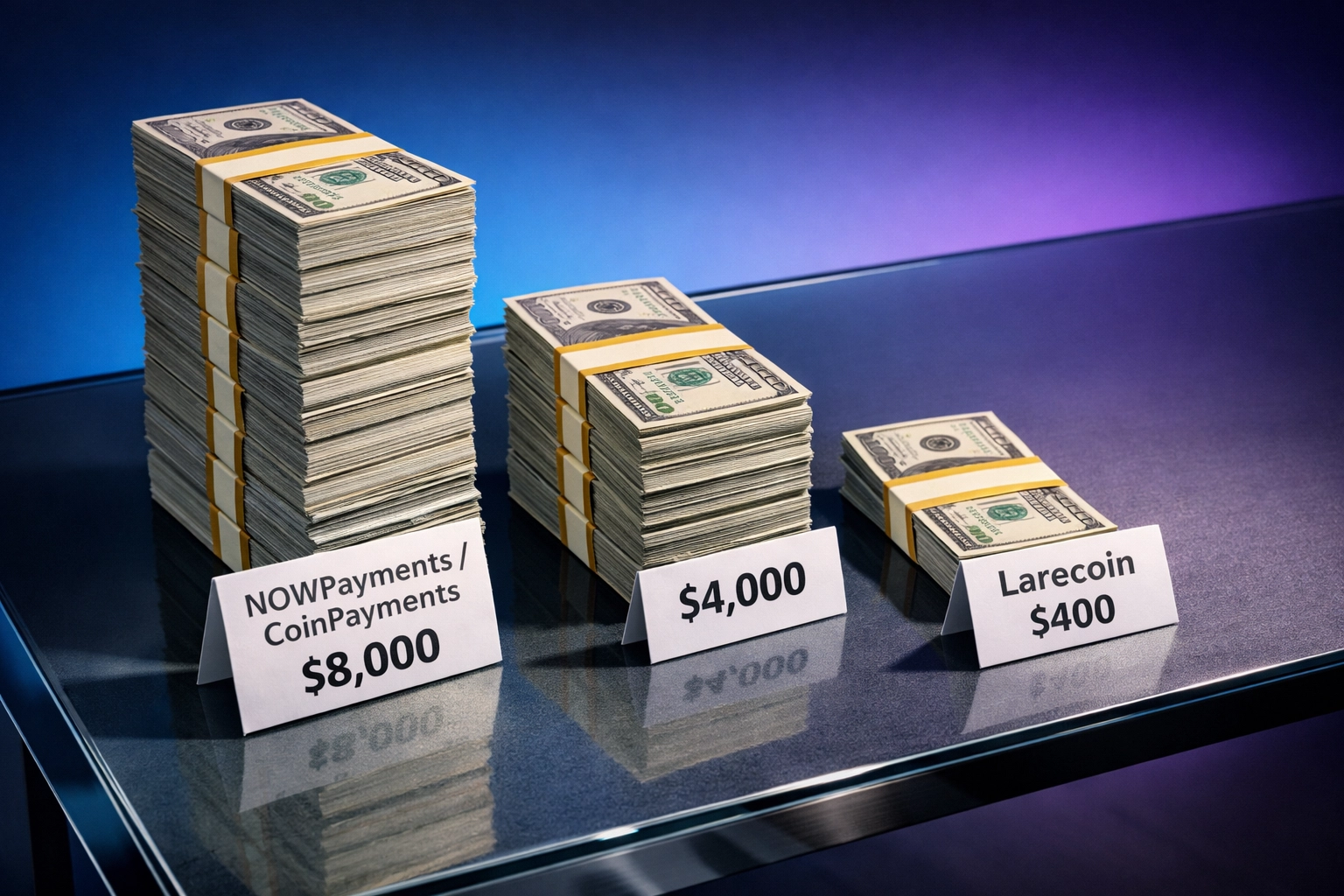
Scale that to $1.2 million in annual volume? You're saving $10,000-$20,000 yearly.
At $5 million? We're talking $20,000-$40,000 back in your pocket.
Why Self-Custody Changes Everything
Here's what nobody tells you about traditional crypto payment processors.
They custody your funds. You're essentially using a bank: but without FDIC insurance.
When you accept payment through NOWPayments or CoinPayments, the crypto hits their wallet first. Then you request a payout. They process it. Charge fees. Take days to settle.
Larecoin flips this model.
Payments hit your wallet instantly. You control the keys. You decide when to convert. You own the assets from second one.
This isn't just philosophical. It's practical financial sovereignty.
Self-custody means:
Zero settlement delays
No frozen accounts
Complete transaction control
Instant liquidity access
True ownership

The NFT Receipt Revolution Nobody Saw Coming
Traditional POS systems give you paper or digital receipts. Useful for accounting. Terrible for customer engagement.
NFT receipts transform transactions into assets.
Every purchase minted as an NFT on Solana creates:
Immutable purchase proof
Loyalty program automation
Resale value opportunities
Community membership tokens
Marketing channel access
Coffee shop example: Customer buys a latte. Receives NFT receipt. That NFT grants 10% discount on next visit. After 10 purchases, the NFT unlocks exclusive merchandise.
The receipt becomes marketing. The transaction becomes relationship-building.
Traditional systems can't do this. They're locked into Web2 thinking.
LUSD: The Stablecoin That Actually Makes Sense
Volatility kills crypto adoption for payments. Nobody wants to accept Bitcoin if it drops 15% before settlement.
Most crypto POS systems solve this by immediately converting to fiat. Great: except you're paying conversion fees both ways.
LUSD changes the game.
Larecoin's native stablecoin pegs to USD 1:1. Zero volatility. Built on Solana for instant settlement. Gas fees measured in fractions of cents.
Accept LUSD, hold LUSD, spend LUSD: all without conversion costs.
You get:
Stable value storage
Instant settlement
Cross-border payments
No bank intermediaries
Sub-penny transaction costs
The merchant keeps 99.9%+ of every transaction. Try that with traditional processors.

Real Business Impact: The Numbers Don't Lie
Let's compare three identical businesses processing $100,000 monthly:
Business A (Traditional Visa/Mastercard):
Monthly fees: $2,900
Annual cost: $34,800
Settlement time: 2-3 days
Chargeback risk: High
Business B (NOWPayments/CoinPayments):
Monthly fees: $800-$1,500
Annual cost: $9,600-$18,000
Settlement time: 5+ minutes to days
Chargeback risk: Moderate
Business C (Larecoin):
Monthly fees: $50-$100
Annual cost: $600-$1,200
Settlement time: Sub-second
Chargeback risk: Zero
Business C saves $9,000-$17,400 compared to crypto competitors. $34,200 compared to traditional processors.
That's hiring another employee. Upgrading equipment. Expanding inventory. Growing the business.
Where Traditional Crypto POS Falls Short
NOWPayments and CoinPayments built better mousetraps. Larecoin eliminated the mice.
The legacy platforms still think like Web2 companies:
Charge percentage fees
Control user funds
Add friction at every step
Prioritize their profits over merchant savings
They're crypto companies operating with fiat mindsets.
Larecoin operates on first principles. What do merchants actually need?
Lowest possible fees
Instant settlement
Complete control
Simple integration
Growth tools
Everything else is noise.
The Solana Speed Advantage
Transaction speed matters more than most realize.
Customer stands at checkout. Initiates crypto payment. Waits. Waits more. Transaction confirms. Finally complete.
On Bitcoin or Ethereum, this takes minutes. Even "fast" processors add 5-10 minutes minimum.
Solana finalizes in 400 milliseconds. Larecoin POS processes payments in under one second.
That's faster than most credit card terminals.
Speed creates better customer experiences. Better experiences drive repeat business. Repeat business builds sustainable growth.
The fastest transaction wins.
Merchant Portal: Control Center That Actually Works
Most crypto processors give merchants bare-bones dashboards. Transaction lists. Export functions. Basic reporting.
Larecoin's merchant portal includes:
Real-time analytics
Inventory management integration
Customer loyalty tracking
NFT receipt customization
LUSD conversion tools
DAO governance participation
Multi-location management
You're not just accepting payments. You're running a Web3-native business.

The Bottom Line: Math Doesn't Lie
Process $500K annually:
Save $4,000-$8,000 vs crypto competitors
Save $10,000-$12,000 vs traditional processors
Process $1.2M annually:
Save $10,000-$20,000 vs crypto competitors
Save $25,000-$30,000 vs traditional processors
Process $5M annually:
Save $20,000-$40,000 vs crypto competitors
Save $120,000-$140,000 vs traditional processors
These aren't projections. They're calculations based on published fee structures.
Small businesses operate on thin margins. Every percentage point matters. Every dollar saved compounds.
Larecoin doesn't ask you to believe in crypto philosophy. It shows you the spreadsheet.
Why This Matters Right Now
2026 is the inflection point for crypto payments. Regulatory clarity emerging. Consumer adoption accelerating. Infrastructure maturing.
Early movers capture market share. Build customer habits. Establish competitive advantages.
Waiting means watching competitors save thousands while you hemorrhage fees to legacy processors.
The technology exists. The savings are real. The implementation is simple.
Merchants choosing Larecoin today don't just save money. They position themselves at the forefront of the payment revolution.
Your Move
Check your current payment processing statements. Calculate annual fees. Compare against Larecoin's gas-only model.
The math makes the decision.
Self-custody. NFT receipts. LUSD stability. Solana speed. Zero platform fees.
This isn't the future of payments. It's payments right now.
Learn more at larecoin.com.
The question isn't whether to switch. It's what you'll do with the savings.
Comments