

.png)
Self-Custody Merchant Accounts Explained: Why Everyone Is Talking About Bank-Free Business Operations
- [[[Free!!]<<<<]] Watch: 스포르팅 - 토트넘 Live Stream 13 September 2022
- 6 days ago
- 5 min read
![Writer: [[[Free!!]<<<<]] Watch: 스포르팅 - 토트넘 Live Stream 13 September 2022](https://lh3.googleusercontent.com/a/AItbvmktwQc0wCdd3ZEETSYItRQubwwBzOyjD_dcigRf=s96-c)
The banking system wasn't built for you. It was built for banks.
Every swipe. Every transaction. Every payment you accept as a merchant flows through intermediaries who take their cut. Hold your funds. Set their rules.
But here's the shift happening right now: self-custody merchant accounts are rewriting the playbook. Business owners are ditching traditional payment processors. Going bank-free. Keeping 100% control of their revenue.
And it's not some fringe movement anymore. It's becoming the new standard.
Let's break down exactly what self-custody means for your business, and why it matters more than ever in 2026.
What Exactly Is a Self-Custody Merchant Account?
Simple concept. Powerful execution.
Traditional merchant accounts work like this: customer pays → bank holds funds → processor takes fees → you eventually receive what's left. Days later. Sometimes weeks.
Self-custody flips the script entirely.
Your keys. Your coins. Your wallet.
Funds move directly from a customer's wallet to yours. Peer-to-peer. Recorded on the blockchain in real time. No intermediary sitting in the middle skimming percentages.
Think of it as accepting cash payments, but digital. Global. Instant. And verifiable by anyone on-chain.
You're not trusting a third party to "eventually" send you your money. You receive it the moment the transaction confirms.
The Problem With Traditional Payment Processing
Let's talk numbers. Because this is where it gets painful.
Interchange fees: 1.5% to 3.5% per transaction
Processing fees: Additional 0.2% to 0.5%
Monthly fees: $10 to $50+ just to keep your account active
Chargeback fees: $15 to $100 per disputed transaction
Settlement delays: 2-7 business days before funds hit your account
Running a small business? That 3% fee on every sale adds up fast. You're essentially paying a tax to access the financial system.
Cross-border payments? Even worse. International transaction fees. Currency conversion markups. Correspondent bank charges.
The system is designed to extract value at every step.
Why Self-Custody Is Gaining Momentum
Business owners are waking up. The benefits are too significant to ignore.
Lower Transaction Costs
Remove the middlemen. Keep more revenue.
Self-custody payments through Web3 solutions like Larecoin can slash your payment processing costs by 50% or more. No interchange fees. No monthly minimums. Just straightforward blockchain transaction costs, often pennies per payment.
Instant Settlement
No more waiting days for your own money.
Transactions settle on-chain in minutes. Sometimes seconds. Cash flow becomes predictable. You can reinvest immediately instead of floating operational costs while banks hold your revenue hostage.
Global Reach Without Borders
Accept payments from anywhere. Send to anywhere.
No correspondent banking relationships needed. No foreign transaction fees. A customer in Singapore pays you the same way as a customer down the street. Frictionless.

Reduced Liability and Risk
Here's something most merchants don't consider: when you hold customer payment data, you're liable for it.
Data breaches. PCI compliance. Fraud investigations.
Self-custody eliminates most of this headache. You're not storing sensitive payment credentials. Customers maintain control of their own wallets. The transaction happens. It's done. No data to protect.
Financial Sovereignty
This is the big one.
Banks can freeze accounts. Payment processors can terminate relationships. Suddenly you can't access your own revenue, often with little explanation and zero recourse.
Self-custody means nobody can freeze your wallet. Your business isn't dependent on maintaining favor with financial institutions.
How Larecoin Powers Bank-Free Business Operations
Not all self-custody solutions are created equal.
Some require technical expertise. Others lack the merchant tools you actually need to run a business. Many offer crypto payments but ignore the volatility problem.
Larecoin solves these gaps.
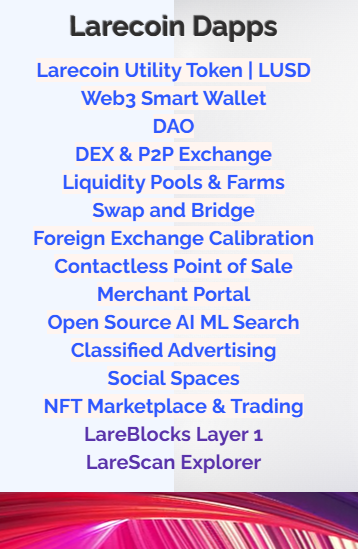
LUSD Stablecoin Benefits
Crypto volatility? Handled.
LUSD maintains dollar parity. Accept payments knowing exactly what you're receiving. No waking up to find yesterday's revenue is worth 15% less.
Price stability meets self-custody. Best of both worlds.
NFT Receipts for Accounting
Every transaction generates a verifiable NFT receipt.
This isn't just cool tech, it's a game-changer for bookkeeping. Immutable records. Timestamped. Cryptographically secured. Your accountant can verify any transaction on-chain. Auditors can't dispute blockchain records.
Tax season just got simpler.
Receivables Token System
Turn your incoming payments into tradeable assets.
Larecoin's receivable token technology lets you tokenize expected revenue. Use it as collateral. Trade it. Unlock liquidity without waiting for traditional settlement windows.
Crypto POS System for Small Business
Not tech-savvy? No problem.
Larecoin's contactless POS system works at physical retail locations. Customers scan. Pay. Done. No coding required. No complicated setup.
Works alongside your existing operations or replaces legacy systems entirely.
Self-Custody vs. Traditional Crypto Processors
"But what about CoinPayments? NOWPayments? Triple-A?"
Fair question. Let's compare.
Feature | Traditional Crypto Processors | Larecoin Self-Custody |
Fund Control | Processor holds funds | You hold funds |
Settlement | Hours to days | Instant |
Processing Fees | 0.5% - 1%+ | Near-zero |
Account Freezing Risk | Yes | No |
NFT Receipts | No | Yes |
Stablecoin Native | Limited | LUSD Built-in |
Services like NOWPayments and CoinPayments are improvements over traditional processors. But they still operate as intermediaries. They custody your funds: even temporarily. They set withdrawal minimums. They can terminate service.
Larecoin's approach: true peer-to-peer payments. The moment a customer pays, funds land in your wallet. Not theirs.

Who Should Consider Self-Custody Merchant Accounts?
Self-custody isn't for everyone. Yet.
Ideal candidates:
E-commerce businesses tired of payment processor fees eating margins
International sellers dealing with cross-border payment friction
Service providers accepting recurring payments
Physical retail locations ready for crypto POS adoption
Anyone concerned about account freezes or financial censorship
Businesses with crypto-native customer bases
Maybe wait if:
Your entire customer base refuses to touch crypto (though that's shrinking fast)
You're not comfortable managing wallet security
Getting Started With Bank-Free Operations
Ready to make the switch?
Here's your roadmap:
Set up your self-custody wallet through Larecoin's merchant portal
Configure payment acceptance for LUSD and supported cryptocurrencies
Integrate with your storefront using available plugins or POS hardware
Start accepting payments with instant settlement
Use NFT receipts for clean accounting records
The learning curve is minimal. The upside is massive.
The Future Is Self-Custody
Traditional payment infrastructure had its moment. Decades of dominance.
But the inefficiencies are glaring. The fees are extractive. The control is one-sided.
Self-custody merchant accounts represent something bigger than cost savings. They represent financial independence for business owners.
No bank deciding whether you can operate. No processor holding your cash flow hostage. No intermediaries skimming percentage points from every customer interaction.
Just direct value exchange between you and your customers.
The merchants who move early gain the advantage. Lower costs. Better cash flow. Operational resilience.
Everyone else will catch up eventually. But by then? You're already ahead.
Ready to explore self-custody for your business?Check out Larecoin's merchant solutions and see what bank-free operations actually look like.
Comments