

.png)
The Enterprise Merchant's Guide to Web3 Payments: Self-Custody, LUSD Stability, and Zero Chargebacks
- [[[Free!!]<<<<]] Watch: 스포르팅 - 토트넘 Live Stream 13 September 2022
- Feb 21
- 5 min read
![Writer: [[[Free!!]<<<<]] Watch: 스포르팅 - 토트넘 Live Stream 13 September 2022](https://lh3.googleusercontent.com/a/AItbvmktwQc0wCdd3ZEETSYItRQubwwBzOyjD_dcigRf=s96-c)
Why Enterprise Merchants Are Done With Traditional Payment Rails
Visa charges 2.9% + $0.30 per transaction. Mastercard hits you with similar rates. Then chargebacks destroy your margins. Settlements take 3-5 days. International transfers? Add another 3-7% for foreign exchange and wire fees.
Web3 payments cut these costs by over 50%. Settlement happens in seconds, not days. Chargebacks become impossible. Your funds stay under your complete control.
This isn't theory. It's infrastructure that's processing millions in transactions today.
Self-Custody: Your Money, Your Keys, Your Control
Traditional payment processors hold your funds. They freeze accounts. They reverse transactions. They impose arbitrary limits on your business operations.
Self-custody flips this model entirely.
With Larecoin's enterprise architecture, you maintain cryptographic control over every dollar. No intermediary can freeze your account. No processor can withhold your settlements. No payment gateway dictates your operational limits.
How Enterprise Self-Custody Works:
Master wallet controlled by your treasury team
Sub-wallets deployed for departments, locations, or business units
Multi-signature requirements for large transactions
Hardware wallet integration for maximum security
Real-time visibility across all wallet addresses

The master/sub-wallet structure lets you manage complex organizational hierarchies. Your flagship store operates independently from your e-commerce division. Your European operations maintain separate accounting from North American transactions. All under one unified treasury view.
Compliance teams love this. Finance departments demand it. CFOs sleep better knowing funds can't be arbitrarily seized by a payment processor having a bad day.
LUSD: The Stability Your Balance Sheet Requires
Volatility kills enterprise adoption. Your CFO won't accept Bitcoin's price swings. Your accountants can't reconcile Ethereum's daily fluctuations.
Enter LUSD, Liquity's decentralized stablecoin.
Unlike USDC or USDT, LUSD maintains its peg through algorithmic mechanisms and over-collateralization. No central authority controls its issuance. No bank account can be frozen. No corporate entity decides whether you can transact.
LUSD Advantages for Merchants:
100% backed by ETH collateral at minimum 110% ratio
No centralized freeze mechanisms
Algorithmic stability without human intervention
Complete transparency on-chain
Integration with Larecoin payment infrastructure
When customers pay in LUSD, you receive stable value immediately. Settlements complete in under 10 minutes versus 3-5 days with card networks. No conversion fees. No FX spreads. No correspondent banking charges.
Your accounting team books revenue the same day. Your treasury deploys funds immediately. Your cash flow improves by orders of magnitude.
Zero Chargebacks: The Feature Every Merchant Dreams About
Chargebacks cost U.S. merchants $31 billion annually. Fraudulent disputes drain resources. Friendly fraud destroys margins on digital goods. Card networks automatically side with consumers.
Web3 payments eliminate chargebacks entirely.
Blockchain transactions are final. Once confirmed, they cannot be reversed without the recipient's cryptographic approval. No dispute process exists because transactions are mathematically verified before execution.
The Operational Impact:
Digital goods merchants stop losing 1-3% of revenue to chargebacks
High-ticket retailers eliminate friendly fraud exposure
Customer service focuses on real issues, not payment disputes
Accounting reconciliation becomes trivial
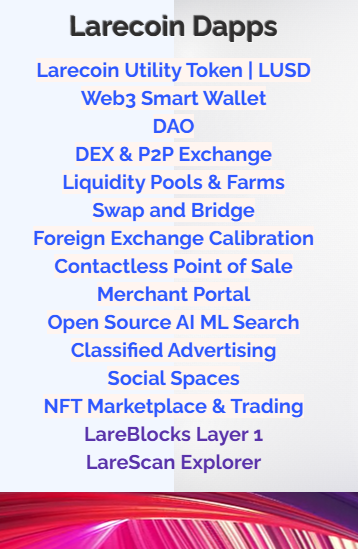
This doesn't mean customer service disappears. Legitimate issues still deserve resolution. But merchants regain control over the process. Refunds become intentional business decisions, not forced reversals by payment networks.
Master/Sub-Wallet Infrastructure for Complex Enterprises
Single-wallet setups work for small businesses. Enterprises need hierarchical treasury management.
Larecoin's master/sub-wallet architecture supports:
Departmental Segregation
Marketing holds promotional budgets in dedicated wallets
Operations manages supplier payments separately
Retail locations track point-of-sale receipts independently
E-commerce maintains distinct treasury operations
Geographical Distribution
Regional managers control local working capital
International subsidiaries operate autonomously
Cross-border settlements happen peer-to-peer
Compliance reporting segments by jurisdiction
Permission Hierarchies
Junior staff can receive but not send from certain wallets
Department heads approve up to predefined limits
C-suite multi-sig required for treasury movements
Automated rules enforce spending policies
Each sub-wallet reports to the master treasury view. Finance teams see real-time balances across the entire organization. Auditors trace every transaction through on-chain records. Reconciliation becomes automated instead of manual.
Fee Structures That Actually Make Sense
Traditional payment processing hammers merchants with layered fees:
Interchange fees (1.5-3.5%)
Assessment fees (0.13-0.15%)
Payment processor markup (0.3-0.5%)
Monthly minimums and statement fees
PCI compliance charges
Cross-border surcharges (1-3%)
Currency conversion spreads (3-7%)
Larecoin charges gas fees. That's it.
Real Fee Comparison:
Traditional: $2.90 + on a $100 transaction
Larecoin: $0.05-0.50 depending on network conditions
Savings: Over 90% on most transactions
For international payments, the gap widens further. A $10,000 wire transfer to Europe costs $45-75 in fees plus 3-5% FX markup. The same transaction on Larecoin costs under $2 and settles in minutes.
Enterprise volume makes this math even more compelling. Process $1 million monthly and you're saving $25,000+ every single month versus card networks.

NFT Receipts: Programmable Transaction Records
Every payment generates an NFT receipt. Sounds gimmicky until you understand the implications.
Traditional receipts are PDFs or printouts. They get lost. They can't be verified. They're disconnected from the actual transaction.
NFT receipts are:
Permanently linked to the on-chain payment
Cryptographically verified and unforgeable
Programmable with metadata and business logic
Transferable for warranty tracking or resale proof
Searchable across the entire transaction history
Your customer buys a $5,000 appliance. The NFT receipt includes:
Purchase date and amount
Warranty terms encoded in metadata
Service history updated on-chain
Proof of authenticity for high-value items
Automatic eligibility for loyalty programs
Accounting teams query transactions by NFT attributes. Warranty claims get verified instantly. Secondary markets authenticate product provenance. Customer service accesses complete purchase histories without centralized databases.
Implementation Without Disruption
Enterprises hate rip-and-replace technology deployments. Larecoin integrates with existing systems:
Payment Terminal Integration
Contactless POS accepts crypto like any other payment method
Existing checkout flows remain unchanged
Staff training takes minutes, not weeks
E-Commerce Plugins
Drop-in components for major platforms
Checkout experience optimized for conversions
Automatic LUSD conversion at point of sale
API-First Architecture
REST endpoints for custom integrations
Webhooks for real-time settlement notifications
SDKs for major programming languages
Merchant Portal
Dashboard tracks all payments in real-time
Export data for existing accounting software
Generate reports for financial and tax compliance
You don't abandon your current stack. You augment it with Web3 capabilities that reduce costs and increase operational flexibility.
The Decentralization Advantage
Centralized payment processors are single points of failure. They experience outages. They change terms unilaterally. They exit markets without notice.
Decentralized infrastructure never goes down because no single entity controls it. The Larecoin network operates across distributed nodes. LareBlocks and LareScan provide transparent verification of every transaction.
When traditional processors experienced widespread outages in 2025, Web3 merchants continued processing payments without interruption. No customer service hotlines. No waiting for system restoration. No lost sales.
Your payment infrastructure becomes as reliable as the internet itself.
Moving Forward
Enterprise merchants face a choice. Continue paying 3% to card networks while absorbing chargebacks and waiting days for settlements. Or adopt Web3 rails that cost 90% less, settle in minutes, and eliminate fraud.
The infrastructure exists today. The cost savings are measurable. The operational advantages are undeniable.
Learn more about reducing interchange fees and join the Web3 payments revolution reshaping enterprise commerce.
The question isn't whether to adopt Web3 payments. It's how quickly you can implement them before your competitors do.
Comments