

.png)
The Merchant's Guide to Metaverse Shopping: Why VR/AR Commerce Is Your Next Revenue Stream
- [[[Free!!]<<<<]] Watch: 스포르팅 - 토트넘 Live Stream 13 September 2022
- 2 hours ago
- 5 min read
![Writer: [[[Free!!]<<<<]] Watch: 스포르팅 - 토트넘 Live Stream 13 September 2022](https://lh3.googleusercontent.com/a/AItbvmktwQc0wCdd3ZEETSYItRQubwwBzOyjD_dcigRf=s96-c)
The metaverse isn't coming. It's here.
Nike, Gucci, Balenciaga, Ralph Lauren: they've already built virtual storefronts. Ikea and Walmart have launched integrated shopping experiences on Roblox. And the numbers don't lie: 51% of shoppers want to purchase both physical and virtual goods in immersive environments.
The question isn't whether VR/AR commerce will reshape retail. The question is whether your business will capture this revenue stream: or watch competitors take it.
Here's your merchant playbook for metaverse shopping. And why Web3 payments infrastructure matters more than you think.
Why Metaverse Shopping Is Your Next Revenue Stream
Traditional e-commerce hit its ceiling. Flat product images. Static checkout flows. Zero emotional connection.
VR/AR commerce changes everything.
Virtual try-ons eliminate purchase barriers. Fashion brands let customers see how clothes fit on their avatars. Beauty companies simulate makeup application. Furniture retailers place products directly in customers' living rooms via AR.
Result? Lower return rates. Higher conversion. Bigger average order values.
Unlimited merchandising space. Physical stores have square footage limits. Metaverse stores don't. Display every product variation simultaneously. Create impossible showrooms. Build experiences that would cost millions in brick-and-mortar.
Social commerce on steroids. Metaverse shopping is inherently social. Friends attend product launches together. Avatars influence purchasing decisions in real-time. This transforms isolated browsing into community-driven experiences with viral growth potential.
Gen Z and Millennials are leading adoption. Higher-income consumers engage at elevated rates. First movers capture market share before mass-market expansion makes competition brutal.
The Payment Problem No One's Talking About
Here's where most metaverse merchants get stuck.
You build a beautiful virtual storefront. You create immersive product experiences. Customers are ready to buy.
Then what?
Traditional payment rails don't work smoothly in virtual environments. Credit card processors designed for 2015 e-commerce can't handle cross-border, real-time, avatar-to-merchant transactions efficiently.
And existing crypto payment processors? They come with their own problems.
NOWPayments charges transaction fees that eat into margins. No self-custody means you're trusting a third party with your funds. Limited metaverse integration capabilities.
CoinPayments takes a similar approach: custody your funds, charge fees, minimal innovation on the immersive commerce front.
Triple-A offers decent compliance but lacks the technical infrastructure for next-gen shopping experiences.
None of these platforms were built with metaverse commerce as a core use case. They're retrofitting old solutions onto new problems.
Larecoin's Technical Edge for VR/AR Commerce
Larecoin was architected differently. Built for Web3 global payments. Designed for where commerce is heading.
NFT Receipts
Every transaction generates a verifiable NFT receipt. In metaverse environments, this matters enormously.
Prove purchase authenticity for virtual goods
Enable resale markets with verified ownership history
Create collectible receipt experiences that strengthen brand loyalty
Build transparent transaction records customers can verify themselves
Traditional payment processors give you a confirmation email. Larecoin gives you cryptographic proof living on-chain forever.
LUSD Stablecoin
Volatility kills commerce. Nobody wants to accept payment worth 15% less by tomorrow.
LUSD eliminates this problem. Merchants accept payments denominated in a stable asset. No conversion anxiety. No price volatility risk.
For metaverse transactions happening across time zones and currencies, stablecoin settlement simplifies everything.
Gas-Only Transfers
Most crypto payment solutions charge transaction fees on top of network costs. Larecoin uses gas-only transfers.
You pay network fees. That's it.
This architecture makes micro-transactions viable. Virtual goods selling for $2? Now economically feasible. In-game purchases, digital accessories, small virtual experiences: all become profitable product categories.
Self-Custody
This is the big one.
With NOWPayments, CoinPayments, and most competitors, they hold your funds. You're trusting a third party. You're subject to their policies, their withdrawal limits, their potential issues.
Larecoin enables full self-custody. Your keys. Your funds. Your control.
Fee Savings That Actually Move the Needle
Let's talk numbers.
Traditional interchange fees run 2-4% per transaction. For high-volume merchants, that's hundreds of thousands annually: sometimes millions: going to payment processors.
Larecoin cuts interchange fees by over 50%.
How?
QR-generated POS eliminates expensive hardware and processing middlemen. Generate payment requests instantly. Accept them anywhere: physical stores, virtual storefronts, hybrid experiences.
Master/sub-wallet architecture lets enterprises manage multiple locations, franchises, or virtual store instances from unified infrastructure. One dashboard. Complete visibility. Simplified reconciliation.
Gas-only transfers mean you're not paying percentage-based fees that scale with transaction volume. Sell $10 million in virtual goods? Your payment processing costs don't scale linearly upward.
For metaverse merchants anticipating significant volume, these fee savings compound dramatically.
MTL Compliance: The Foundation for Serious Commerce
Innovation means nothing without trust.
Metaverse commerce will attract regulatory attention. Virtual goods, cross-border transactions, crypto payments: this landscape requires bulletproof compliance.
Larecoin delivers:
Federal MSB registration with FinCEN
State-level Money Transmitter License (MTL) coverage across the U.S.
This isn't optional. Serious merchants need payment infrastructure that won't create compliance headaches down the line.
NOWPayments and CoinPayments operate under different regulatory frameworks. For U.S.-focused merchants building metaverse commerce strategies, Larecoin's MTL compliance provides peace of mind.
The Future: Social Shopping in Larecoin's B2B2C Metaverse
Here's where it gets interesting.
Larecoin isn't just building payment rails. We're building social shopping spaces.
The B2B2C metaverse vision:
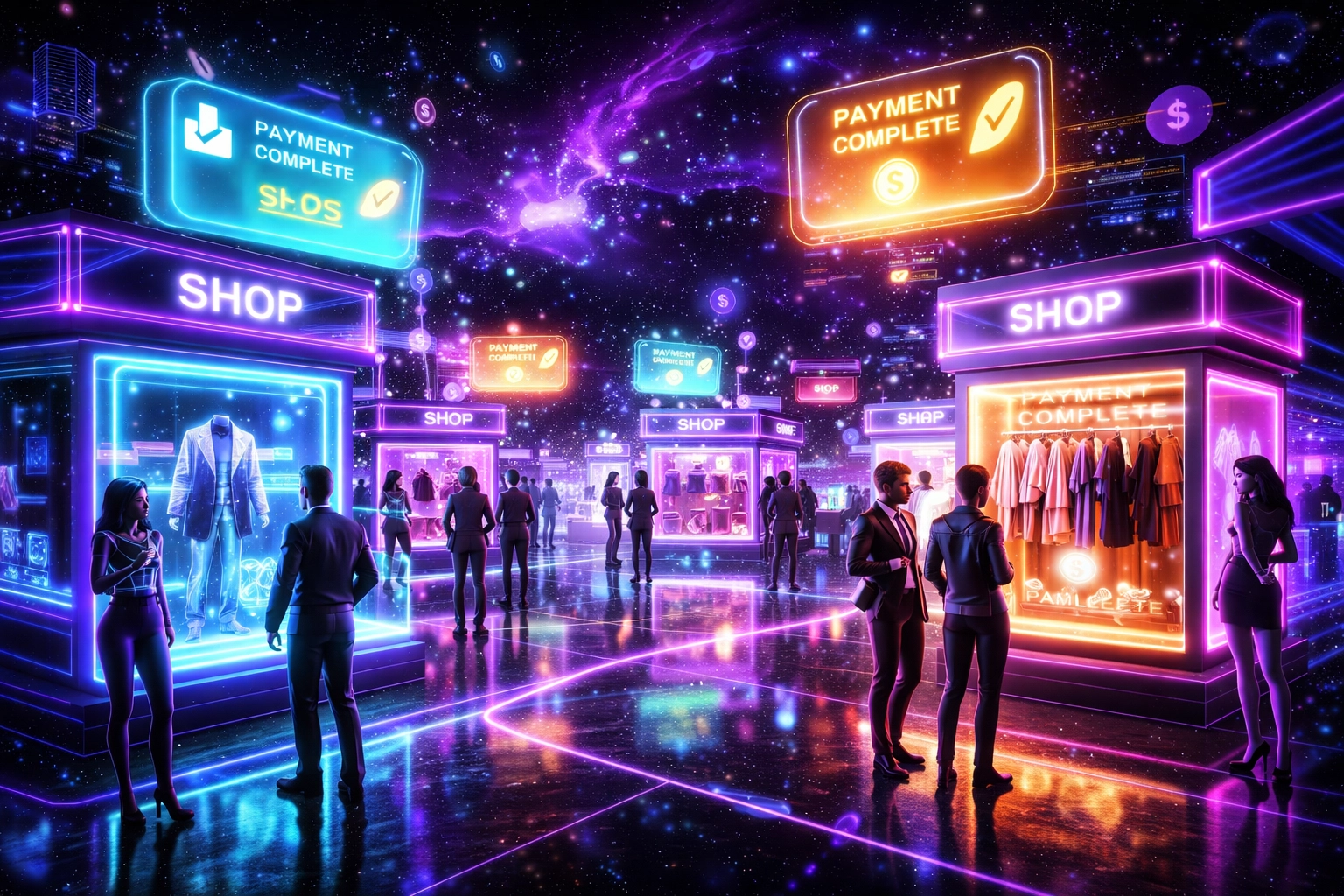
Merchants create virtual storefronts within Larecoin's ecosystem. Customers browse, socialize, and purchase: all in immersive environments. Payments flow through integrated crypto POS infrastructure. NFT receipts verify every transaction.
Imagine your customers:
Attending virtual product launches together
Getting recommendations from trusted avatar friends
Unlocking exclusive items through engagement challenges
Building community around your brand in ways impossible on traditional e-commerce
Forever 21 let Roblox shoppers create custom digital stores with real-world delivery. Alo Yoga built loyalty through meditation challenges. Nike's Nikeland combines digital try-ons with brand engagement.
Larecoin makes this architecture accessible to merchants of all sizes. Not just enterprise brands with million-dollar metaverse budgets.
Getting Started: Your Metaverse Commerce Checklist
Ready to capture this revenue stream? Here's your action plan:
1. Audit your product catalog for virtual potential
Which products translate to immersive experiences? Virtual try-ons? AR visualization? Digital goods companions to physical products?
2. Evaluate payment infrastructure
Does your current processor handle cross-border crypto transactions? Can it support micro-transactions profitably? Do you maintain self-custody?
3. Calculate fee savings potential
Model your transaction volume. Compare traditional interchange fees against gas-only transfers. The math usually makes the decision obvious.
4. Consider compliance requirements
If you're U.S.-focused, MTL compliance matters. Don't build on infrastructure that creates future regulatory risk.
5. Think social-first
Metaverse shopping is community shopping. Plan for social features, shared experiences, and viral mechanics from day one.
The Bottom Line
VR/AR commerce represents the next evolution of retail. Early-moving merchants will capture market share, build customer loyalty, and establish brand presence before competition intensifies.
But the payment infrastructure you choose matters enormously.
Traditional processors weren't built for this. Existing crypto payment solutions like NOWPayments and CoinPayments lack critical features for metaverse commerce: NFT receipts, self-custody, gas-only transfers, and social shopping integration.
Larecoin delivers all of this. Plus 50%+ fee savings. Plus MTL compliance. Plus a B2B2C metaverse vision that puts your brand at the center of social shopping experiences.
The metaverse revenue stream is real. The technology exists. The customers are ready.
Your move.
Comments