

.png)
Why Receivables Tokens Will Change the Way You Process Crypto Payments Forever
- [[[Free!!]<<<<]] Watch: 스포르팅 - 토트넘 Live Stream 13 September 2022
- 2 days ago
- 5 min read
![Writer: [[[Free!!]<<<<]] Watch: 스포르팅 - 토트넘 Live Stream 13 September 2022](https://lh3.googleusercontent.com/a/AItbvmktwQc0wCdd3ZEETSYItRQubwwBzOyjD_dcigRf=s96-c)
Cash flow kills businesses. Not bad products. Not weak marketing. Cash flow.
You deliver the goods. You send the invoice. Then you wait. And wait. Thirty days. Sixty days. Sometimes longer.
Meanwhile, rent is due. Payroll is coming. Suppliers want their cut.
Traditional payment processors don't solve this. They make it worse. High fees. Slow settlements. Middlemen everywhere.
Receivables tokens flip the entire script.
This isn't just another crypto buzzword. It's the most significant shift in merchant payments since the credit card. And if you're still processing payments the old way, you're leaving money: and time: on the table.
What Exactly Is a Receivables Token?
Simple concept. Powerful execution.
A receivables token converts your unpaid invoices into tradeable digital assets on the blockchain. That invoice sitting in your accounts receivable? It becomes a token. That token has real value. And you can use it right now.
No more waiting for customers to pay. No more cash flow gaps. No more begging banks for credit lines.
Here's the breakdown:
You issue an invoice → It gets tokenized on-chain
The token represents that receivable → It's backed by real business value
You access funds immediately → Use it as collateral or trade it
Customer pays later → Smart contract settles automatically
Traditional factoring charges 3-5% and takes weeks. Receivables tokens? Near-instant. Fraction of the cost.
Why Traditional Crypto Processors Are Already Outdated
Let's talk about your current options.
NOWPayments. Decent for basic crypto acceptance. But you're still waiting for settlements. Still dealing with volatility. Still stuck in the old paradigm of "receive payment, wait, access funds."
CoinPayments. Been around forever. Shows its age. Complex fee structures. Limited automation. No receivables infrastructure.
Triple-A. Enterprise-focused. Heavy compliance overhead. Not built for the small business owner who needs capital today.
None of them give you access to your money before it arrives.
That's the receivables token difference. You're not waiting for the payment cycle to complete. You're unlocking value the moment the transaction initiates.
The Five Ways Receivables Tokens Transform Your Business
1. Immediate Working Capital
Stop living invoice-to-invoice.
When you tokenize receivables, you convert future payments into present-day liquidity. Use those tokens as collateral in DeFi lending protocols. Get funded in hours, not weeks.
Example: You're a small business running a crypto POS system. Customer makes a $5,000 purchase with a 30-day payment term. Instead of waiting, you tokenize that receivable. Access 80-90% of the value immediately. Customer pays on day 30. Smart contract settles the rest.
Cash flow problem? Solved.
2. Slash Intermediary Costs by 50%+
Traditional payment processing is a fee buffet:
Interchange fees
Processing fees
Gateway fees
Currency conversion fees
Settlement fees
It adds up. Fast. Some merchants lose 3-4% on every transaction before they see a dime.
Receivables tokens cut out the middlemen. You're interacting directly with investors and customers through smart contracts. No banks skimming off the top. No processors taking their cut.
Real savings for real merchants.

3. Automation That Actually Works
Manual invoicing is dead. Manual follow-ups are dead. Manual reconciliation is dead.
Smart contracts handle everything:
Invoice generation → Automatic
Payment triggers → Condition-based execution
Settlement → Instant when terms are met
Record-keeping → Immutable on-chain
What used to take your accounting team hours now happens in seconds. No human intervention required.
4. Liquidity On Demand
Here's something traditional payment processors can't offer: a secondary market for your receivables.
Once your invoices are tokenized, they become tradeable assets. Don't want to wait for the customer to pay? Sell the token. Need to exit a position early? Find a buyer.
This liquidity didn't exist before blockchain. Now it's standard for anyone using receivables tokens.
5. Self-Custody Means Self-Control
With traditional processors, your money sits in their accounts. Their systems. Their rules. Their timelines.
Self-custody merchant accounts change that equation.
Your tokens. Your wallet. Your control.
No frozen accounts. No arbitrary holds. No "we'll review your case and get back to you in 5-7 business days."
Financial sovereignty isn't just a buzzword. It's operational reality.
How Larecoin Makes This Actually Work
Theory is great. Execution matters more.
Larecoin built receivables tokens into the core payment infrastructure. Not an add-on. Not a future feature. It's live.
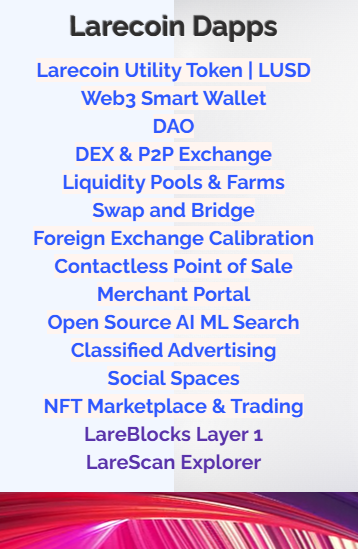
Here's what the stack looks like:
Feature | What It Does |
Receivables Token | Converts invoices to tradeable on-chain assets |
LUSD Stablecoin | Eliminates volatility during settlement |
Smart Wallet | Self-custody with enterprise-grade security |
Contactless POS | Accept crypto in-store, tokenize receivables instantly |
Merchant Portal | Manage everything from one dashboard |
No coding required. No blockchain expertise necessary. Just plug in and go.
The LUSD stablecoin integration deserves special mention. Volatility kills crypto payment adoption. When you tokenize a receivable in LUSD, the value stays stable. Customer pays in crypto. You receive stable value. No surprises.
Real-World Use Case: The Small Business Advantage
Let's make this concrete.
Scenario: You run a boutique retail operation. Average transaction: $200. Monthly volume: $50,000. Currently using a traditional processor charging 2.9% + $0.30 per transaction.
Monthly fees: ~$1,525 in processing costs alone.
Switch to receivables tokens:
Transaction fees drop to under 1%
Monthly savings: $900+
Receivables tokenized instantly
Access working capital same-day
No bank required
Over a year, that's $10,800 back in your pocket. Plus improved cash flow. Plus fewer headaches.
That's not incremental improvement. That's transformation.
The Bank-Free Business Model Is Here
This is the bigger picture.
Receivables tokens aren't just about faster payments. They're about removing banks from the merchant equation entirely.
Traditional business finance:
Open business bank account
Apply for credit line
Wait for approval
Pay interest
Hope they don't freeze your account
Web3 business finance:
Accept crypto payments
Tokenize receivables
Access capital instantly
Keep full control
No credit checks. No lengthy applications. No gatekeepers.

This matters especially for:
International merchants → No cross-border banking headaches
High-risk industries → No arbitrary account closures
New businesses → No credit history required
Small operations → No minimum volume requirements
Financial sovereignty for everyone. Not just the big players.
Getting Started Is Easier Than You Think
Ready to stop waiting for your own money?
Three steps:
Set up your Larecoin merchant account → Visit larecoin.com
Integrate the POS or payment gateway → Works with existing systems
Start tokenizing receivables → Automatic from day one
No long contracts. No hidden fees. No "enterprise only" restrictions.
The future of payment processing isn't coming. It's here. And merchants who move first capture the advantage.
The Bottom Line
Receivables tokens solve the oldest problem in business: waiting for money you've already earned.
Immediate liquidity
Lower fees
Full automation
Self-custody control
Bank-free operations
Traditional processors like NOWPayments and CoinPayments served their purpose. But they're built on yesterday's architecture.
Larecoin is built for what's next.
Your invoices have value. Stop letting that value sit idle. Tokenize it. Trade it. Use it.
Comments