

.png)
Are Traditional POS Systems Dead? Why Metaverse Shopping Will Change the Way You Accept Payments in 2026
- [[[Free!!]<<<<]] Watch: 스포르팅 - 토트넘 Live Stream 13 September 2022
- 3 hours ago
- 5 min read
![Writer: [[[Free!!]<<<<]] Watch: 스포르팅 - 토트넘 Live Stream 13 September 2022](https://lh3.googleusercontent.com/a/AItbvmktwQc0wCdd3ZEETSYItRQubwwBzOyjD_dcigRf=s96-c)
Traditional POS systems aren't dead yet. But they're about to be.
52% of North American retailers planned POS software upgrades by 2020. That was before metaverse shopping became real. Before VR headsets hit mass adoption. Before customers started expecting payment experiences that blend physical and digital worlds seamlessly.
Legacy terminals can't handle what's coming. They were built for swipe-and-go. Not for spatial commerce. Not for decentralized payments. Not for customers shopping in virtual stores while their transactions settle on-chain in real-time.
The gap between what merchants need and what traditional systems deliver is widening fast.
The 2026 Reality: Digital Wallets Dominate, Metaverse Shopping Explodes
Worldpay predicts digital wallets will account for over 50% of in-store payments globally by 2026. That's massive. But here's what traditional payment processors miss: those same customers expect to use those wallets everywhere. Including virtual environments.
Social shopping in metaverses isn't science fiction anymore. It's infrastructure.
Customers browse products in VR. They interact with 3D models. They purchase with crypto wallets. They receive NFT receipts that double as proof of authenticity and loyalty rewards. Traditional POS terminals can't process any of this.
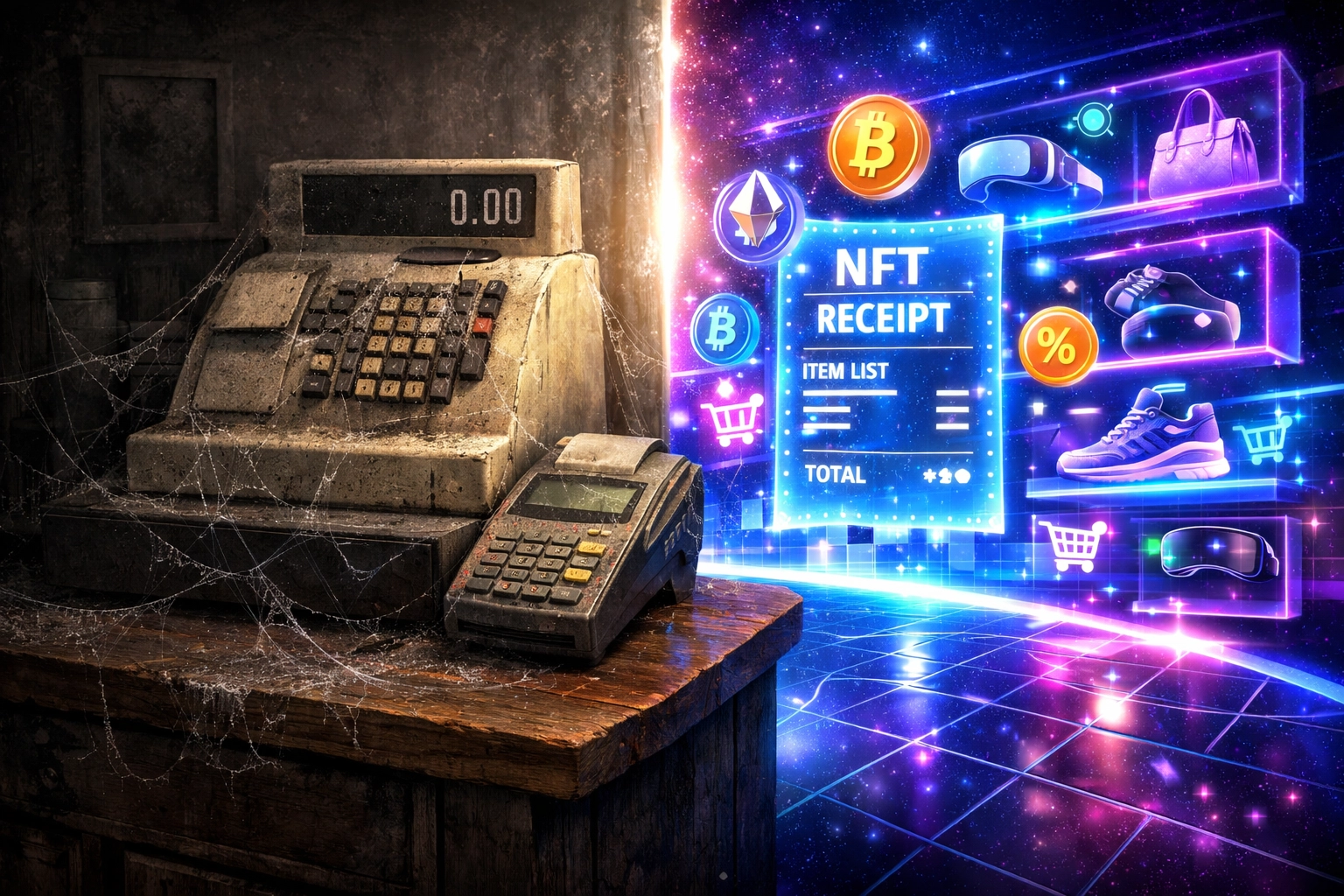
The brands winning in 2026 are building payment systems for spatial commerce from day one. Not retrofitting decades-old hardware.
Why Traditional Systems Can't Keep Up
Traditional POS infrastructure has three fatal flaws for metaverse commerce:
Hardware dependency. Physical terminals limit where transactions happen. Virtual stores don't have counters.
Centralized processing. Every transaction routes through intermediaries. Interchange fees stack up. Settlement takes days.
No programmable receipts. Paper or email confirmations can't unlock digital experiences or verify authenticity on secondary markets.
Contactless payments reduced checkout time by 50% versus cash or chip cards. That was a step forward. But it's still anchored to physical locations.
The next generation of commerce happens anywhere. Virtual malls. AR overlays in physical stores. Social spaces where friends shop together across continents.
Your POS system needs to follow your customers into these environments. Or you'll lose them to competitors who already have.
Larecoin's Technical Edge: Built for Metaverse-First Commerce
Larecoin doesn't retrofit legacy systems. It rebuilds payment infrastructure for how people actually shop in 2026.
NFT Receipts: Every transaction generates an on-chain receipt. Permanent proof of purchase. Verifiable authenticity for resale markets. Built-in loyalty program structure. Physical products get digital twins automatically.
LUSD Stablecoin Integration: Customers who want price stability can pay with LUSD. No volatility exposure. Instant settlement. Self-custody stays intact.
Gas-Only Transfers: Merchants receive 100% of transaction value. No processing fees. No interchange rates. Just network gas costs that average under $0.01 per transaction.
Self-Custody Architecture: Merchants control their funds. Master wallets for business operations. Sub-wallets for department tracking. No custodial risk. No frozen accounts.
Traditional processors can't offer this. They're locked into centralized rails that charge 2-3% per transaction. They don't support NFT receipts. They don't enable self-custody. They're optimized for physical checkout lanes, not virtual shopping experiences.
The Cost Savings Reality: Over 50% Fee Reduction
Legacy payment processing costs merchants dearly. Interchange fees average 2-3%. Hardware leases add monthly costs. Chargeback fees stack up.
Larecoin eliminates most of these expenses.
No interchange fees. Crypto transfers don't route through card networks. Merchants keep what customers pay.
QR-generated POS. No hardware leases. Generate payment QR codes from any device. Customers scan and pay. Transaction complete.
Master/sub-wallet structure. Track department performance without multiple processing accounts. Allocate funds instantly. No wire transfer fees.
For a merchant processing $100,000 monthly, traditional systems cost $2,000-$3,000 in fees. Larecoin's gas-only model costs under $100. That's a 95%+ reduction.
Scale that across a year. Five years. The savings compound dramatically.
This isn't theoretical. It's math. Check out the full breakdown of how Web3 payments cut merchant costs.
How Larecoin Stacks Against Competitors
NOWPayments, CoinPayments, and Triple-A all process crypto transactions. But none are built for metaverse commerce.
NOWPayments: Strong for basic crypto checkout. No NFT receipts. No metaverse integration. No native stablecoin. Still requires merchants to trust custodial wallets.
CoinPayments: Wide token support. High processing fees (0.5%). No spatial commerce tools. No B2B2C social shopping infrastructure.
Triple-A: Good for enterprise crypto payments. Custodial model. No self-custody option. No VR/AR shopping framework.
Larecoin combines the technical advantages of crypto payments with infrastructure designed specifically for virtual commerce environments. You're not just accepting crypto. You're building a presence in the next generation of retail.

The Larecoin B2B2C Metaverse Vision
Traditional POS systems process transactions. Larecoin builds ecosystems.
The B2B2C metaverse model flips conventional e-commerce. Instead of merchants operating isolated storefronts, they participate in shared social spaces where customers discover products organically.
Virtual showrooms. Display full product catalogs in 3D. Let customers interact with items before purchase. No warehouse needed.
Social shopping experiences. Customers invite friends into virtual stores. Browse together. Get real-time feedback. Purchase collectively.
Cross-platform presence. Same payment infrastructure works in VR headsets, AR mobile apps, traditional websites, and physical locations.
Community-driven discovery. Customers share favorite products in social feeds. NFT receipts prove authenticity. Secondary markets form naturally.
This isn't futuristic speculation. The infrastructure exists now. Brands already testing metaverse commerce are seeing engagement metrics that dwarf traditional e-commerce. Because shopping becomes experience, not transaction.
Traditional POS terminals can't facilitate any of this. They were designed for "customer approaches counter, pays, leaves" scenarios. Metaverse commerce is "customer enters space, explores, socializes, discovers, purchases, shares."
Compliance: The Competitive Advantage Nobody Talks About
Crypto payments sound risky to traditional merchants. They're not. When you choose properly licensed providers.
Larecoin maintains federal MSB registration and state-level MTL coverage across the U.S. That's not standard in crypto payments. Many processors operate in regulatory gray areas. Some actively avoid licensing.
Why does this matter for merchants?
Legal protection. You're not exposed to partner compliance failures.
Bank relationship preservation. Properly licensed crypto payment processing doesn't jeopardize your traditional banking relationships.
Audit readiness. Clean compliance documentation for tax purposes and financial audits.
Long-term stability. Providers without proper licensing face enforcement risk. Your payment infrastructure shouldn't disappear overnight.
Competitors like NOWPayments and CoinPayments don't always maintain this level of regulatory compliance. That creates downstream risk for merchants. When regulators tighten crypto oversight: and they will: properly licensed providers will be the only ones left standing.

What Happens Next
Traditional POS systems will continue declining. Not because the hardware fails. Because the transaction model they represent is obsolete.
Customers increasingly shop across physical and digital environments simultaneously. They expect payment experiences that work everywhere. They want receipts that unlock digital experiences. They demand transparency and self-custody.
Legacy payment processors can't adapt fast enough. They're constrained by decades of infrastructure decisions that prioritized centralization and control.
Metaverse shopping in 2026 isn't replacing physical retail. It's extending it. Merchants need payment systems built for this hybrid reality.
Larecoin delivers that infrastructure today. NFT receipts. LUSD stability. Self-custody. Sub-wallet organization. Federal and state compliance. And a B2B2C metaverse where your products exist in social contexts that drive organic discovery.
Traditional POS isn't quite dead. But it's terminal.
The question isn't whether metaverse shopping will change payment acceptance. It's whether your business will be ready when customers expect it.
Get started with Larecoin and build payment infrastructure for where commerce is actually heading.
Comments