

.png)
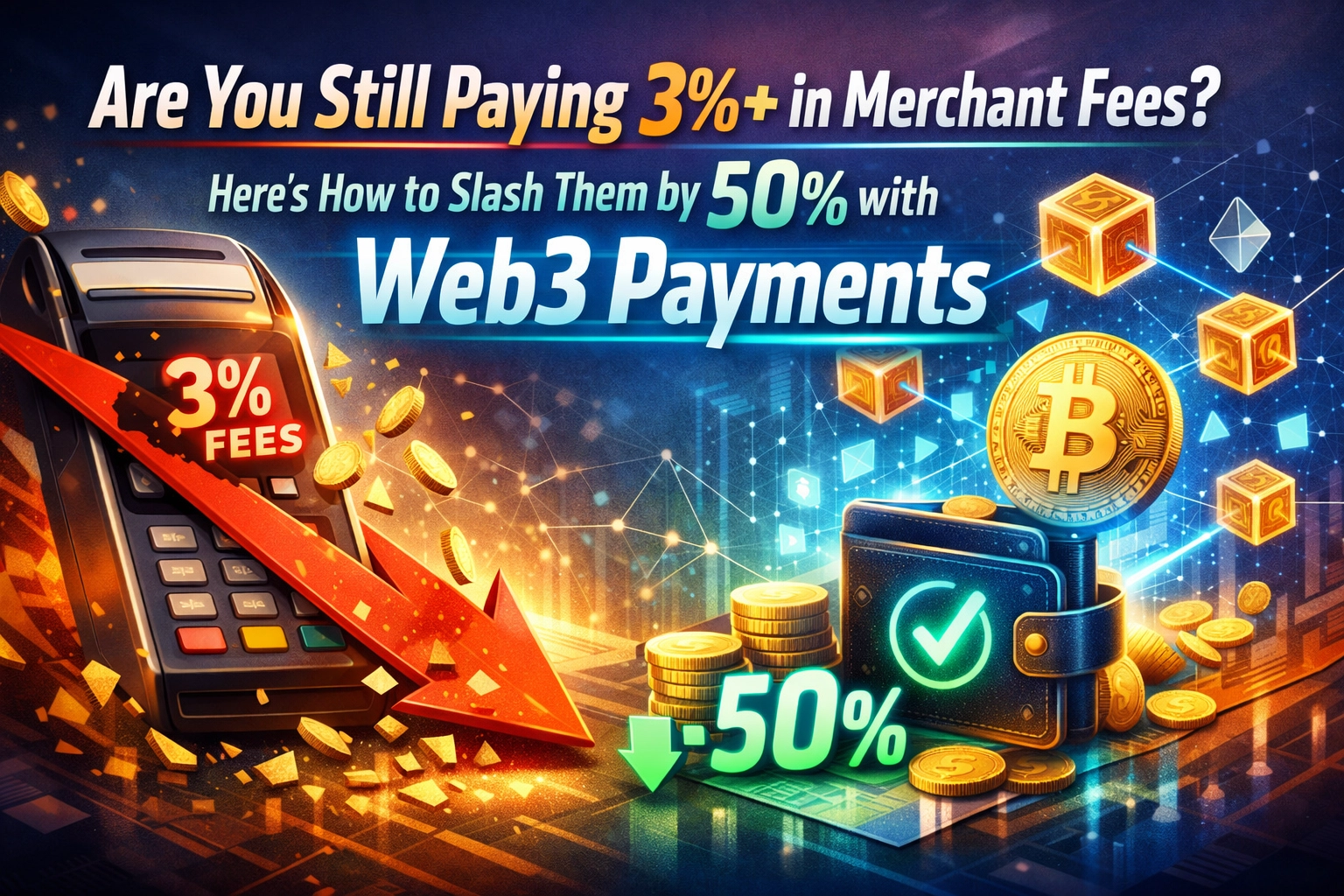
Are You Still Paying 3%+ in Merchant Fees? Here's How to Slash Them by 50% with Web3 Payments
- [[[Free!!]<<<<]] Watch: 스포르팅 - 토트넘 Live Stream 13 September 2022
- 2 hours ago
- 5 min read
![Writer: [[[Free!!]<<<<]] Watch: 스포르팅 - 토트넘 Live Stream 13 September 2022](https://lh3.googleusercontent.com/a/AItbvmktwQc0wCdd3ZEETSYItRQubwwBzOyjD_dcigRf=s96-c)
The Merchant Fee Problem Is Bleeding Your Business Dry
Every swipe costs you money.
Traditional payment processors are extracting 2-3% from every single transaction. That's $2,000 to $3,000 for every $100,000 you process.
Do the math on your annual revenue.
If you're doing $1 million in sales, you're hemorrhaging $20,000-$30,000 in fees alone. Hit $5 million? That's $100,000-$150,000 gone before you even pay rent or payroll.
These fees aren't negotiable. They're baked into the legacy financial system.
Until now.

Why Legacy Payment Systems Are Expensive (And Always Will Be)
Traditional card networks operate on a 1970s infrastructure.
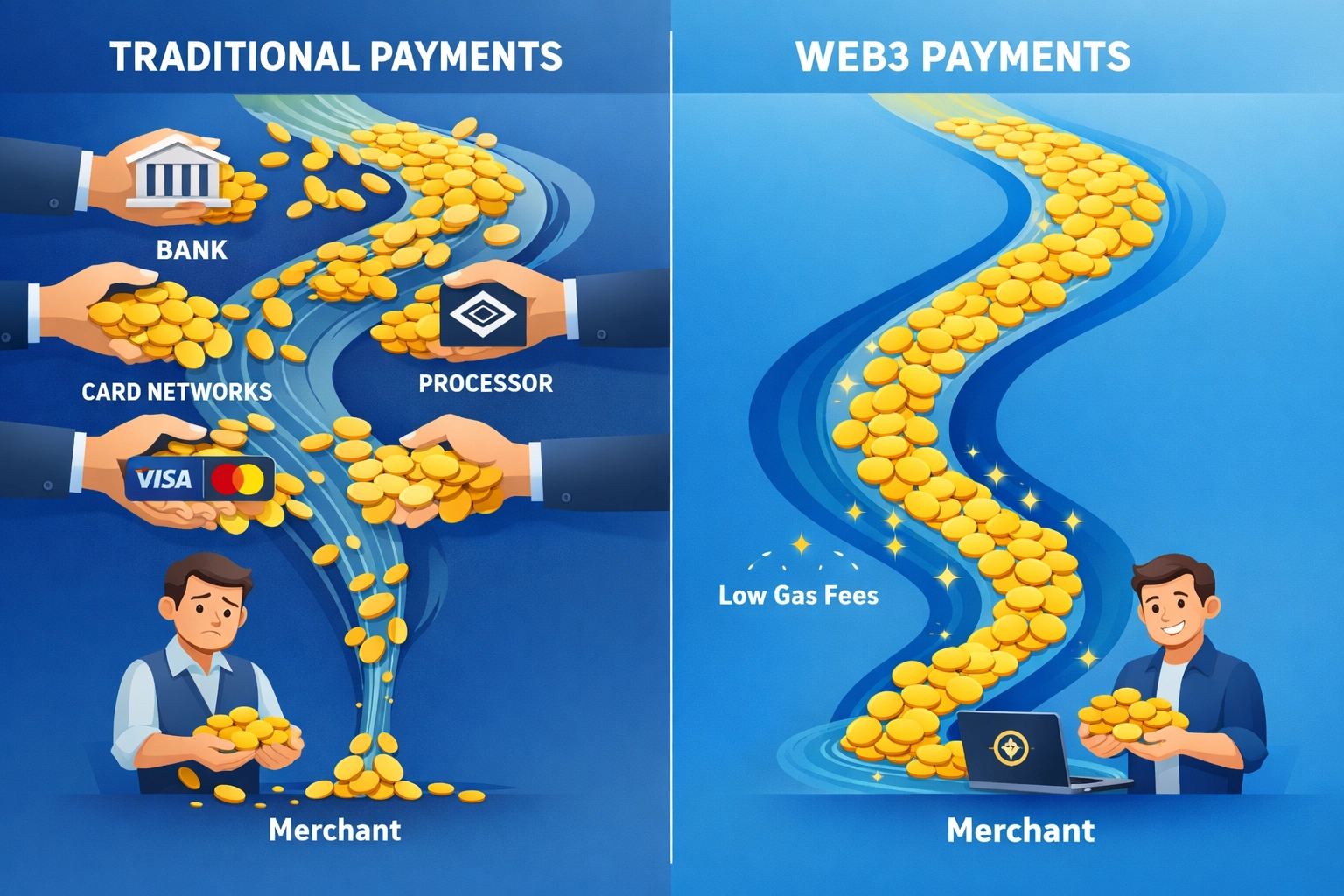
Every transaction passes through multiple gatekeepers:
Issuing bank
Card network (Visa, Mastercard)
Acquiring bank
Payment processor
Gateway provider
Each entity takes a cut. That's why your fees are 2-3% minimum: everyone needs to get paid.
The system wasn't designed for efficiency. It was designed for control.
Web3 payments eliminate these middlemen entirely.
How Web3 Payments Cut Fees by 50-80%
Blockchain-based settlements bypass legacy infrastructure completely.
No banks. No card networks. No payment processors extracting percentage fees.
Just direct peer-to-peer value transfer.
The Gas-Only Model
Instead of percentage-based fees, Web3 payments use a gas-only model. You pay only the blockchain network fee required to process the transaction.
These fees are negligible at scale.
Processing $5 million annually? Traditional systems charge $100,000-$150,000 in fees. Gas-only Web3 systems? Around $5,000.
That's a $95,000 difference you keep in your business.
Real Numbers: What You Actually Save
Let's break down the savings by volume:
$1 Million Annual Processing
Traditional 2-3%: $20,000-$30,000 in fees
Web3 gas-only: ~$2,000 in fees
Your savings: $18,000-$28,000
$5 Million Annual Processing
Traditional 2-3%: $100,000-$150,000 in fees
Web3 gas-only: ~$5,000 in fees
Your savings: $95,000-$145,000
$10 Million Annual Processing
Traditional 2-3%: $200,000-$300,000 in fees
Web3 gas-only: ~$10,000 in fees
Your savings: $190,000-$290,000
That's real money. Money you can reinvest in inventory, hiring, marketing, or your own pocket.
The difference compounds over time.
Not All Crypto Payment Systems Are Equal
Some crypto processors still charge percentage fees.
NOWPayments charges 0.5% per transaction plus network fees and withdrawal fees. Better than 2-3%, but you're still paying percentage-based extraction.
CoinPayments charges 0.5-1% per transaction with similar additional fees. Same problem: scaled-down percentage fees that grow with your revenue.
These platforms offer convenience and broad cryptocurrency support. But they're fundamentally still charging you based on transaction volume.
The more you make, the more they take.
That's not financial sovereignty. That's just a cheaper landlord.

Larecoin's Gas-Only Advantage
Larecoin operates on a pure gas-only model.
Zero platform fees. Zero percentage extraction. Zero withdrawal charges.
You pay only the blockchain network cost to settle the transaction. That's it.
Self-Custody Payments
Larecoin payments settle directly to your wallet. No custodial accounts. No withdrawal delays. No permission needed to access your funds.
Your money. Your keys. Your control.
NFT Receipt Technology
Every Larecoin payment generates an immutable NFT receipt. Permanent proof of transaction. Built-in compliance. Zero dispute resolution fees.
These receipts live on-chain forever. No third-party servers. No data loss. No subscription fees for record-keeping.
LUSD Stablecoin Integration
Accept crypto. Settle in stablecoins. Eliminate volatility risk.
Larecoin's LUSD integration lets you receive payment in any supported cryptocurrency while automatically settling in dollar-pegged stablecoins.
Price stability without traditional banking rails.
Why Gas-Only Matters for High-Volume Merchants
Percentage fees punish success.
The more revenue you generate, the more traditional processors extract. It's a tax on growth.
Gas-only models flip this equation.
Your 1,000th transaction costs the same as your first. Network fees don't scale with transaction value: they scale with network congestion, which is predictable and manageable.
Real Example:
Merchant processes 10,000 transactions monthly at $200 average order value.
Total monthly volume: $2,000,000
Traditional 2.5% fees: $50,000/month ($600,000/year)
NOWPayments 0.5% fees: $10,000/month ($120,000/year)
Larecoin gas-only: ~$800/month ($9,600/year)
Larecoin saves this merchant $590,400 annually compared to traditional processing.
That's half a million dollars staying in the business instead of leaking to payment processors.

The Self-Custody Requirement
Web3 payments require self-custody.
You manage your own wallet. You control your private keys. You're responsible for security.
This isn't a bug. It's the feature that enables zero-fee payments.
Custodial solutions charge fees because they hold your funds, manage security, handle compliance, and provide recovery services. Those costs get passed to merchants as percentage fees.
Self-custody eliminates these intermediaries.
No one can freeze your account. No one can reverse your payments without your consent. No one can charge you platform fees for holding your own money.
The tradeoff: you need basic Web3 literacy and secure wallet management practices.
For merchants processing significant volume, this learning curve pays for itself immediately in fee savings.
Beyond Fee Savings: The Full Web3 Stack
Larecoin isn't just about cheaper payments.
Cross-Border Settlement
Accept payments from anywhere. Settle instantly. No currency conversion fees. No international wire delays. No correspondent banking fees.
Global commerce without global banking friction.
Smart Contract Integration
Automate payment splitting, escrow releases, recurring billing, and subscription management through programmable smart contracts.
No middleware. No platform fees. Just code executing exactly as written.
Composable Payment Infrastructure
Build custom payment flows. Integrate with existing Web3 tools. Connect to DeFi protocols for instant liquidity or yield generation.
Your payment stack becomes programmable infrastructure instead of a black-box service.
Making the Switch: What to Consider
Volume Requirements
Gas-only models shine at scale. If you're processing under $50,000 monthly, the percentage difference might not justify the self-custody learning curve.
Above $100,000 monthly? The savings become substantial enough to warrant the switch.
Technical Comfort
You need basic Web3 wallet management skills. Creating wallets, managing seed phrases, verifying transactions, monitoring gas fees.
Not difficult, but different from traditional payment dashboards.
Cryptocurrency Acceptance
Your customers need cryptocurrency to pay. The market is growing, but it's not universal yet.
Many merchants run dual systems: traditional payments for mainstream customers, Web3 payments for crypto-native buyers who value privacy and lower costs.
The 10-Year Perspective
Payment infrastructure evolves slowly.
Credit cards took 30 years to achieve mainstream adoption. Digital payments took 15 years. Web3 payments are on an accelerated curve.
Early adopters capture disproportionate advantages.
Lower fees mean higher margins. Higher margins mean more competitive pricing. More competitive pricing means faster growth.
Merchants who optimize payment infrastructure today position themselves ahead of competitors still paying 3% extraction fees.
The savings compound. The competitive advantage grows.
Your Next Move
Calculate your current annual payment processing fees.
Multiply your yearly revenue by 0.025 (2.5% average).
That's your current cost.
Now multiply your yearly revenue by 0.0001 (0.01% gas-only estimate).
That's your potential cost with Larecoin.
The difference is your annual savings.
What would you do with that capital back in your business?
Stop paying 3% extraction fees to legacy payment processors. Switch to gas-only Web3 payments and keep the profits you earn.
Your business. Your payments. Your profits.
Welcome to Web3 commerce.
Comments