

.png)
CoinPayments Vs Larecoin: The Ultimate Guide to Self-Custody Merchant Freedom
- [[[Free!!]<<<<]] Watch: 스포르팅 - 토트넘 Live Stream 13 September 2022
- 2 hours ago
- 4 min read
![Writer: [[[Free!!]<<<<]] Watch: 스포르팅 - 토트넘 Live Stream 13 September 2022](https://lh3.googleusercontent.com/a/AItbvmktwQc0wCdd3ZEETSYItRQubwwBzOyjD_dcigRf=s96-c)
Merchant freedom starts with one question: Who controls your money?
CoinPayments and Larecoin both process crypto payments. But they operate on completely different philosophies. One holds your funds. The other sends them straight to your wallet. One charges percentage fees that scale with your success. The other charges only blockchain gas.
Let's break down what actually matters for your business.
The Fee Structure Battle: Percentage vs Gas-Only
CoinPayments charges 0.5-1% platform fees on every transaction. Plus network costs. Plus withdrawal fees when you want to access your money.
Larecoin charges zero platform fees. Just Solana network gas costs of $0.001-$0.02 per transaction.
Here's what that looks like at scale:
Processing $500,000 annually? CoinPayments costs you $2,500-$5,000. Larecoin stays under $2,000. That's 50-60% savings.
Hit $1 million in annual volume? CoinPayments takes $5,000-$10,000. Larecoin remains under $2,000. Now you're saving 67-83%.
Scale to $5 million? CoinPayments extracts roughly $25,000. Larecoin costs approximately $5,000. Savings jump to 50-80%.
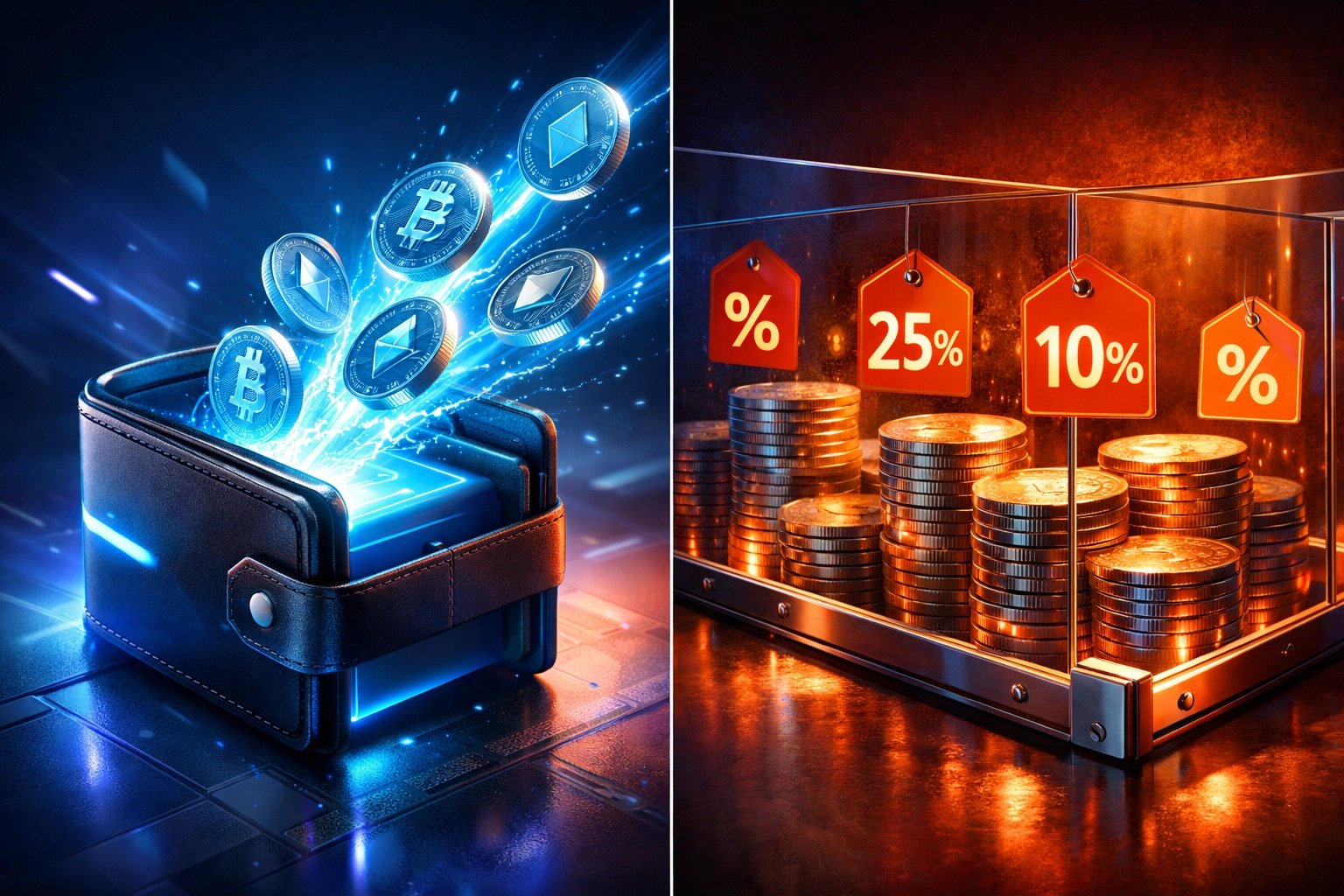
The pattern is clear. Percentage-based fees punish growth. Gas-only fees reward it.
Every dollar you process with percentage-based systems makes them richer. With gas-only models, every dollar makes YOU richer.
Self-Custody vs Custodial Control: Who Owns Your Money?
CoinPayments uses a custodial model. They hold your cryptocurrency. You request withdrawals. They process them (eventually). You pay fees to access your own money.
This creates three major problems:
Problem 1: Counter-party risk. Your funds sit in their wallet. If CoinPayments faces regulatory issues, hacks, or business problems, your money is caught in the crossfire.
Problem 2: Withdrawal delays. Minutes to hours. Sometimes longer. Your capital is frozen while they process requests.
Problem 3: Withdrawal fees. You already paid processing fees. Now you pay again to access your funds.
Larecoin operates differently. Complete self-custody from the first transaction.
Funds settle directly to your wallet with sub-second finality. No withdrawal requests. No processing delays. No fees to access your money. Because it's already in your wallet.
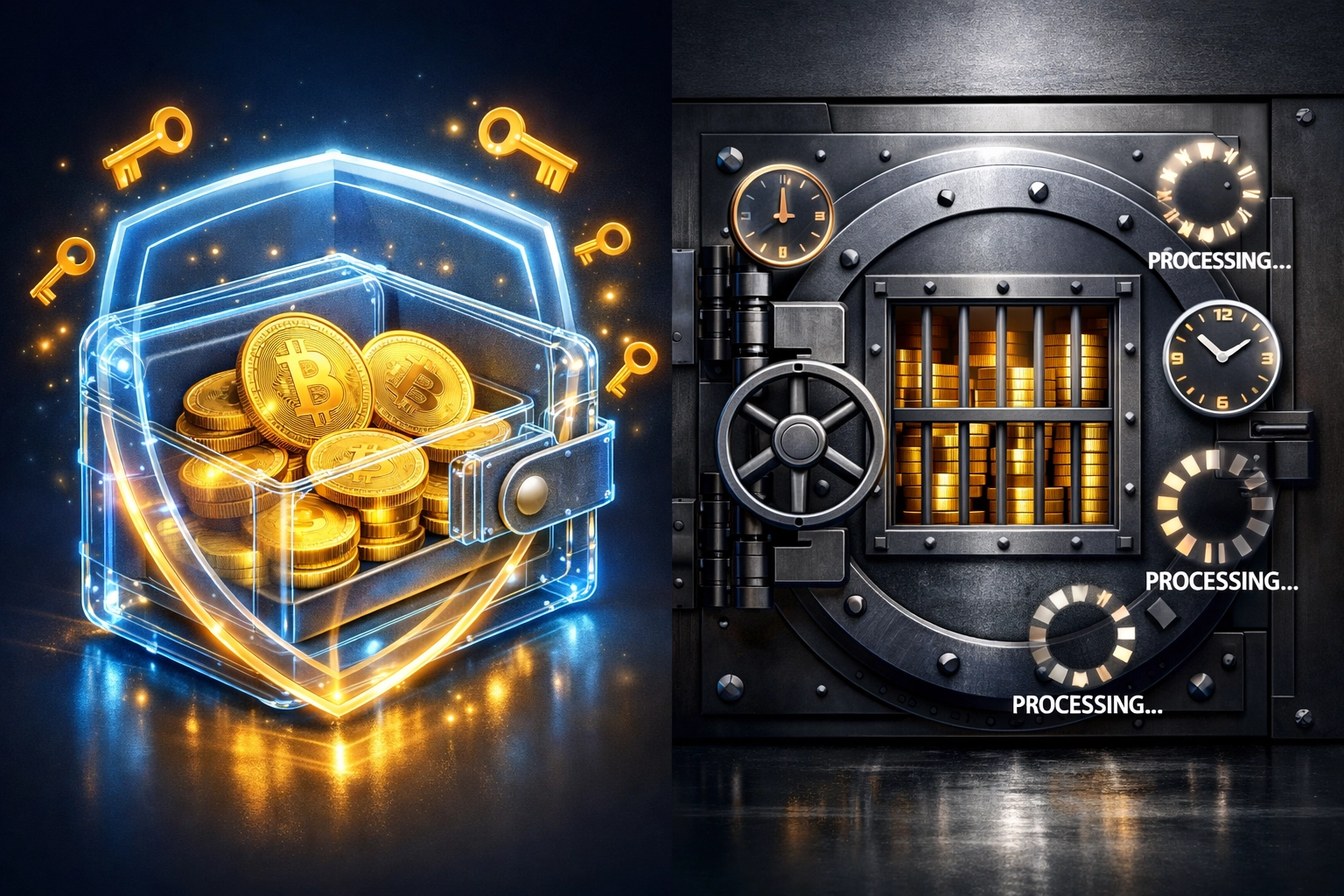
This isn't just about convenience. It's about financial sovereignty. Your wallet. Your keys. Your funds. Always.
Settlement Speed: Minutes vs Seconds
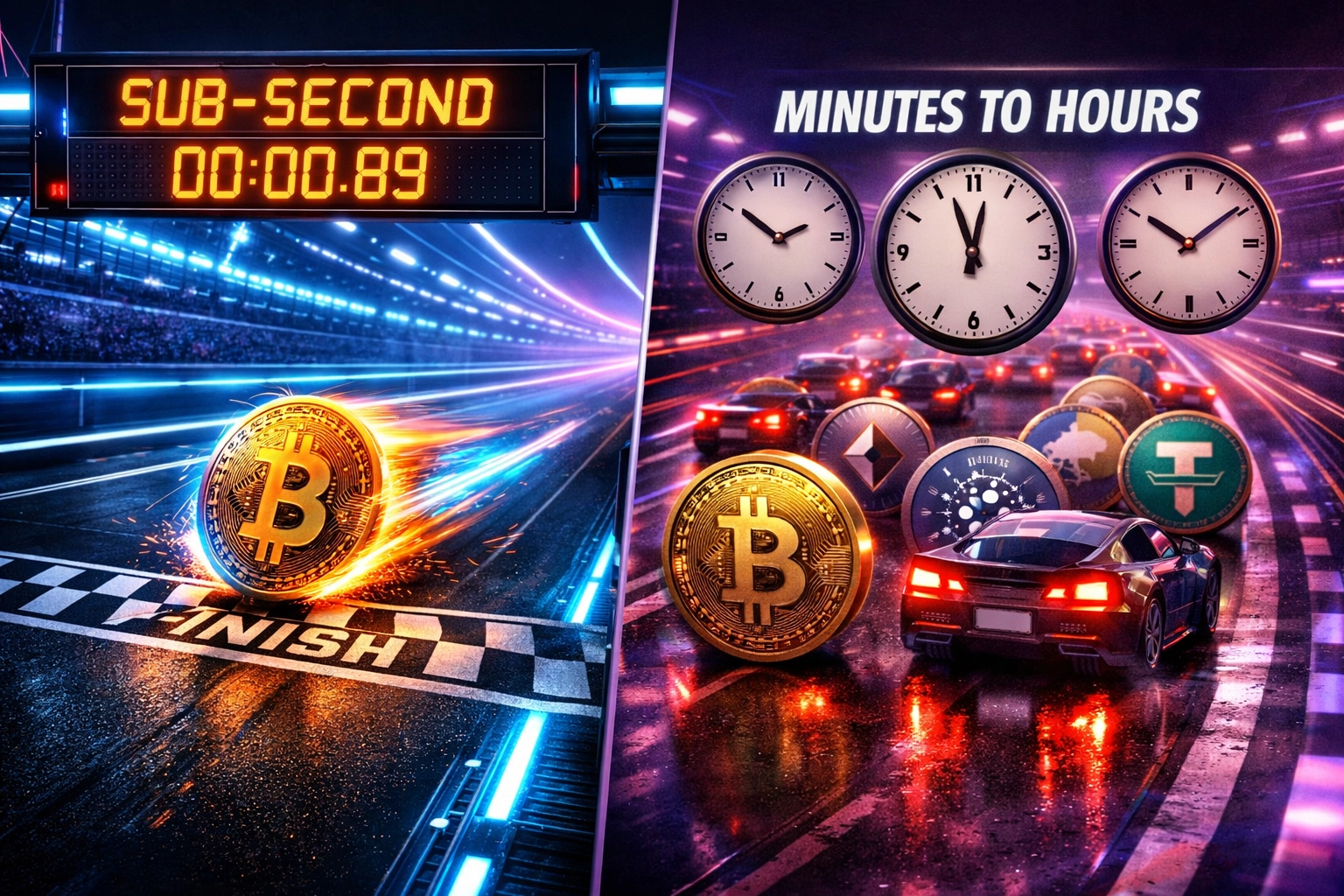
CoinPayments processes transactions in minutes to hours depending on the blockchain. Bitcoin takes longer. Ethereum takes longer. Multi-chain support means inconsistent settlement times.
Larecoin achieves sub-second transaction finality. Complete processing in 2-3 minutes. Every time. No exceptions.
Why does speed matter?
Cash flow. Faster settlement means faster access to working capital. You can reinvest, restock, or pay expenses immediately.
Risk management. Crypto markets move fast. Extended settlement windows expose you to price volatility. Sub-second finality locks in values instantly.
Customer experience. Faster confirmations mean smoother checkout processes. No waiting. No uncertainty.
Speed isn't everything. But when combined with self-custody and zero platform fees, it becomes a competitive advantage.
The Innovation Gap: Standard Features vs Web3 Native
CoinPayments offers extensive altcoin support. Their API documentation is solid. They've been around since 2013. They're reliable in a traditional sense.
But they're building on Web2 infrastructure with Web3 tokens. It's crypto payments, not crypto-native commerce.
Larecoin is purpose-built for Web3 commerce from the ground up:
NFT receipts for every transaction. Not just proof of payment. Collectible, tradable, programmable receipts that unlock loyalty programs, membership access, and secondary market opportunities.
LUSD stablecoin integration. Native stablecoin eliminates volatility concerns without leaving the ecosystem. Accept LARE, settle in LUSD, spend in either.
DeFi integration. Your merchant wallet connects directly to liquidity pools, yield farming, and decentralized exchanges. Your working capital earns returns between transactions.
Smart wallets. Multi-sig support, spending limits, automated payments, and programmable treasury management built into the merchant experience.
LareBlocks blockchain. Purpose-built Layer 1 optimized specifically for commerce. Not a general-purpose blockchain adapted for payments. A commerce blockchain from day one.
These aren't add-ons. They're fundamental architecture decisions that change what's possible.
The Cost Analysis Deep Dive
Let's get specific with real merchant scenarios.
Scenario 1: Small online retailer processing $50,000 monthly
CoinPayments: $250-$500/month in platform fees + network costs + withdrawal fees = ~$300-$600/month
Larecoin: ~$15-$100/month in gas costs = ~$15-$100/month
Annual savings: $3,420-$6,000
Scenario 2: Mid-size e-commerce store processing $250,000 monthly
CoinPayments: $1,250-$2,500/month in platform fees + network costs + withdrawal fees = ~$1,500-$3,000/month
Larecoin: ~$75-$500/month in gas costs = ~$75-$500/month
Annual savings: $17,100-$30,000
Scenario 3: High-volume merchant processing $1,000,000 monthly
CoinPayments: $5,000-$10,000/month in platform fees + network costs + withdrawal fees = ~$6,000-$12,000/month
Larecoin: ~$300-$2,000/month in gas costs = ~$300-$2,000/month
Annual savings: $68,400-$120,000
The math is undeniable. Percentage-based fees compound your costs. Gas-only fees keep them fixed.
Which Platform for Which Merchant?
CoinPayments makes sense if you need maximum altcoin support. If your customers demand obscure tokens and you need compatibility with 100+ different cryptocurrencies, their multi-chain infrastructure delivers.
CoinPayments also works if you prefer custodial arrangements. Some merchants want a platform to handle security, key management, and wallet operations. That convenience comes with trade-offs, but it's a valid preference.
Larecoin wins on cost efficiency, self-custody, settlement speed, and Web3 innovation. If you're building for the future of commerce: not just accepting crypto as an alternative payment method: Larecoin provides infrastructure that scales with your vision.
The question isn't which platform is "better." It's which platform aligns with your business philosophy.
The Freedom Equation
Merchant freedom = Control + Cost efficiency + Settlement speed + Innovation potential
CoinPayments delivers on altcoin variety and established reliability.
Larecoin delivers on every element of the freedom equation.
Self-custody means you control funds from transaction one. Gas-only fees mean costs stay predictable as you scale. Sub-second finality means instant access to working capital. NFT receipts, LUSD, DeFi integration, and LareBlocks blockchain mean you're building on tomorrow's infrastructure today.
Traditional crypto payment processors adapted Web2 business models for Web3 tokens. They charge like credit card processors. They hold funds like banks. They process like legacy systems.
Larecoin started with the question: What would crypto-native commerce look like if we designed it from scratch?
The answer is a gas-only fee model, complete self-custody, sub-second settlement, programmable receipts, and a purpose-built blockchain optimized for merchant freedom.
Make the Switch
Volume merchants already know the truth. Percentage-based fees are expensive at scale. Every transaction chips away at your margins. Every withdrawal request delays your capital deployment. Every custodial arrangement introduces counter-party risk.
Check out how Web3 global payments are solving real-world problems or dive into reducing merchant interchange fees.
The infrastructure is live. The savings are real. The freedom is immediate.
Your funds. Your wallet. Your control. That's merchant freedom.
Visit larecoin.com to get started today.
Comments