

.png)
How the CLARITY Act Unlocks Larecoin's Full Potential: Layer 1 Infrastructure, NFT Receipts, and 50% Lower Fees Explained
- [[[Free!!]<<<<]] Watch: 스포르팅 - 토트넘 Live Stream 13 September 2022
- 2 hours ago
- 4 min read
![Writer: [[[Free!!]<<<<]] Watch: 스포르팅 - 토트넘 Live Stream 13 September 2022](https://lh3.googleusercontent.com/a/AItbvmktwQc0wCdd3ZEETSYItRQubwwBzOyjD_dcigRf=s96-c)
February 2026 just got a whole lot more interesting.
The CLARITY Act passed. Crypto payments changed overnight. And Larecoin's full infrastructure is now operating with zero regulatory gray area.
Here's what that actually means for merchants, developers, and anyone sick of paying 3-7% fees to legacy payment processors.
The CLARITY Act: Commodity Status = Game Over for Regulatory Uncertainty
H.R. 3633 reclassified Larecoin as a digital commodity under CFTC jurisdiction.
Not a security. Not trapped in SEC purgatory. A commodity.
This classification unlocked three immediate advantages:
No registration requirements that kill crypto payment processors
Direct institutional liquidity access without compliance nightmares
Predictable legal framework that traditional processors can't match
The "mature blockchain test" in the CLARITY Act? LareBlocks meets every single criterion. Decentralized validators. No controlling party. Transparent consensus mechanisms visible on LareScan.
Translation: Merchants can now accept Larecoin payments with the same regulatory certainty as accepting dollars. Except with 50% lower fees.
LareBlocks: The Layer 1 Infrastructure Nobody Talks About (Until Now)
Most crypto payment platforms ride on someone else's blockchain. Ethereum. Polygon. Solana. Whatever's cheapest this month.
Larecoin built its own. LareBlocks is a dedicated Layer 1 blockchain processing 100% of Larecoin transactions.
Why does this matter?
Direct Settlement = No Multi-Hop Fees
Every transaction settles directly on LareBlocks. Zero intermediary blockchains. Zero bridge fees. Zero waiting for cross-chain confirmations.
When a customer pays with Larecoin at checkout, that transaction:
Processes on LareBlocks
Settles in seconds
Costs under 1% in fees
Generates an NFT receipt (more on this below)
Compare that to NOWPayments routing through multiple blockchains, eating 2.5% in fees before you even factor in currency conversion spreads.
The Infrastructure Stack Merchants Actually Need
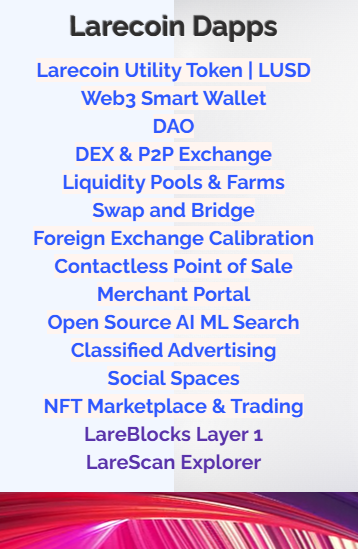
LareBlocks isn't just transaction settlement. It's the full payment infrastructure:
Smart Wallet Technology – Master/sub-wallet architecture for business treasury management
Decentralized Validators – No single point of failure
Real-Time Explorer – Every transaction visible on LareScan
Gas-Only Transfers – Send tokens without burning through fees
All operating under CLARITY Act commodity classification. All exempt from security registration requirements that crush competitors.
NFT Receipts: The Feature Nobody Asked For (But Every Merchant Needs)
Here's where Larecoin gets weird in the best way.
Every transaction on LareBlocks automatically generates an immutable NFT receipt.
Not some gimmick. Not a marketing stunt. A functional piece of infrastructure that solves real problems.
What NFT Receipts Actually Do
1. Warranty Tracking Without Paper Trails
Customer buys a product. NFT receipt stores purchase date, item details, warranty terms. No lost receipts. No "sorry, we can't find that in our system."
Return window expires? The NFT proves it. Warranty claim? The blockchain verifies authenticity.
2. Loyalty Program Integration
Every purchase mints proof of transaction. Smart contracts automatically issue rewards. No point-tracking database. No expired coupons. Just permanent, verifiable purchase history.
3. Fraud Prevention Through Immutability
Chargebacks plague traditional processors. With NFT receipts, both parties hold cryptographic proof of transaction terms. Timestamps are permanent. Details can't be altered.
4. Tax Documentation That Doesn't Suck
Business expense tracking becomes automatic. Every Larecoin purchase generates a blockchain-verified receipt. Export to accounting software. Done.
CoinPayments offers transaction history. Triple-A provides invoices. Larecoin gives you permanent, immutable, blockchain-verified proof stored as an NFT.
Different category entirely.

The 50% Fee Savings Breakdown (With Actual Numbers)
"Lower fees" means nothing without context.
Here's the comparison merchants actually care about:
Traditional Payment Processor Math
Processing $100,000 monthly through legacy rails:
Base interchange: 2.9% = $2,900
Cross-border fees: 1.5% = $1,500
Currency conversion spread: 2% = $2,000
Monthly total: $6,400
Crypto Competitor Math (NOWPayments, CoinPayments)
Same $100,000 monthly volume:
Platform fee: 0.5-1% = $500-$1,000
Blockchain gas fees: $200-$500 (varies by network)
Conversion spread: 1-2% = $1,000-$2,000
Monthly total: $1,700-$3,500
Larecoin Math
$100,000 monthly through LareBlocks:
Platform fee: <1% = <$1,000
Gas fees: Negligible (native Layer 1)
No conversion spread (direct settlement)
Monthly total: <$1,000
Annual savings vs. legacy processors: $54,000-$76,800 Annual savings vs. crypto competitors: $8,400-$30,000
That's not marketing speak. That's infrastructure efficiency.

Why the CLARITY Act Changes Everything
Pre-CLARITY Act, every crypto payment processor operated in legal limbo.
Is our token a security? Will the SEC come knocking? Can we access institutional liquidity? Should we register as a money transmitter?
Those questions killed innovation. Made compliance teams pull their hair out. Forced platforms to build for regulatory uncertainty instead of merchant needs.
The CLARITY Act answered every single question:
✅ Larecoin = Commodity ✅ CFTC jurisdiction (not SEC) ✅ Clear legal framework ✅ Institutional access unlocked ✅ No security registration needed
Combined with LareBlocks Layer 1 infrastructure and NFT receipt technology, you get:
Regulatory certainty
Direct settlement
Permanent transaction records
50% lower fees than competitors
No other payment platform offers this combination. Because no other platform built a dedicated Layer 1 blockchain before regulatory clarity arrived.
The Merchant Advantage Stack
Here's what merchants get when they plug into Larecoin:
Infrastructure Layer
LareBlocks Layer 1 settlement
Master/sub-wallet treasury management
Push-to-Card services for instant fiat conversion
LUSD stablecoin for price stability
Receipt Technology
NFT-based transaction records
Blockchain-verified warranties
Automated loyalty program integration
Tax-ready documentation
Fee Structure
Sub-1% platform fees
No hidden conversion spreads
No cross-border surcharges
50% savings vs. NOWPayments/CoinPayments
Regulatory Compliance
CLARITY Act commodity classification
CFTC oversight (not SEC)
Predictable legal framework
Institutional-grade infrastructure
Traditional processors can't compete with this stack. They're stuck with interchange fees, currency conversion spreads, and banking intermediaries eating margins.
Crypto competitors? They're routing through third-party blockchains, paying gas fees, and operating in regulatory gray zones.
Larecoin built different. Layer 1 infrastructure. CLARITY Act compliance. NFT receipts. All operational. All live.
What Happens Next
The CLARITY Act passed. Larecoin is classified as a commodity. LareBlocks processes transactions. NFT receipts mint with every purchase.
Merchants save 50% on fees. Customers get blockchain-verified receipts. Developers build on infrastructure with regulatory certainty.
The full payment ecosystem is live. The regulatory framework is locked in. The infrastructure advantage is permanent.
Check out the full Larecoin ecosystem and see how Layer 1 infrastructure changes the payment game.
Or keep paying 3-7% to legacy processors. Your call.
Comments