

.png)
Social Impact Meets Web3: Why Larecoin's 1.5% Charity Tax Will Change the Way You Think About Crypto Payments
- [[[Free!!]<<<<]] Watch: 스포르팅 - 토트넘 Live Stream 13 September 2022
- 2 hours ago
- 5 min read
![Writer: [[[Free!!]<<<<]] Watch: 스포르팅 - 토트넘 Live Stream 13 September 2022](https://lh3.googleusercontent.com/a/AItbvmktwQc0wCdd3ZEETSYItRQubwwBzOyjD_dcigRf=s96-c)
Let's be honest. Crypto has an image problem.
We talk about decentralization and financial freedom. Meanwhile, most people see speculation, volatility, and get-rich-quick schemes.
But what if every crypto payment you made automatically fed hungry people? Not as an opt-in checkbox. Not as a marketing gimmick. As a hardcoded protocol rule.
That's exactly what Larecoin built.
The 1.5% That Changes Everything
Here's how it works: every transaction on Larecoin automatically allocates 1.5% to verified charitable organizations.
You buy coffee with LUSD stablecoin? 1.5% goes to charity.
Your enterprise processes payroll through master wallets? 1.5% goes to charity.
Someone purchases a gift card with LARE tokens? 1.5% goes to charity.
Zero additional steps. Zero opt-in forms. Zero "would you like to round up your purchase?" prompts.

It's protocol-enforced through smart contracts on LareBlocks, our Layer 1 blockchain. You literally cannot process a payment without the charity allocation happening simultaneously.
The Math That Breaks Traditional Payments
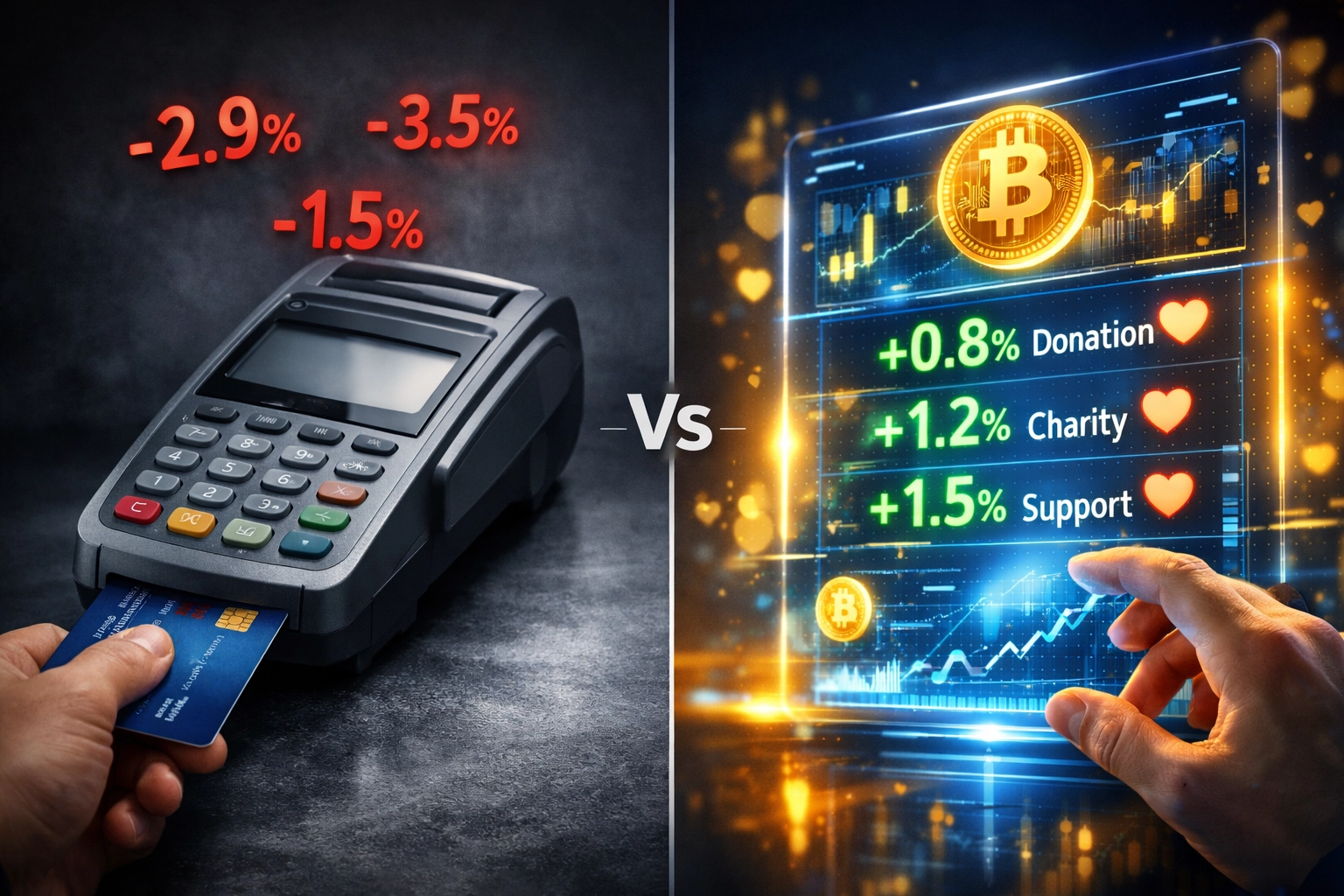
Traditional processors charge merchants 2.9% to 3.5%. Every penny goes to Visa, Mastercard, or payment companies.
Larecoin charges effectively less than 50% of that. And 1.5% of what you do pay feeds people.
Let's break this down with real numbers:
Traditional Payment Processor:
$1,000 transaction
3% fee = $30 to the processor
$0 to charity (unless you manually donate later)
Total cost: $30
Larecoin:
$1,000 transaction
~1.4% total fee = $14 total
Approximately $8 to verified hunger relief charities
$6 for network operations
Total cost: $14
You save money. People get fed. The math isn't complicated.

Not Your Typical "Feel-Good" Feature
Most payment platforms offer charity integration as a feature. Stripe has donation buttons. PayPal has giving funds. Cool.
Those are optional. That means most transactions never trigger charitable giving. Merchants forget to enable it. Customers skip the prompt. Donations become an afterthought.
Larecoin flipped the model. The charity allocation happens at the protocol level through LareBlocks' smart contract architecture.
This isn't a feature you toggle on. It's infrastructure. Like gas fees. Like transaction validation. Like consensus mechanisms.
Every single payment contributes. No exceptions. No opt-outs. No "maybe next time."
Transparency You Can Actually Verify
Traditional charities lose 30-40% of donations to administrative overhead, fundraising costs, and operational expenses.
Blockchain infrastructure eliminates that entirely.
Every charity allocation gets recorded on-chain through LareScan, our blockchain explorer. You can trace every penny from transaction to recipient organization.
Want to see exactly where your 1.5% went? Pull up the transaction hash. Check the smart contract execution. Verify the recipient wallet.
This isn't about trust. It's about proof.
The charitable organizations themselves rotate quarterly based on community voting. All must pass verification protocols before receiving funds. And approximately 0.8% goes directly to global hunger relief initiatives specifically focused on measurable impact.
Enterprise Architecture Meets Social Impact
For businesses processing high volumes, Larecoin's master/sub-wallet management system extends the charity model across entire organizational structures.
Set up a master wallet for your company. Create sub-wallets for departments, locations, or specific use cases. Every transaction from any sub-wallet automatically includes the 1.5% allocation.
Your accounting team doesn't need to track charitable giving separately. It's built into every transaction receipt: which, by the way, comes as an NFT on-chain.
Tax reporting becomes straightforward. Social impact becomes automatic. Compliance becomes transparent.
This architecture also supports AI-driven shopping features through our metaverse integration. Customers browse virtual storefronts, make purchases with LARE or LUSD, and contribute to charitable causes without even thinking about it.
Real-World Application: Gift Cards and Beyond
One of the fastest-growing use cases? Gift card purchases with crypto.
Traditional gift card platforms charge hefty fees and provide zero social value. You're essentially converting money into locked-value cards with expiration dates.
Larecoin's gift card crypto purchases work differently. Buy a gift card with LARE tokens. The merchant gets paid in their preferred currency (LUSD stablecoin or fiat). 1.5% automatically funds verified charities. The recipient gets an NFT receipt documenting the social impact.
Suddenly that Amazon gift card isn't just convenient. It fed someone.
That Starbucks card? Supported hunger relief.
That gaming platform credit? Contributed to measurable charitable outcomes.
Community Governance Changes The Game
Here's where it gets interesting: the community decides which charities receive funds.
Quarterly voting through our community social hubs determines charity rotation. Token holders propose organizations. The community vets them. Verification protocols ensure legitimacy. Voting determines allocation percentages.
This isn't top-down charity. It's decentralized philanthropy.
Traditional charities depend on wealthy donors, board decisions, and opaque selection criteria. Larecoin puts the power in the hands of the network participants actually generating the charitable funds.
Want hunger relief prioritized? Vote for it. Care more about education? Propose verified organizations. Think environmental causes matter most? Rally community support.
The blockchain records everything. LareScan provides full transparency. Smart contracts execute results automatically.
The Fee Structure Nobody's Talking About
Let's address the elephant in the room: why aren't more payment processors doing this?
Because traditional payment infrastructure can't support it profitably.
Visa and Mastercard charge 2.9%+ because their infrastructure requires massive overhead: servers, compliance teams, fraud detection, customer service, marketing, executive compensation.
Blockchain infrastructure operates differently. LareBlocks handles transaction validation through decentralized consensus. Smart contracts execute automatically. LareScan provides transparent record-keeping without dedicated staff.
Operational costs drop dramatically. That efficiency enables the charity allocation without destroying merchant margins.
You literally cannot replicate this model on traditional payment rails. The math doesn't work. The infrastructure won't support it.
Why This Matters for 2026 and Beyond
We're ten years into this marathon. Not sprinting. Building.
The crypto payment space keeps talking about adoption. But nobody's addressing the fundamental question: why would normal people switch?
"Lower fees" isn't compelling enough. Most consumers never see merchant fees directly.
"Decentralization" sounds like tech jargon. Average users don't care about trustless systems.
But "every purchase feeds hungry people while saving businesses money"? That resonates.
That's a value proposition that breaks through crypto's image problem. That's social impact meeting Web3 infrastructure in a way that actually matters.
Getting Started Takes Minutes
The barrier to entry? Basically zero.
Merchants: set up an account on larecoin.com. Integrate payment APIs. Accept LARE, LUSD, or bridge from other cryptocurrencies. Start processing payments with automatic charity allocation.
Customers: hold LARE or LUSD in any compatible wallet. Spend at participating merchants. Receive NFT receipts documenting your social impact.
Enterprises: implement master/sub-wallet structures. Scale across departments. Maintain full transparency through LareScan explorer.
The infrastructure exists. The smart contracts are live. The charities are verified.
The only question left: when are you joining?
Join the Movement
Larecoin isn't just another crypto project promising moon shots and lambos. We're building payment infrastructure that makes social impact automatic, transparent, and protocol-enforced.
Lower fees than traditional processors. Automatic charitable giving. Enterprise-grade architecture. NFT receipts. LUSD stablecoin stability. Full decentralization.
This is what crypto payments look like when you stop chasing hype and start building real value.
Check out our community discussion hub to connect with other businesses already implementing Larecoin. Or dive into our comprehensive guide on reducing merchant interchange fees to understand the full cost savings.
The marathon continues. 100 hours of coverage on social impact, infrastructure, enterprise solutions, and community building.
Because changing how people think about crypto payments requires more than promises. It requires protocol.
Comments