

.png)
Are Traditional Payment Systems Dead? How Web3 Global Payments and Metaverse Shopping Will Change Your Business in 2026
- [[[Free!!]<<<<]] Watch: 스포르팅 - 토트넘 Live Stream 13 September 2022
- Feb 10
- 5 min read
![Writer: [[[Free!!]<<<<]] Watch: 스포르팅 - 토트넘 Live Stream 13 September 2022](https://lh3.googleusercontent.com/a/AItbvmktwQc0wCdd3ZEETSYItRQubwwBzOyjD_dcigRf=s96-c)
Traditional payment systems aren't dead.
But they're bleeding out.
51% of digital wallet users have already abandoned businesses that only accept traditional payments. Debit cards still dominate the U.S. market, but interchange fees are eating 2-3% of every transaction. Your customers want speed. Your bottom line needs savings.
Web3 global payments and metaverse shopping aren't "future tech" anymore. They're here. And if you're still relying on legacy payment rails in 2026, you're leaving money on the table.
The Payment Processing Reality Check
Legacy processors charge you for everything. Card networks take their cut. Banks take theirs. Payment gateways add another layer. You're paying 2.9% + $0.30 per transaction on average.
Meanwhile, crypto payment processors are cutting that by more than half.
The catch? Most crypto payment solutions are just dressed-up versions of the same old problems. They still charge processing fees. They still control your funds. They still require KYC delays and withdrawal restrictions.
That's where self-custody changes everything.
How Larecoin Stacks Up Against the Competition
Let's compare apples to apples.
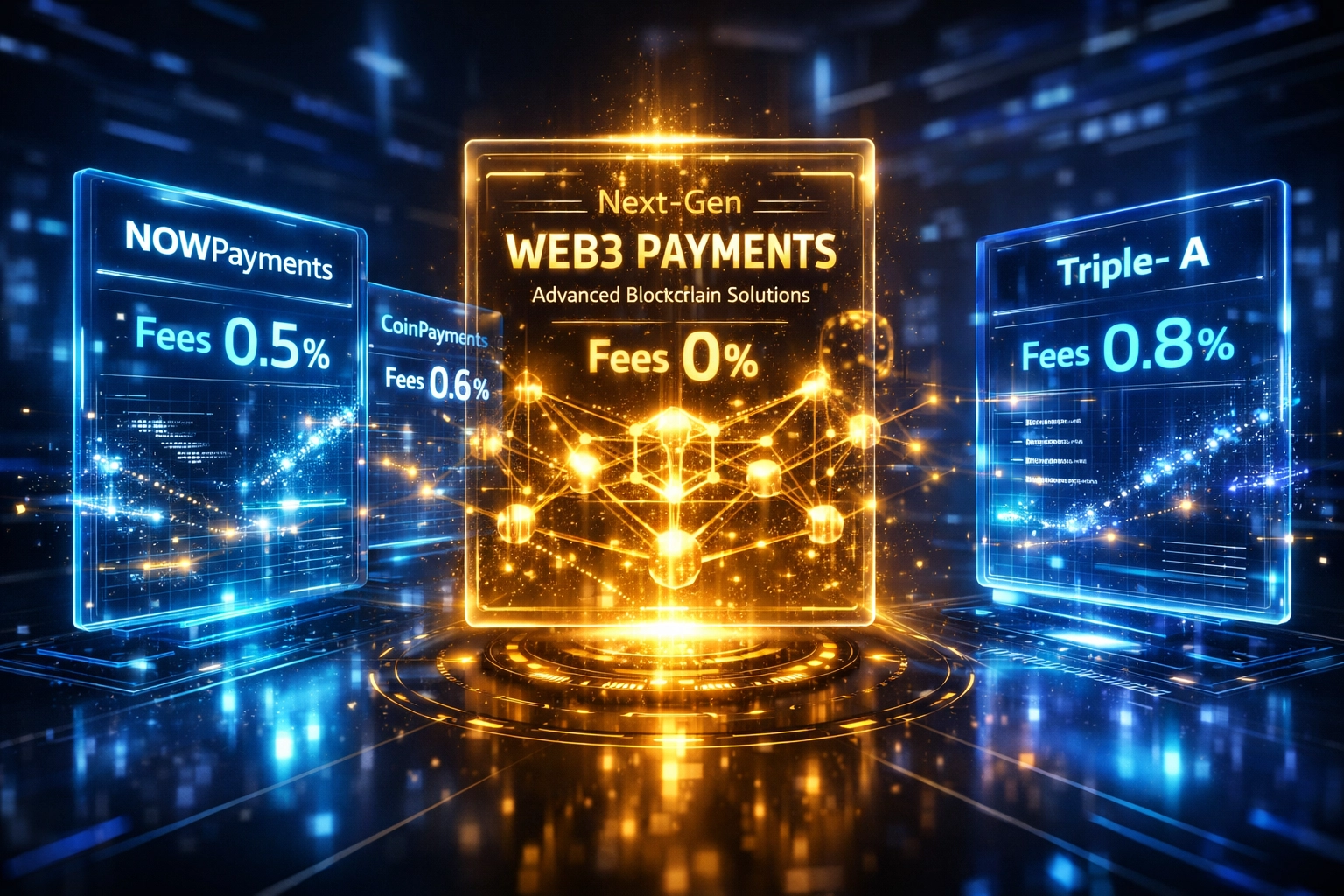
NOWPayments charges 0.5% transaction fees. Supports 200+ cryptocurrencies. But you're waiting 3-5 days for fiat settlements. Their custody model means they hold your crypto until you withdraw. No NFT receipts. No metaverse integration.
CoinPayments takes 0.5% for crypto transactions. They've been around since 2013. Established player. But their fee structure gets complicated fast with additional charges for conversions and withdrawals. Still no self-custody. Still no future-facing features.
Triple-A focuses on enterprise with 1% transaction fees. Better for high-volume merchants. But you're locked into their ecosystem. No flexibility with master/sub-wallet structures. No stablecoin native to the platform.
Larecoin operates differently.
Gas-only transfers mean you only pay network fees. No platform processing charges eating into margins. Full self-custody through master and sub-wallets. Your funds stay yours from the moment of transaction.
And here's the kicker: NFT receipts for every transaction.
Technical Advantages That Actually Matter
NFT Receipts
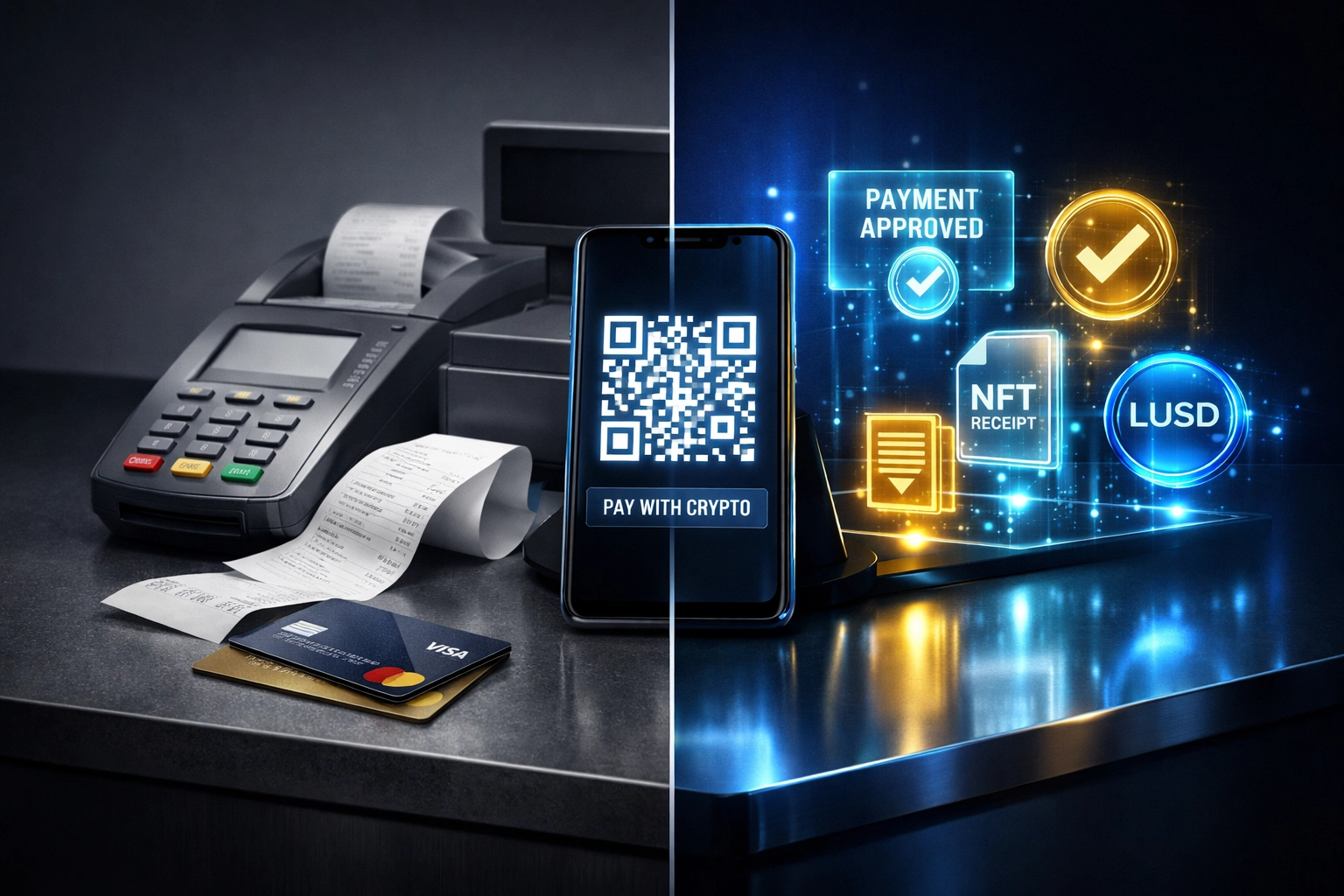
Every payment generates an NFT receipt. Immutable proof of transaction. Zero-knowledge verification for accounting. Automated tax reporting. Dispute resolution built into the blockchain.
This isn't a gimmick. It's solving real merchant problems with Web3 infrastructure.
LUSD Stablecoin
LUSD provides stability without custodial risk. Pegged 1:1 with USD. Built on Ethereum's battle-tested infrastructure. Perfect for merchants who want crypto efficiency without volatility exposure.
Accept volatile crypto. Settle in LUSD. Convert to fiat when you're ready. The whole process happens on-chain with transparent pricing.
Gas-Only Transfers
Pay network fees only. No platform fees. No hidden charges. No percentage cuts. Transaction costs average $0.02-0.15 depending on network congestion.
Compare that to 2.9% + $0.30 on traditional processors. On a $100 transaction, you save $2.73. Scale that across thousands of transactions.
The math speaks for itself.
Self-Custody Architecture
Master wallets for businesses. Sub-wallets for departments, locations, or franchises. Complete financial control. No waiting for settlement. No permission required for access to your own money.
Smart contract automation handles payment routing. Multi-sig security protects high-value accounts. Recovery protocols prevent lockouts.
This is what financial sovereignty looks like in practice.
Merchant Benefits: The Fee Savings Revolution
Traditional interchange fees kill small business margins.
Visa and Mastercard set interchange rates between 1.5-3.5%. Add processor markup. Add gateway fees. Add monthly fees and compliance costs. You're suddenly paying 3-5% of gross revenue just to accept payments.
Fee Structure Breakdown
Traditional payment processing on $100,000 monthly volume:
Interchange fees: $2,900
Gateway fees: $300
Monthly fees: $50
Chargeback fees: $200
Total: $3,450/month ($41,400/year)
Larecoin on same volume:
Gas fees (average): $150
Platform fees: $0
Monthly fees: $0
Chargeback prevention through blockchain: Minimal
Total: $150/month ($1,800/year)
Savings: $39,600 annually
That's capital you can reinvest in inventory, marketing, or expansion.
Master/Sub-Wallet Infrastructure
Franchise operations get complicated fast. Multiple locations. Different managers. Separate accounting.
Larecoin's master/sub-wallet system solves this elegantly. One master wallet controls the treasury. Sub-wallets handle location-specific transactions. All transparent. All auditable. All in real-time.
No more waiting for settlement reports. No more reconciliation headaches.
QR-Generated Crypto POS
Turn any device into a payment terminal. Generate QR codes instantly. Accept payments in seconds. Works online, in-store, or in the metaverse.
No expensive hardware. No long-term contracts. No monthly terminal rentals.
Deploy at farmers markets, pop-up shops, or permanent retail locations. Same seamless experience everywhere.
The Metaverse Shopping Revolution
This is where traditional payments completely break down.
VR commerce is exploding. AR shopping experiences are going mainstream. Social commerce in virtual spaces is creating entirely new revenue streams.
Legacy payment systems can't bridge physical and virtual commerce. Credit cards don't work in decentralized virtual worlds. Banks can't process transactions for digital-first businesses without physical addresses.
Larecoin's B2B2C Metaverse
Social shopping meets Web3 payments. Browse products in immersive 3D environments. Try before you buy with AR visualization. Complete transactions without leaving the experience.
Merchants set up virtual storefronts. Customers explore with friends. Payments happen automatically through connected wallets. NFT receipts prove ownership instantly.
This isn't theoretical. The infrastructure exists today at Larecoin's platform.
VR/AR Shopping Convenience
Virtual try-on for fashion and accessories. Furniture placement in your actual room through AR. Social shopping events with live product demonstrations.
Traditional payment systems require checkout friction. Pop-ups. Form fills. Card number entry. Security codes.
Web3 payments eliminate friction. Connected wallets authorize with one click. Transactions confirm in seconds. Receipts arrive as NFTs automatically.
The shopping experience becomes seamless.
Check out the 15 metaverse shopping features that future-proof your business.
Compliance & Trust: The Regulatory Foundation
Crypto payments need regulatory clarity.
Larecoin delivers.
Federal MSB Registration
Registered Money Services Business with FinCEN. Full compliance with Bank Secrecy Act requirements. AML/CFT protocols implemented at the infrastructure level.
This isn't optional for serious payment processors. It's table stakes for institutional adoption.
State-Level MTL Coverage
Money Transmitter Licenses across U.S. jurisdictions. State-by-state compliance with payment transmission laws. Consumer protection through regulated operations.
Most crypto platforms skip this step. They operate in regulatory gray zones. When enforcement comes, merchants get caught in the crossfire.
Larecoin built compliance into the foundation. Check the trust page for full regulatory documentation.
Security Through Transparency
Open-source smart contracts. Auditable blockchain transactions. Public verification of compliance credentials.
Traditional processors hide behind proprietary systems. Black-box fee structures. Opaque settlement processes.
Web3 makes everything transparent by default. Trust through verification, not blind faith.
What This Means for Your Business
Traditional payment systems aren't dying tomorrow.
But the gap is widening fast. Customers expect instant settlement. They want lower fees. They demand better privacy. They're shopping in virtual spaces.
Legacy processors can't adapt fast enough. They're constrained by decades of infrastructure debt. Card networks set fees they can't negotiate. Banks control settlement timelines they can't change.
Web3 payments offer a parallel financial system. Lower costs. Faster settlement. Global reach. Self-custody.
The question isn't whether to adopt crypto payments. It's whether you can afford not to.
Visit Larecoin merchants to set up your account. Start accepting payments with NFT receipts, LUSD stability, and gas-only fees. Join the businesses already saving 50%+ on payment processing.
Traditional payments had a good run. But 2026 belongs to Web3 global payments and metaverse shopping. Your competition is already making the switch.
Are you ready?
Comments