

.png)
How to Slash Your Merchant Interchange Fees by 50%+ (Without Giving Up Custody)
- [[[Free!!]<<<<]] Watch: 스포르팅 - 토트넘 Live Stream 13 September 2022
- 2 hours ago
- 4 min read
![Writer: [[[Free!!]<<<<]] Watch: 스포르팅 - 토트넘 Live Stream 13 September 2022](https://lh3.googleusercontent.com/a/AItbvmktwQc0wCdd3ZEETSYItRQubwwBzOyjD_dcigRf=s96-c)
The $125,000 Problem Nobody Talks About
Your payment processor is quietly draining your business.
Every swipe. Every tap. Every online checkout.
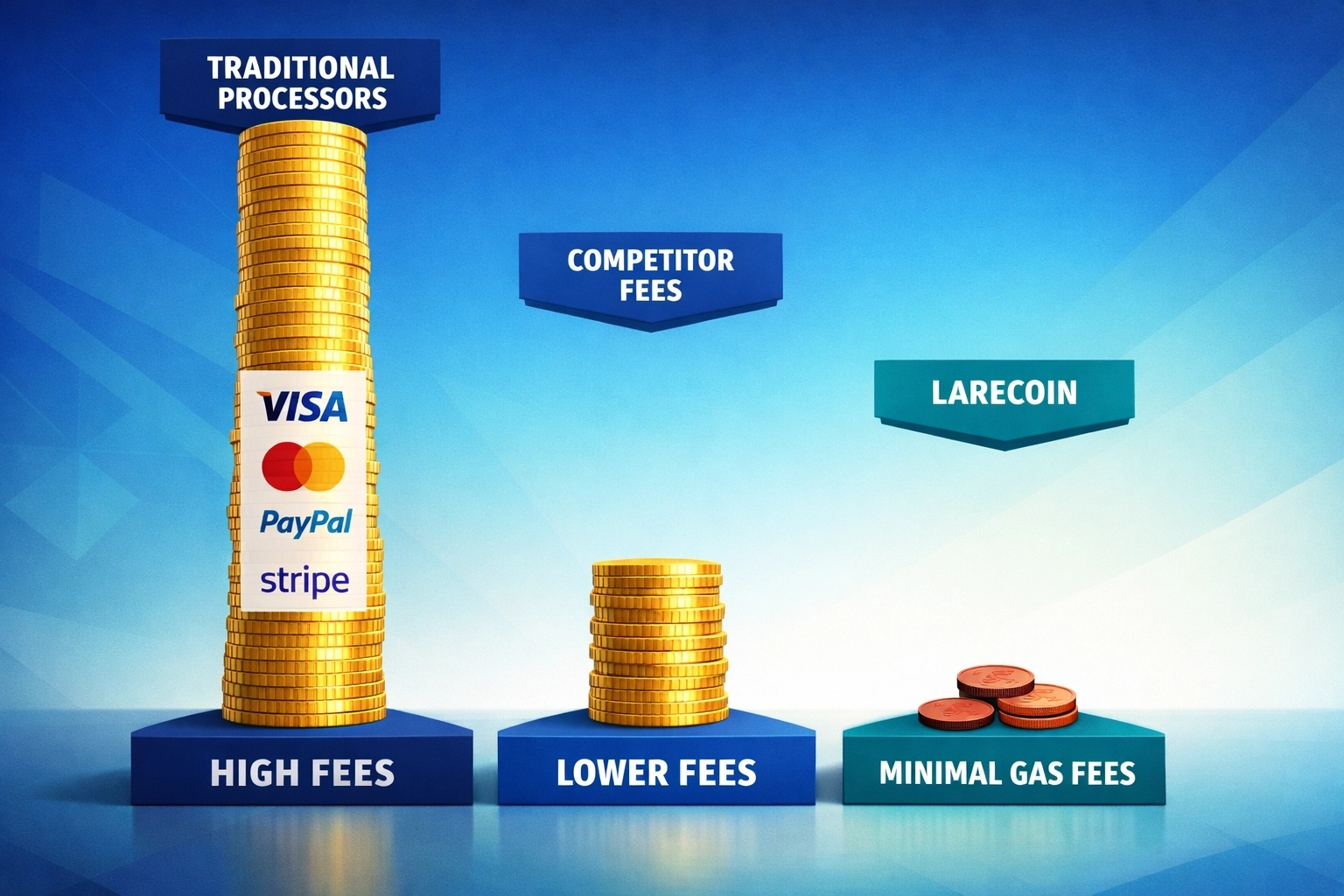
Merchants processing $5 million annually lose over $125,000 to interchange fees alone. That's not including processor markups, gateway fees, or chargeback costs.
And here's the kicker: traditional "solutions" only cut fees by 20-40% max.
Surcharging? Caps at 4% and annoys customers.
Negotiating interchange-plus pricing? Still paying Visa and Mastercard their cut.
Level 2/3 data optimization? Saves 0.70%-1.50% if you're lucky.
There's a better way.
The Web3 Payments Revolution
Blockchain payments eliminate the middleman entirely.
No Visa. No Mastercard. No interchange fees.

Larecoin processes payments on-chain using stablecoin infrastructure. You accept crypto. Customer pays in LUSD or USDC. Settlement happens in seconds.
Fee structure? Gas only. Pennies per transaction.
Your annual processing cost for $1 million in sales? Under $50.
Traditional cost? $20,000-$30,000.
That's a 99.5% reduction.
And you maintain full self-custody. Your funds. Your wallet. Your control.
Real Numbers: The Merchant Savings Model
Let's break down actual scenarios.
Small Merchant ($250K Annual Volume)
Traditional Processing:
Average interchange rate: 2.5%
Annual fees: $6,250
Plus gateway fees, monthly minimums, PCI compliance
Larecoin Processing:
Fixed gas fees: ~$10-15 annually
Savings: $6,235+
Reduction: 99.7%
Mid-Sized Business ($1M Annual Volume)
Traditional Processing:
Average interchange rate: 2.2%
Annual fees: $22,000
Plus processor markup, statement fees, equipment rentals
Larecoin Processing:
Fixed gas fees: ~$40-50 annually
Savings: $21,950+
Reduction: 99.5%
High-Volume Merchant ($5M Annual Volume)
Traditional Processing:
Average interchange rate: 2.1%
Annual fees: $105,000
Plus chargeback fees, fraud prevention costs
Larecoin Processing:
Fixed gas fees: ~$200 annually
Savings: $104,800+
Reduction: 99.8%
The math doesn't lie.

Why Self-Custody Matters
Most crypto payment processors act like traditional banks.
They hold your funds. They control withdrawals. They can freeze accounts.
That's not Web3. That's Web2 with crypto paint.
Larecoin operates differently:
Non-custodial architecture – You control private keys
Instant settlement – Funds hit your wallet immediately
No withdrawal limits – Your money, your rules
Censorship-resistant – No account freezes or payment blocks
When you process through Larecoin, you're not trusting a third party. You're using open-source smart contracts verified on-chain.
Every transaction is transparent on LareScan.
Every payment settles to your designated wallet address.
No intermediary can touch your funds.
The Competitor Comparison
Let's be honest about alternatives.
NOWPayments
Fee structure: 0.5% per transaction
Custody: Full custodial control
Settlement: Batch processing, delays common
Hidden costs: Withdrawal fees, minimum thresholds
On $1M volume: $5,000 in fees + withdrawal costs
Not terrible. But not revolutionary.
You're still paying percentage-based fees. You're still giving up custody. You're still waiting for settlements.
CoinPayments
Fee structure: 0.5% + blockchain network fees
Custody: Custodial wallet system
Settlement: Manual withdrawal process
Hidden costs: Conversion fees, fiat withdrawal premiums
On $1M volume: $5,000+ in base fees, more with conversions
Same story. Different branding.
Both platforms require trust. Both platforms control your funds. Both platforms add layers between you and your money.
Larecoin
Fee structure: Gas only (pennies per transaction)
Custody: Full self-custody
Settlement: Instant on-chain
Hidden costs: None
On $1M volume: $40-50 total
The difference is structural, not incremental.
The LUSD Advantage
Larecoin ecosystem supports multiple stablecoins, but LUSD offers unique benefits.
Decentralized issuance – No centralized company controlling supply.
Over-collateralized – Backed by 110%+ in ETH, not fiat promises.
Immutable protocol – No admin keys, no blacklists, no freezing.
When merchants accept LUSD through Larecoin:
Zero counterparty risk
Algorithmic stability
True censorship resistance
Integration with DeFi protocols
Compare this to USDC (Circle can freeze) or USDT (Tether controls reserves).
LUSD represents actual Web3 values. Not corporate stablecoins pretending to be decentralized.
NFT Receipts: The Understated Feature
Every Larecoin transaction generates an NFT receipt.
Sounds gimmicky until you understand the utility:
Proof of payment – Immutable, timestamped, blockchain-verified.
Accounting integration – Auto-imports to Web3 accounting tools.
Tax compliance – Complete transaction history on-chain.
Customer loyalty – Receipts can unlock rewards, memberships, discounts.
Dispute resolution – No more "I never received it" claims.
Traditional payment processors give you a PDF statement. Larecoin gives you cryptographic proof of every transaction.

For high-ticket merchants, this is game-changing. Art dealers, luxury goods sellers, B2B vendors – all benefit from immutable transaction records.
The Migration Path
Switching sounds complicated. It's not.
Step 1: Create Larecoin merchant account (5 minutes).
Step 2: Set up self-custody wallet or connect existing one.
Step 3: Add payment integration (checkout plugin, API, or point-of-sale).
Step 4: Start accepting payments.
No month-long onboarding. No extensive KYC nightmares. No equipment purchases.
Many merchants run hybrid systems initially. Keep traditional processing for customers who insist on credit cards. Route crypto-savvy customers through Larecoin.
Over time, the cost difference becomes obvious. Customers appreciate the lower prices (you can pass savings along). Accounting gets simpler (blockchain records beat reconciliation spreadsheets).
Within 90 days, most merchants process 40-60% of volume through Larecoin. Within a year, crypto payments become primary.
The Real Question
Can you afford NOT to switch?
If you're processing $1 million annually, you're losing $20,000+ to legacy payment rails.
That's a full-time employee's salary. Marketing budget. Expansion capital.
Gone. Every year. Forever.
Unless you adopt Web3 payments.
Larecoin isn't competing with traditional payment processors on their terms. We're operating in a different paradigm entirely.
No interchange fees. No custodial risk. No batch settlements. No permission needed.
Just pure, decentralized, merchant-controlled payments.
Join the Marathon
This is post #78 in the Larecoin 100-Post Blog Marathon.
We're documenting the Web3 payments revolution one article at a time. Real solutions. Real savings. Real financial sovereignty.
Want to see how merchants are implementing these systems? Check out our comprehensive guide to reducing merchant fees.
Follow the full marathon at larecoin.com.
Next up: Why stablecoin cards beat crypto cards (and how both beat traditional banking).
Your move, merchant.
Comments