

.png)
The Ultimate Guide to Metaverse Shopping: Why B2B2C VR/AR Commerce Will Replace Your POS by 2030
- [[[Free!!]<<<<]] Watch: 스포르팅 - 토트넘 Live Stream 13 September 2022
- 2 hours ago
- 5 min read
![Writer: [[[Free!!]<<<<]] Watch: 스포르팅 - 토트넘 Live Stream 13 September 2022](https://lh3.googleusercontent.com/a/AItbvmktwQc0wCdd3ZEETSYItRQubwwBzOyjD_dcigRf=s96-c)
Your traditional POS system is already obsolete.
It charges you 2.9% + $0.30 per transaction. It locks you into proprietary hardware. It forces customers through friction-filled checkout flows.
The future? Virtual storefronts. Augmented reality try-ons. NFT receipts. Zero interchange fees.
By 2030, metaverse shopping won't be complementary: it'll be primary.
Here's why B2B2C VR/AR commerce is replacing every POS terminal in your store.
The Death of Traditional Point-of-Sale
Traditional POS systems bleed merchants dry.
Hidden costs include:
2-3.5% interchange fees per transaction
Monthly terminal rental ($50-$200)
PCI compliance fees ($100-$500 annually)
Chargeback penalties ($15-$100 per dispute)
Hardware replacement cycles every 3-5 years
Card networks control pricing. Banks take their cut. Merchants absorb the pain.
The average small business loses $15,000 annually to payment processing fees alone.
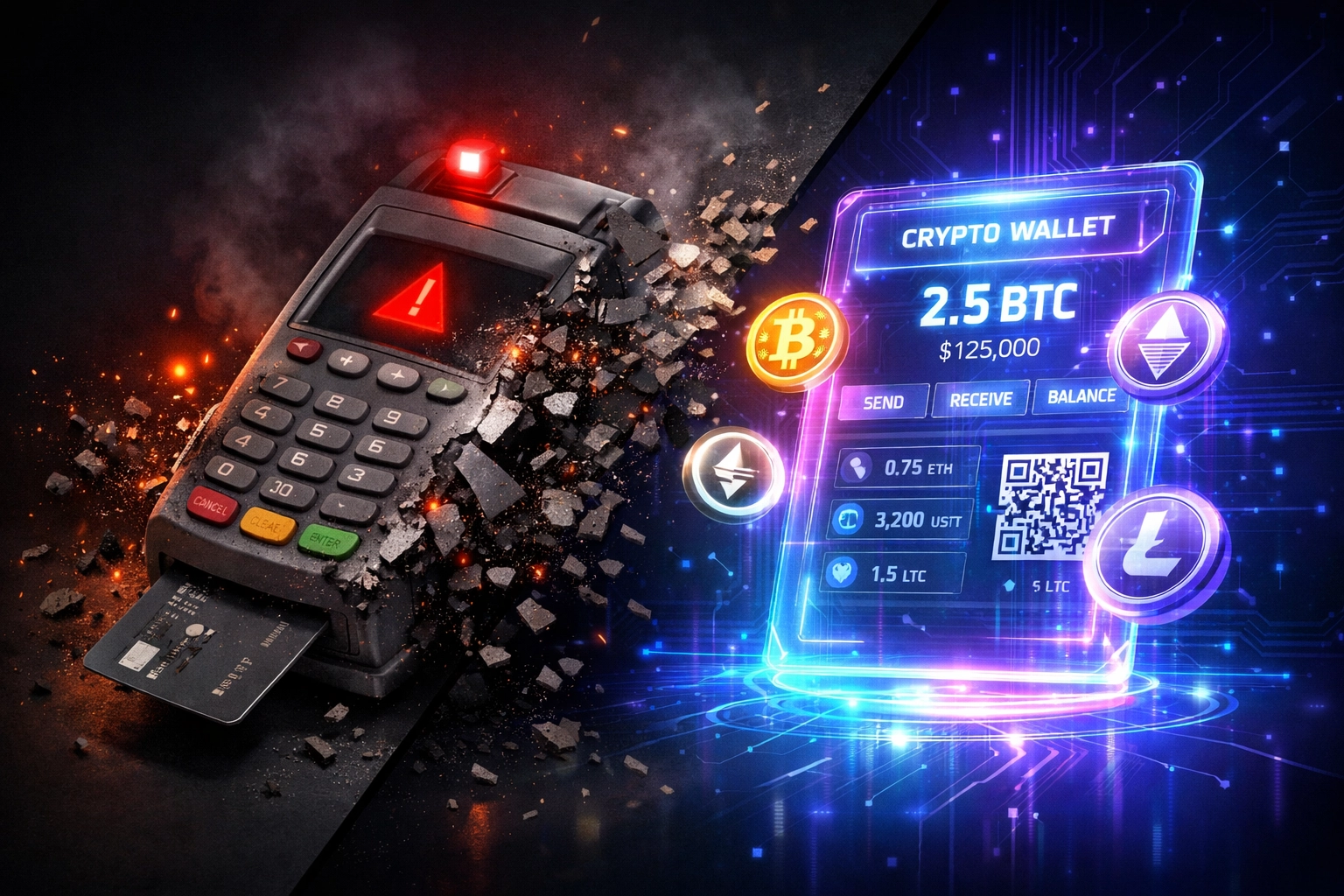
That ends with crypto POS systems.
Why 2030 Is the Metaverse Commerce Tipping Point
Five converging technologies make VR/AR commerce inevitable:
1. Hardware accessibility Apple Vision Pro brought spatial computing mainstream. By 2027, AR glasses cost less than iPhones.
2. 5G/6G infrastructure Low-latency networks enable real-time 3D rendering. Virtual stores load faster than traditional websites.
3. Blockchain maturity Self-custody wallets are simpler than bank apps. Smart contracts automate transactions without intermediaries.
4. Consumer behavior shifts Gen Z and Gen Alpha expect immersive experiences. 72% prefer virtual shopping over physical browsing by 2025.
5. Regulatory clarity Federal MSB registration and state-level MTL compliance legitimize crypto commerce. Banks can't block what regulators approve.
The infrastructure is here. The adoption curve is steep. The replacement is happening now.
Larecoin's Technical Edge: Built for Metaverse Commerce
Traditional crypto payment processors weren't designed for spatial commerce.
NOWPayments? Just a gateway. CoinPayments? Legacy infrastructure. Triple-A? Still charging 1% fees.
Larecoin rebuilt payments from scratch for the metaverse era.
NFT Receipts
Every transaction generates an on-chain receipt.
Benefits:
Permanent purchase proof
Automatic warranty tracking
Resellable digital goods
Tax documentation without reconciliation
Your customers can trade, gift, or verify purchases without contacting support.
LUSD Stablecoin Integration
Price volatility kills commerce adoption.
LUSD eliminates volatility without bank dependencies. Merchants receive stable value. Customers pay predictable amounts.
No 3-day settlement periods. No currency conversion fees. No bank-imposed holds.
Gas-Only Transfers
Larecoin's architecture charges zero transaction fees.
You pay only network gas: typically $0.01-$0.03 per transaction.
Compare that to:
Square: 2.6% + $0.10
Stripe: 2.9% + $0.30
NOWPayments: 0.5% + gas
CoinPayments: 0.5% flat
A $100 transaction costs $0.02 with Larecoin vs. $2.90 with traditional processors.
That's a 98.6% fee reduction.

Self-Custody Architecture
Merchants control their funds. Always.
No frozen accounts. No platform risk. No payment processor gatekeeping.
Master/sub-wallet systems let you:
Separate revenue streams
Delegate permissions to staff
Automate accounting splits
Maintain full sovereignty
Your money. Your keys. Your control.
Competitor Comparison: Why Legacy Crypto Gateways Fail Metaverse Commerce
Traditional crypto processors treat Web3 payments like Web2 with token support.
NOWPayments:
Charges 0.5% per transaction
No native metaverse integration
Custodial model with withdrawal delays
Limited AR/VR API support
CoinPayments:
0.5% transaction fees
Legacy codebase from 2013
No NFT receipt functionality
No spatial commerce features
Triple-A:
1% transaction fees
Fiat off-ramp focus
Basic API without VR/AR hooks
No B2B2C marketplace infrastructure
Larecoin's advantage:
Gas-only pricing (98% cheaper)
Native metaverse integration
NFT receipts built-in
B2B2C social shopping platform
QR-generated POS for physical/virtual convergence
Legacy processors bolt crypto onto old infrastructure.
Larecoin was built for spatial commerce from day one.
Merchant Benefits: Beyond Fee Savings
Reducing interchange fees by 50-98% is just the start.
QR-Generated POS
No hardware required. No terminal rentals. No PCI compliance audits.
Generate a payment QR code. Customer scans with their wallet. Transaction completes in 2-3 seconds.
Works for:
In-store purchases
Virtual storefronts
Pop-up events
Metaverse kiosks
One system. All channels. Zero hardware costs.
Master/Sub-Wallet Management
Franchise owners manage 50+ locations from one dashboard.
Automated features include:
Revenue routing to corporate wallets
Per-location spending limits
Real-time settlement tracking
Multi-signature security
Traditional processors charge $50-$200 monthly per location for multi-store management.
Larecoin? Free. Native. Self-custodied.

Real-Time Settlement
Card processors hold funds for 2-7 business days.
Larecoin settles instantly. Your revenue lands in your wallet within seconds.
No waiting for batch processing. No weekend delays. No bank holidays.
Cash flow problems disappear when settlement is instant.
Compliance & Trust: Why Regulatory Clarity Matters
Crypto's Wild West days are over.
Larecoin maintains:
Federal MSB registration
State-level MTL coverage across all 50 states
Bank Secrecy Act compliance
FinCEN reporting standards
Traditional processors love regulatory ambiguity: it kills competition.
Larecoin embraced compliance from launch. That makes us:
Bankable for merchants
Insurable by traditional carriers
Acceptable to enterprise accounting departments
Compatible with legacy financial systems
When regulators crack down, compliant platforms survive. Non-compliant platforms disappear.
Choose accordingly.
The B2B2C Metaverse Vision: Social Shopping Reimagined
Traditional e-commerce is isolated. You shop alone. You browse product images. You guess at sizing.
Metaverse shopping is social. Immersive. Experiential.
Virtual Storefronts with Real-Time Interaction
Walk into a virtual Nike store with friends. Try on shoes using AR sizing. Your avatar mirrors your actual measurements.
Your friend recommends a different colorway. The store assistant (human or AI) helps you find matching apparel.
You purchase with one wallet signature. NFT receipt arrives instantly. Physical shoes ship to your home.
The digital and physical merge seamlessly.
Larecoin's B2B2C Marketplace Infrastructure
B2B2C means brands sell through platforms that serve consumers.
Larecoin provides:
White-label storefronts for merchants
Social features for group shopping
Native crypto checkout
Cross-platform inventory management
Merchants access enterprise tools without enterprise costs.
Platforms earn revenue sharing: not transaction gatekeeping.
The Convenience Factor
Why VR/AR shopping beats traditional retail:
Time savings:
No driving to stores
No parking hassles
No waiting in checkout lines
Better decision-making:
3D product visualization
True-to-scale AR previews
Social validation from friends
Gamification:
Collect achievement NFTs
Unlock exclusive drops
Participate in brand events
Shopping becomes entertainment. Commerce becomes community.
That's why Gen Z will never return to traditional POS systems.
Implementation: How to Transition from POS to Metaverse Commerce
Merchants don't need to choose between physical and virtual.
The transition is gradual. The integration is seamless.
Phase 1: Add crypto checkout Install Larecoin QR codes at existing POS terminals. Accept both cards and crypto. Track which customers prefer which method.
Phase 2: Launch virtual storefront Create a metaverse presence. Mirror your physical inventory. Let customers browse before visiting.
Phase 3: Integrate AR try-ons Add augmented reality to product pages. Let customers visualize items in their space. Reduce returns by 40-60%.
Phase 4: Full B2B2C integration Join Larecoin's social shopping marketplace. Sell to customers you'd never reach with physical locations alone.
The businesses that transition early capture market share.
The businesses that wait become obsolete.
Why Traditional POS Systems Can't Compete
Card networks had 50+ years to innovate.
They chose rent-seeking over customer value.
Now they're facing existential disruption:
Interchange fees drop to near-zero
Hardware costs disappear completely
Settlement delays vanish
Chargebacks become impossible with crypto
Banks can't compete with self-custody. Card networks can't match blockchain transparency.
The question isn't whether POS systems disappear by 2030.
The question is whether your business transitions before your competitors do.
Ready to future-proof your business?
Explore Larecoin's merchant solutions and eliminate transaction fees today.
Or read our complete guide to reducing interchange fees for deeper technical analysis.
The metaverse is coming. Your customers are already there.
Your POS system? Already obsolete.
Comments