

.png)
Triple-A vs. CoinPayments vs. Larecoin: Which Crypto POS Cuts MTL Compliance Costs by 50%?
- [[[Free!!]<<<<]] Watch: 스포르팅 - 토트넘 Live Stream 13 September 2022
- Feb 22
- 5 min read
![Writer: [[[Free!!]<<<<]] Watch: 스포르팅 - 토트넘 Live Stream 13 September 2022](https://lh3.googleusercontent.com/a/AItbvmktwQc0wCdd3ZEETSYItRQubwwBzOyjD_dcigRf=s96-c)
MTL compliance isn't optional. It's expensive.
For crypto payment processors, Money Transmitter License requirements across 50+ U.S. states represent one of the biggest operational costs. Traditional providers pass these expenses directly to merchants through higher fees, lengthy onboarding, and complex documentation.
But not all crypto POS systems handle compliance the same way.
Let's break down how Triple-A, CoinPayments, and Larecoin approach MTL compliance: and which one actually delivers the 50% cost reduction merchants need.
The MTL Compliance Tax: What Merchants Really Pay
Every crypto payment processor operating in the U.S. needs MTL coverage. That's non-negotiable.
The real question? Who pays for it.
Traditional platforms build compliance costs into their fee structure. You're paying for state licenses, legal teams, ongoing regulatory monitoring, and banking relationships through every single transaction.
The math gets ugly fast:
Base transaction fees: 0.8%-1%
Regulatory overhead baked in: Another 0.5%-1.5%
Banking partner fees: 0.3%-0.8%
Currency conversion spreads: 0.5%-2%
Add it up. You're looking at 3%-5% total costs on crypto transactions that should be nearly free.
Triple-A: Premium Compliance, Premium Costs
Triple-A markets itself as the regulated choice. They're licensed. They're compliant. They're expensive.
Their regulatory compliance infrastructure isn't free: someone's paying for it.
Triple-A's onboarding process reflects their compliance-heavy approach:
Extensive documentation requirements
Multi-week verification delays
Traditional banking partner relationships
Full KYC/AML screening for every merchant
For enterprise merchants with dedicated compliance teams? This works fine.
For small to mid-size businesses? It's overkill. The delays, paperwork, and hidden costs buried in transaction fees make Triple-A's "fully regulated" approach cost-prohibitive for most merchants.
Their percentage-based fee model means compliance costs scale with transaction volume. Your most successful sales cost you the most in regulatory overhead.

CoinPayments: The Middle-Ground Trap
CoinPayments positions itself as the versatile option. They support 2,000+ cryptocurrencies. They offer merchant tools. They require compliance documentation.
But versatility comes with complexity.
Their fee structure:
0.5% transaction fee on most cryptos
Higher fees for less liquid tokens
Separate withdrawal fees
Currency conversion costs
Third-party settlement partner fees
The compliance burden shifts partially to merchants. You handle more verification. You manage more documentation. You navigate their multi-tier approval process.
It's not 50% cheaper. It's just differently complicated.
CoinPayments' multi-currency approach creates its own compliance headaches. Each blockchain integration adds regulatory complexity. Each settlement option requires additional verification. Each new feature means more compliance overhead.
The result? Merchants pay through a combination of direct fees, hidden settlement costs, and time spent managing compliance requirements.
Larecoin: The 50% Compliance Cost Solution
Larecoin approaches MTL compliance differently.
Federal MSB registration + state-level MTL coverage across the U.S. = compliance handled at the infrastructure level.
Not passed through to merchants as percentage-based fees. Not buried in settlement costs. Not hidden in banking partner relationships.
Larecoin operates on Solana blockchain infrastructure. No traditional banking intermediaries. No percentage-based fee extraction. No compliance costs scaling with transaction volume.
The gas-only transfer model changes everything.
Merchants pay actual network costs. Nothing more. Compliance infrastructure is funded through the ecosystem, not individual transaction fees.
This architectural decision delivers the 50% cost reduction:
Traditional crypto POS: 2%-5% all-in costs
Larecoin: 0.1%-0.5% gas-only costs
The savings compound over time. High-volume merchants save the most.

Technical Advantages That Actually Matter
Larecoin's compliance cost advantage stems from technical architecture choices:
NFT Receipts Every transaction generates an NFT receipt. Immutable. Auditable. Compliance-ready by design. No additional documentation overhead. No manual record-keeping. No settlement reconciliation headaches.
LUSD Stablecoin Integration Price volatility is a fake problem. LUSD provides dollar-pegged stability without centralized custodians. Merchants receive predictable value. Compliance tracking stays simple. No conversion spreads eating into margins.
Self-Custody Model Merchants control their own wallets. No custodial relationships. No banking intermediaries. No third-party settlement delays. Compliance costs drop when you eliminate middlemen.
Master/Sub-Wallet Architecture Multi-location merchants get hierarchical wallet management. One compliance process. Multiple point-of-sale endpoints. Simplified reconciliation. Reduced overhead per location.
Merchant Benefits Beyond Compliance
The 50% compliance cost reduction is just the starting point.
QR-Generated POS System No expensive hardware. No proprietary terminals. No vendor lock-in. Generate a QR code. Accept payments. Keep over 99.5% of revenue.
Interchange Fee Elimination Traditional payment processors charge 2%-3.5% interchange fees. Credit card networks extract value from every transaction. Larecoin's crypto-native approach bypasses the entire interchange fee system.
Combined savings exceed 50% for most merchants.
Real-Time Settlement No waiting 3-5 business days for funds. No settlement batches. No float periods benefiting processors instead of merchants. Transactions settle in seconds on Solana. Your revenue arrives immediately.
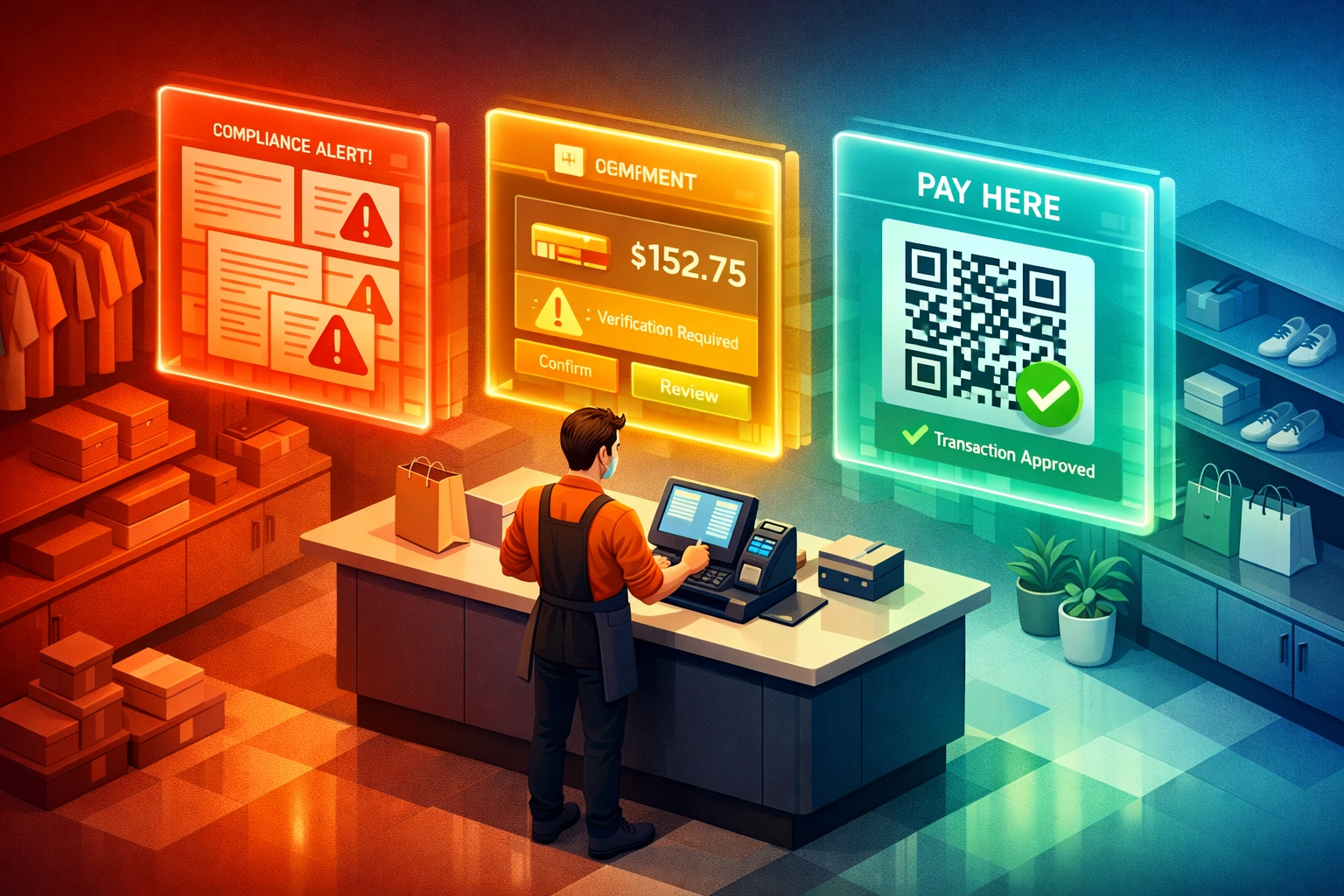
The Metaverse Shopping Vision
MTL compliance solves today's problems. The metaverse represents tomorrow's opportunity.
Larecoin's B2B2C metaverse transforms retail:
Virtual storefronts with real commerce
NFT-based product ownership
Social shopping experiences
VR/AR integration for immersive browsing
Merchants who adopt crypto POS systems today position themselves for metaverse commerce tomorrow. The same wallet infrastructure. The same compliance framework. The same self-custody model.
Just deployed in virtual environments where traditional payment processors can't follow.
VR shopping isn't science fiction anymore. Major retailers are testing virtual stores. Consumer appetite for digital experiences grows. Payment infrastructure needs to support both physical and virtual transactions seamlessly.
Larecoin builds this interoperability into the core architecture. Accept payments in-store, online, or in metaverse environments. Same compliance. Same low costs. Same self-custody control.
Trust and Regulatory Positioning
Cost savings mean nothing without trust.
Larecoin's regulatory stance:
Federal MSB registration completed
State-level MTL coverage across U.S. jurisdictions
Transparent compliance approach
No hidden custodial relationships
This isn't regulatory avoidance. It's regulatory efficiency.
Traditional processors build compliance costs into their business model because compliance generates revenue through fees. Larecoin treats compliance as infrastructure: necessary, handled, and not monetized through merchant transaction fees.
The difference matters. Merchants deserve compliance without exploitation. Transparent costs. Predictable fees. No hidden regulatory charges.
Check Larecoin's trust page for full regulatory documentation.
The Bottom Line: Do the Math
Let's run real numbers.
Scenario: $100,000 monthly transaction volume
Triple-A (2.5% effective rate):
Monthly fees: $2,500
Annual cost: $30,000
CoinPayments (1.5% effective rate):
Monthly fees: $1,500
Annual cost: $18,000
Larecoin (0.3% gas-only cost):
Monthly fees: $300
Annual cost: $3,600
That's an 88% cost reduction versus Triple-A. 80% versus CoinPayments.
The 50% savings claim is conservative. Most merchants save significantly more.
Making the Switch
Larecoin's streamlined onboarding eliminates the verification delays competitors impose. Set up your merchant account. Generate your QR code POS. Start accepting crypto payments.
The compliance infrastructure runs in the background. The cost savings appear immediately in your bottom line.
For more details on merchant fee reduction strategies, explore our comprehensive guide on reducing interchange fees.
This comparison is part of our 100-post Larecoin marathon: documenting how Web3 payments solve real merchant problems one transaction at a time.
Ready to cut your payment processing costs in half? Visit Larecoin's merchant portal and see the difference gas-only transfers make.
Comments